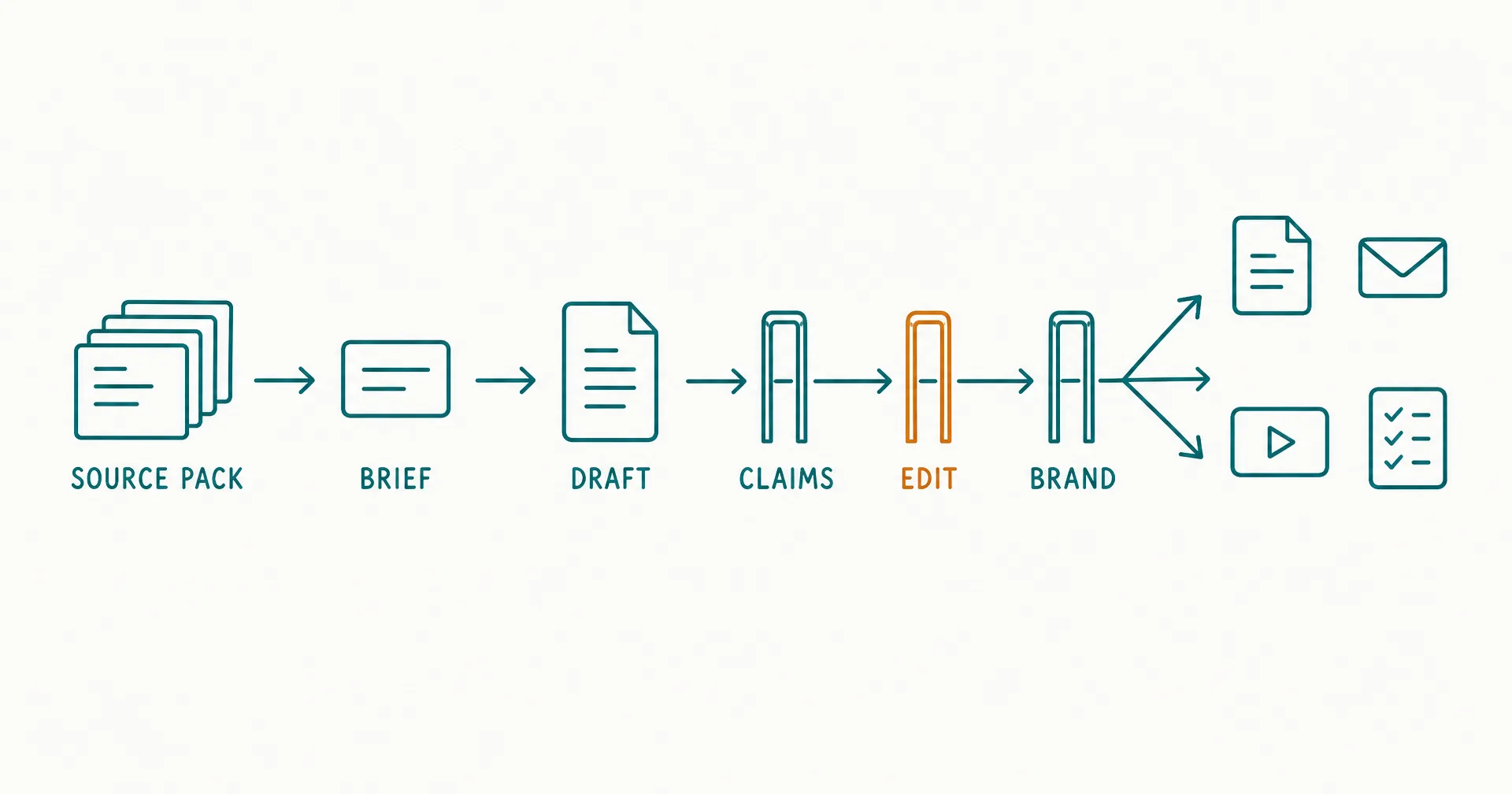
AI content operations should increase the amount of accepted, useful content - not the amount of text waiting for review.
A production workflow needs more than a prompt and a publishing calendar. It needs:
- an audience and business job;
- an accepted insight;
- a source and claim pack;
- a content brief;
- a versioned draft;
- editorial and subject-matter review;
- visual, rights, accessibility, and brand checks;
- channel-specific approval;
- controlled publishing;
- repurposing rules;
- performance evidence; and
- an update, correction, or retirement path.
The AI employee can coordinate and perform bounded work across that chain. It should not manufacture an insight, detach a claim from its evidence, publish an unapproved asset, or treat one source article as raw material for many thin rewrites.
The operating pattern is:
Audience need > accepted insight > source pack > brief > draft > claim review > editorial review > visual/accessibility review > approval > publish > repurpose > measure > update
On this page · 11 sectionsOpen
- What Is an AI Content Operations Workflow?
- What Should the Content Charter Define?
- How Do You Turn Research into an Accepted Source Pack?
- What Should a Content Brief Contain?
- How Should AI Drafting Work?
- What Should Editorial Review Check?
- How Do You Handle Visuals, Accessibility, Rights, and Brand?
- How Should Repurposing Work Without Content Drift?
- How Should Publishing and Distribution Work?
- What Should You Measure?
- How Do You Pilot and Scale the Workflow?
- Define the audience, content job, channel, decision stage, promised outcome, owner, and acceptance rule before drafting.
- Begin with an accepted insight and source pack. A popular query, a trending phrase, or a competitor page is not an insight by itself.
- Use one versioned brief to control angle, scope, claims, examples, proof, structure, CTA, visual needs, exclusions, and reviewers.
- Separate draft status from factual acceptance, editorial acceptance, legal/brand approval, and publication authority.
- Repurpose from the accepted source-and-claim layer, not by shortening the long-form draft repeatedly.
- Track accepted assets, correction, review time, claim defects, distribution quality, qualified behavior, assisted outcomes, updates, and severe mistakes.
- Scale only when review capacity, evidence quality, publishing controls, and refresh ownership can keep pace.
§ 01What Is an AI Content Operations Workflow?
An AI content operations workflow is a governed system that turns accepted knowledge into audience-specific assets and keeps those assets current.
It can support:
- research-led articles;
- product education;
- comparison pages;
- customer stories;
- sales enablement;
- executive or analyst briefs;
- email sequences;
- social posts;
- webinar and video scripts;
- visual explainers;
- knowledge-base content;
- update and refresh queues; and
- content performance reviews.
The workflow should preserve one evidence backbone while allowing each channel to have a different format and job.
Content production versus content operations
| Activity | Production view | Operations view |
|---|---|---|
| Idea | Topic to write | Audience problem and portfolio role |
| Research | Facts for draft | Accepted source and claim pack |
| Brief | Instructions | Contract across creators and reviewers |
| Draft | Written asset | Versioned proposal awaiting gates |
| Review | Edit text | Factual, editorial, brand, legal, visual, and channel decisions |
| Publish | Go live | Authorized state change with verification |
| Repurpose | Make shorter versions | Transform accepted claims for distinct jobs |
| Measure | Count traffic | Test usefulness, qualified behavior, and business contribution |
| Refresh | Change date | Revalidate evidence, intent, product, and reader need |
The AI employee examples guide shows bounded content roles. This article owns the complete operating chain rather than one role title.
Accepted outcome
One accepted content asset:
- serves the approved audience and job;
- uses the current brief;
- contains only accepted claims;
- adds original analysis, experience, or decision support;
- passes the required editorial, subject, brand, rights, and accessibility gates;
- renders correctly;
- is approved for the destination;
- is published or delivered with verified state; and
- has an owner and review trigger.
“Draft generated” is an intermediate state.
§ 02What Should the Content Charter Define?
The charter sets the system boundary for a program or content cluster.
Content charter
| Field | Required decision |
|---|---|
| Audience | Who needs the content and in what context? |
| Business job | Educate, qualify, support, enable, retain, or convert? |
| Reader job | What should the person understand or do? |
| Portfolio scope | Which categories, products, roles, or journeys? |
| Evidence standard | Which claims require which sources and reviewers? |
| Voice | Tone, density, examples, prohibited patterns |
| Channels | Website, email, social, sales, video, support |
| Authority | Who can approve claims, brand, legal, and publishing? |
| Accessibility | Standards and testing required |
| Rights | Source, image, music, customer, and reuse rules |
| Retention | How source packs, drafts, approvals, and assets are stored |
| Measurement | Accepted outcomes and business signals |
| Refresh | Schedule and event triggers |
| Owner | Who operates the system and resolves exceptions? |
Map the reader journey
| Reader state | Content job | Possible asset |
|---|---|---|
| Unaware of problem | Make the workflow visible | Original research or diagnostic |
| Problem aware | Clarify causes and options | Guide or framework |
| Category aware | Define the category and tradeoffs | Category guide |
| Solution comparing | Support a fair decision | Comparison, RFP, cost model |
| Implementation ready | Reduce launch risk | Checklist, SOP, pilot plan |
| Active customer | Improve use and recovery | Documentation, playbook, troubleshooting |
| Advocate | Help explain value responsibly | Case study, template, shareable visual |
Do not force every asset to sell. A research report and a pricing page can support different stages while sharing evidence.
Define portfolio ownership
| Object | Owner |
|---|---|
| Audience definition | Product marketing or customer owner |
| Portfolio direction | Content lead |
| Source/claim pack | Research or subject owner |
| Product facts | Product owner |
| Legal claims | Qualified legal/compliance reviewer |
| Brand | Brand owner |
| Accessibility | Accessibility owner |
| Publishing | Channel owner |
| Performance | Analytics and business owner |
| Refresh/retirement | Named content owner |
The AI employee context-pack guide helps encode stable audience, product, voice, policy, source, and review context without mixing it with the evidence for one asset.
§ 03How Do You Turn Research into an Accepted Source Pack?
The source pack is the boundary between research and content production.
It should contain:
- decision or audience question;
- insight statement;
- source registry;
- accepted claims;
- qualified claims;
- rejected claims;
- definitions;
- calculations;
- examples;
- contradictions;
- approved product facts;
- approved customer evidence;
- quote and rights status;
- visualizable data;
- open questions;
- as-of date; and
- refresh triggers.
Source-pack objects
| Object | Purpose | Required fields |
|---|---|---|
| Source | Identify evidence | Canonical URL, publisher, date, version, retrieval |
| Claim | State supportable sentence | Wording, source, scope, status, reviewer |
| Calculation | Produce derived value | Inputs, formula, unit, rounding |
| Example | Explain mechanism | Fictional/real label, permission, limitation |
| Quote | Preserve exact words | Speaker, source, permission, usage limit |
| Product fact | Describe current capability | Owner, documentation, conditions, date |
| Visual data | Support chart/diagram | Dataset, fields, transformation, rights |
| Exclusion | Prevent unsupported reuse | Rejected wording and reason |
The AI market-research workflow provides the query, source, screening, claim, contradiction, and review ledgers that produce this pack.
Insight gate
An accepted insight should answer:
- What changed or is commonly misunderstood?
- For which audience and situation?
- What evidence supports it?
- What is the non-obvious implication?
- What decision or behavior could improve?
- What would contradict or limit it?
- Why is this organization qualified to explain it?
Weak:
AI is changing content marketing.
Stronger:
Teams that optimize AI content for draft volume can increase the human review queue faster than accepted publishing capacity. The operating constraint is claim, editorial, and approval throughput - not token generation.
The stronger statement has a mechanism and a decision consequence.
Claim status
Use:
Proposed > sourced > reviewed > accepted > published > corrected/superseded/retired
Qualified and rejected states should remain visible.
| Status | May appear in draft? | May publish? |
|---|---|---|
| Proposed | Yes, marked | No |
| Sourced | Yes | No |
| Reviewed | Yes | Only if policy permits |
| Accepted | Yes | Yes within scope |
| Qualified | Yes with exact qualification | Yes with qualification |
| Rejected | No | No |
| Superseded | No for current claim | Historical record only |
§ 04What Should a Content Brief Contain?
The brief is a production contract, not a keyword list.
Content brief
| Field | Example |
|---|---|
| Asset ID | C-OPS-2026-041 |
| Audience | Content lead at a 50-500-person B2B company |
| Reader job | Design a controlled AI content workflow |
| Business job | Qualify teams that need role-based AI operations |
| Primary promise | Leave with a complete workflow and acceptance gates |
| Insight | Review capacity, not generation, is the scaling constraint |
| Scope | Source pack through refresh |
| Exclusions | Legal advice, universal benchmarks, automatic publishing promise |
| Required claims | 12 accepted claims from pack v1.4 |
| Examples | One 8-asset cluster and one repurpose tree |
| Structure | Decision-led sections and operational tables |
| CTA | Pilot one source-led asset through the full chain |
| Internal destinations | Research, context, SOP, KPI, role pages |
| External evidence | 5 authoritative sources |
| Visual plan | Workflow, gate matrix, repurpose lineage |
| Reviewers | Subject, editorial, brand, accessibility, legal where required |
| Acceptance | Rubric and publishing checks |
Outline around decisions
A useful outline answers:
- What is the operating problem?
- What must exist before drafting?
- Which states and owners govern the asset?
- How are claims and examples controlled?
- How does review work?
- How are visuals and rights handled?
- How is publishing verified?
- How can the asset be repurposed without drift?
- What is measured?
- When is it updated or retired?
Do not create 10 headings that repeat the same keyword with different adjectives.
Define originality
The asset should add at least one of:
- original research;
- first-hand operating experience;
- a new decision model;
- a worked example;
- a useful comparison;
- a calculation;
- a process artifact;
- a tested recommendation;
- a synthesis that resolves contradiction; or
- a clearer explanation for a specific audience.
Google Search Central’s current people-first content guidance asks whether content provides original information or analysis, adds value beyond its sources, serves an intended audience, and leaves the reader able to achieve their goal. It also warns against extensive automation used primarily to attract search visits. Those questions are useful editorial checks, not a guaranteed ranking formula.
The AI employee SOP guide can turn the approved brief, gates, owners, and exception rules into a repeatable production procedure.
§ 05How Should AI Drafting Work?
Draft from the brief and accepted claim pack.
The drafting input should identify:
- current brief version;
- accepted claim IDs;
- exact qualifications;
- reader vocabulary;
- product language;
- style and structure rules;
- required examples;
- allowed and prohibited comparisons;
- CTA;
- reviewers;
- output format; and
- stop conditions.
Draft states
| State | Meaning | Next action |
|---|---|---|
| Requested | Brief accepted and queued | Assign producer |
| In progress | Draft being assembled | Preserve versions |
| Blocked | Source, definition, or owner missing | Resolve or narrow |
| Draft complete | Structure and prose present | Claim audit |
| Claim reviewed | Material claims accepted/qualified | Editorial review |
| Editorial reviewed | Reader and structure pass | Specialist gates |
| Approved | Required reviewers approve | Render/publish |
| Published | Destination state verified | Measure/monitor |
| Correction open | Material issue discovered | Assess and correct |
| Retired | No longer current or useful | Redirect/archive policy |
Claim audit
For every factual, comparative, performance, price, legal, security, or quantified statement:
- identify claim ID;
- verify accepted wording;
- verify citation fit;
- verify date and scope;
- verify product version;
- confirm calculation;
- expose assumption;
- check implication and net impression;
- confirm reviewer; and
- block unsupported strengthening.
The Federal Trade Commission’s advertising substantiation policy explains that advertisers should possess a reasonable basis for objective express and implied claims before dissemination. The precise legal standard depends on the claim and context; qualified counsel should set the organization’s policy.
Prohibit silent claim inflation
| Source supports | Draft must not become |
|---|---|
| Feature is documented | Feature always works |
| 12 pilot cases accepted | Proven across industries |
| Average improved | Every user improves |
| Model scored X on task Y | Platform is X% accurate |
| Customer said value was high | Customers prefer the product |
| Price on current page | Guaranteed future price |
| Correlation | Causation |
| Small interview pattern | Market prevalence |
Use examples honestly
Label:
- real and permissioned;
- anonymized with approved transformation;
- composite;
- fictional;
- illustrative calculation; or
- product demonstration.
Do not create an invented customer and present it as a case study.
Worked draft packet
Consider a fictional B2B software company preparing an article about reducing invoice-review delays. The accepted source pack contains 14 claims, 3 product facts, 2 customer observations approved only for anonymous use, 1 calculation, and 1 unresolved legal question. The brief assigns the asset a narrow job: help an operations leader decide whether a structured review queue is worth piloting. It does not authorize a promise that the software will reduce delay for every company.
The AI content employee receives:
- brief CB-067 v1.2;
- source pack SP-031 v2.0;
- accepted claims C-01 through C-11;
- qualified claims C-12 and C-13;
- rejected claim C-14;
- product facts P-03 through P-05;
- an illustrative calculation labeled CALC-02;
- one approved anonymous observation;
- a ban on naming the second customer observation;
- a required subject review before editorial review; and
- a stop rule for the unresolved legal question.
Suppose the first draft contains 11 accepted claims, both qualified claims, the calculation, and the approved observation. It also turns “some pilot teams reported shorter review queues” into “the platform cuts review time.” The claim audit should block that sentence because it changes a bounded observation into a product-performance promise.
| Draft item | Evidence state | Decision |
|---|---|---|
| Review queues contain repeated manual checks | Accepted claim C-03 | Keep with source |
| Product supports configurable routing | Current product fact P-04 | Keep with conditions |
| Platform cuts review time | Unsupported strengthening | Remove or replace |
| 18-hour illustrative backlog | Calculation CALC-02 | Keep with assumptions |
| Anonymous customer observation | Permissioned for this asset | Keep within approved wording |
| Named customer result | Not permissioned | Block |
| Legal interpretation | Open question | Escalate and stop that passage |
The corrected version may still argue that structured routing can remove avoidable waiting. It simply separates the mechanism, the product fact, the illustrative calculation, and the customer observation. That separation gives the reviewer something testable instead of a polished claim whose provenance is unclear.
A compact trace shows how the packet changes as it moves:
| Step | Elapsed minutes | Open items | Accepted claims |
|---|---|---|---|
| 1. Brief accepted | 0 | 2 | 11 |
| 2. Draft started | 15 | 2 | 11 |
| 3. Structure complete | 40 | 2 | 11 |
| 4. First draft complete | 95 | 3 | 10 |
| 5. Claim audit | 125 | 4 | 9 |
| 6. Subject correction | 155 | 2 | 11 |
| 7. Editorial pass | 190 | 3 | 11 |
| 8. Revision complete | 225 | 1 | 11 |
| 9. Specialist gates | 255 | 1 | 11 |
| 10. Final approval | 275 | 0 | 11 |
| 11. Destination check | 290 | 0 | 11 |
| 12. Publish verified | 300 | 0 | 11 |
The figures are illustrative. The important behavior is that the draft can move backward, accepted claims can temporarily fall, and publication occurs only after the open-item count reaches 0.
§ 06What Should Editorial Review Check?
Editorial review protects the reader’s understanding, not only grammar.
Review layers
| Gate | Reviewer | Main question |
|---|---|---|
| Intent | Content owner | Does it do the assigned job? |
| Evidence | Research/subject owner | Are claims supported and bounded? |
| Product | Product owner | Are capabilities, conditions, and language current? |
| Editorial | Editor | Is the argument clear, complete, and useful? |
| Brand | Brand owner | Does voice and presentation fit? |
| Legal/compliance | Qualified reviewer | Are regulated, comparative, customer, or contractual claims acceptable? |
| Accessibility | Accessibility reviewer | Can intended users perceive and operate it? |
| Channel | Publisher/channel owner | Does it fit destination rules? |
| Final | Accountable owner | Is this version authorized to publish? |
Editorial rubric
Score 0-2:
| Dimension | 0 | 1 | 2 |
|---|---|---|---|
| Audience | Generic | Partly targeted | Specific reader and context |
| Promise | Unclear | Present but broad | Delivered and bounded |
| Insight | Commodity summary | Some original value | Distinct, evidenced argument |
| Structure | Repetitive | Usable | Decision-led progression |
| Evidence | Weak/untraceable | Mixed | Material claims accepted |
| Examples | Missing/misleading | Limited | Concrete and honest |
| Actionability | Generic advice | Some steps | Usable artifacts and decisions |
| Voice | Inconsistent | Mostly aligned | Clear and recognizable |
| Accuracy | Material issues | Minor corrections | Passes claim audit |
| CTA | Forced/irrelevant | Related | Natural next step |
Set a minimum and mandatory zeros. For example, an asset cannot pass with 0 in evidence or accuracy even if the total exceeds 16.
Sentence-flow pass
Check:
- Does each paragraph have one clear job?
- Does the opening sentence follow from the prior paragraph?
- Does a table receive interpretation before the next topic?
- Are pronouns and references unambiguous?
- Are transitions logical rather than decorative?
- Does a claim appear before its evidence or explanation?
- Are fragments used intentionally?
- Are repeated sentences removed?
- Are abstract nouns replaced with actors and actions?
- Does the conclusion match the evidence?
The workflow must not publish private model deliberation, production notes, placeholders, prompts, reviewer chatter, or unresolved instructions. The reader should see the accepted explanation and evidence.
Adversarial review
Ask a reviewer to find:
- the strongest reasonable interpretation of every claim;
- a counterexample;
- missing stakeholder;
- hidden assumption;
- outdated product detail;
- conflicting source;
- misleading visual;
- implied guarantee;
- broken link;
- weak CTA; and
- reason the reader would still need another page.
Calibrate reviewers before scaling
Two qualified reviewers can apply the same rubric differently. One may treat an unsupported adjective as a minor wording issue; another may see it as a material claim defect. A short calibration set makes those differences visible before the queue grows.
Select 3 representative assets: 1 straightforward guide, 1 comparison, and 1 asset with customer or performance claims. Ask each reviewer to score them independently, identify blocking defects, and state the required correction. Then reconcile:
- what counts as a material claim;
- when a qualification must appear in the same sentence;
- which product changes require re-review;
- which accessibility findings block publication;
- which brand issues are preferences rather than defects;
- which reviewer owns the final decision; and
- how disagreement is recorded and resolved.
| Calibration result | Signal | Response |
|---|---|---|
| Scores differ by 1 point but disposition agrees | Normal judgment range | Record examples |
| Scores differ by 5 points | Rubric is underspecified | Define anchors |
| One reviewer blocks and another publishes | Material policy conflict | Resolve before production |
| Same defect recurs in 3 assets | Upstream brief or source problem | Correct the input |
| Review takes over 90 minutes for a standard guide | Scope or evidence is unclear | Narrow and re-template |
Repeat calibration when the team adds a new asset type, channel, product category, regulated claim, or reviewer. The goal is not identical taste. It is consistent handling of material risk and acceptance.
§ 07How Do You Handle Visuals, Accessibility, Rights, and Brand?
Visuals need a communication job.
Visual decision
| Need | Best starting format |
|---|---|
| Sequence or state change | Flow or timeline |
| Comparison across dimensions | Table |
| Relationship among components | Diagram |
| Quantitative pattern | Chart |
| Interface action | Annotated screenshot |
| Conceptual metaphor | Illustration |
| Reusable process | Checklist or template |
Do not add an image merely because the page is long.
Visual specification
- message;
- placement;
- source data;
- chart type or visual grammar;
- labels;
- dimensions;
- brand constraints;
- alt text;
- caption;
- source/credit;
- rights;
- mobile behavior;
- dark/light behavior;
- editable source;
- reviewer; and
- acceptance check.
W3C’s Web Content Accessibility Guidelines 2.2 provide recommendations for making web content more accessible across visual, auditory, physical, speech, cognitive, language, learning, and neurological needs. The exact conformance target should be set by the organization and qualified accessibility owners.
Accessibility checks
| Asset | Check |
|---|---|
| Image | Meaningful alt text or intentionally empty alternative |
| Chart | Data or text equivalent; readable labels and contrast |
| Video | Captions; transcript; audio description where required |
| Audio | Transcript and controls |
| Heading | Logical hierarchy |
| Link | Descriptive purpose |
| Table | Header relationships and linear readability |
| Form/CTA | Label, focus, keyboard, error handling |
| Animation | Motion control and no harmful flashing |
| Document | Reading order, tags, language, export verification |
Rights and authorship
Track:
- asset source;
- creator;
- license or permission;
- allowed channels;
- allowed edits;
- territory and duration;
- attribution;
- model/tool used;
- human contribution;
- customer/talent release;
- training-data restriction where contractual;
- registration implications; and
- expiry.
The U.S. Copyright Office’s AI copyrightability report addresses human authorship and AI-assisted or AI-generated material under U.S. copyright law. It is not legal advice for a particular asset, jurisdiction, contract, or registration. Use qualified counsel for the organization’s rights policy.
The multimodal-agent guide explains how source data, script, visual, audio, render, and final artifact can remain separate versioned objects.
§ 08How Should Repurposing Work Without Content Drift?
Repurpose from the accepted insight, claims, examples, and source pack.
Do not use:
Article > summarize > summarize again > shorten again
Use:
Accepted source/claim pack > channel brief > channel-specific draft > channel review
Repurpose tree
Suppose one accepted research asset contains:
- 1 core insight;
- 12 accepted claims;
- 3 calculations;
- 2 original frameworks;
- 1 decision table;
- 4 qualified examples; and
- 2 charts.
It can produce:
| Asset | Job | Evidence subset |
|---|---|---|
| Long-form article | Teach complete workflow | Full accepted pack |
| Executive brief | Frame one operating decision | Insight, 4 claims, decision table |
| Sales enablement | Support qualification | 5 claims, 2 examples, exclusions |
| Move subscriber to full guide | Insight, 2 claims | |
| Social post | Explain one surprising mechanism | Insight, 1 framework |
| Webinar | Teach and demonstrate | Full framework, examples, Q&A boundaries |
| Short video | Visualize one sequence | 1 framework and script |
| Checklist | Enable implementation | Accepted steps and gates |
Each asset needs its own audience, promise, CTA, length, context, disclosure, accessibility, and approval.
Lineage record
| Field | Example |
|---|---|
| Parent pack | SP-2026-017 v1.4 |
| Parent insight | I-04 |
| Child asset | LinkedIn post LP-044 |
| Used claims | C-12, C-18 |
| Omitted qualification | None |
| New claim | None |
| Channel owner | Social lead |
| Approved | July 30, 2026 |
| Refresh dependency | C-12 or C-18 superseded |
If a parent claim changes, the workflow can find every dependent child.
Prevent channel inflation
A short headline, chart, thumbnail, or social post can imply more than the article.
Review the whole asset:
- title;
- image;
- caption;
- chart scale;
- labels;
- CTA;
- surrounding copy;
- hashtags;
- comments or pinned context; and
- destination page.
Qualification hidden after a click may not correct a misleading first impression.
Give every child asset an acceptance test
Repurposing is complete only when the child asset succeeds at its own job. A short video is not accepted because it accurately summarizes 40 seconds of a webinar. It must also work without the missing slides, present the required qualification, provide captions, point to a suitable next step, and fit the destination.
| Child asset | Minimum acceptance test |
|---|---|
| Subject and body make the same bounded promise; links and audience segment verified | |
| Social post | Main claim survives without thread context; visual and caption do not inflate it |
| Short video | Script, spoken words, on-screen text, captions, and destination agree |
| Sales one-pager | Product facts are current; exclusions and next step are usable in conversation |
| Checklist | Steps are ordered, owned, and sufficient for the stated task |
| Executive brief | Decision, evidence, uncertainty, recommendation, and owner are explicit |
Assume a primary article produces 6 proposed child assets. If 2 repeat the article without a distinct channel job, reject them. If 1 omits a necessary qualification, return it for correction. If 3 pass their channel checks, the accepted repurpose count is 3 - not 6. Measuring proposals as output would hide the same queue problem that draft counts hide in long-form production.
§ 09How Should Publishing and Distribution Work?
Publishing changes external or internal state. Treat it as an authorized action.
Publish gate
| Check | Pass condition |
|---|---|
| Version | Exact approved artifact identified |
| Claims | Material claims accepted and current |
| Links | Internal and external destinations resolve |
| Metadata | Title, description, canonical, social preview correct |
| Visuals | Final assets match approved versions |
| Accessibility | Required tests pass |
| Rights | Permissions and attribution complete |
| Brand/legal | Required approvals recorded |
| Destination | Correct site, account, audience, and schedule |
| Recovery | Rollback, correction, or pause path exists |
Publishing authority
| Action | Default authority |
|---|---|
| Save internal draft | Pre-authorized |
| Create CMS draft | Pre-authorized with log |
| Schedule approved asset | Channel owner or policy-based approval |
| Publish public asset | Named publisher/approver |
| Send to external list | Marketing operations approval |
| Edit material claim live | Re-review affected gates |
| Remove or redirect | Content owner and SEO/operations review |
| Correct regulated claim | Legal/compliance process |
Verify:
- public URL;
- HTTP status;
- canonical;
- rendered title and headings;
- links;
- images and alt text;
- mobile layout;
- structured data where used;
- access;
- index/noindex intent;
- analytics;
- publish time; and
- destination version.
An “API success” or “publish clicked” event is not enough.
The AI employee audit-log guide provides the request, version, approval, action, result, postcondition, and final-state record needed for publishing.
§ 10What Should You Measure?
Measure the production system, content quality, reader usefulness, and business contribution separately.
Metric system
| Layer | Metric |
|---|---|
| Intake | Briefs accepted, rejected, blocked |
| Research | Source completeness, claim acceptance, contradiction coverage |
| Flow | Cycle time, waiting time, queue age, work in progress |
| Quality | First-pass editorial acceptance, claim defects, severe error |
| Human demand | Review and correction minutes per accepted asset |
| Production | Accepted assets, not drafts generated |
| Distribution | Correct destination, delivery, render, accessibility |
| Reader | Engaged reading, task completion, saves, return use |
| Commercial | Qualified action, assisted opportunity, retention/support contribution |
| Portfolio | Coverage, cannibalization, freshness, retirement |
| Cost | Full cost per accepted asset and per qualified outcome |
| Risk | Corrections, takedowns, rights/accessibility/claim incidents |
The AI employee KPI framework explains why accepted outcomes, quality, escalation, cost, reliability, and severity should remain together.
Fictional monthly example
| Result | Count/rate |
|---|---|
| Briefs accepted into production | 16 |
| Drafts completed | 16 |
| Accepted first pass | 9 of 16, 56.3% |
| Accepted after correction | 6 of 16, 37.5% |
| Rejected/retired before publish | 1 of 16, 6.3% |
| Published primary assets | 15 |
| Approved child assets | 42 |
| Material claims reviewed | 188 |
| Claim defects found before publish | 11 |
| Material claim corrections after publish | 1 |
| Reviewer time | 1,260 minutes |
| Review minutes per accepted primary asset | 84 |
| Full monthly cost | $18,750 |
| Cost per accepted primary asset | $1,250 |
| Qualified reader actions | 310 |
| Cost per qualified action | $60.48 |
All figures are illustrative.
The low 56.3% first-pass rate and 84 review minutes per accepted asset indicate a production problem even though 57 assets shipped. Diagnose brief clarity, claim-pack quality, draft structure, and review calibration before increasing volume.
Performance interpretation
Do not attribute every conversion to one article.
Use:
- direct outcome;
- assisted outcome;
- influenced journey;
- diagnostic engagement; and
- unknown.
Compare by audience, intent, asset type, distribution, period, and cohort. A product guide, research report, and support article need different success measures.
Use thresholds as decision rules
A dashboard is useful only when a result changes an action. Define each threshold with an owner, time window, comparison basis, and response.
| Signal | Example threshold | Required response |
|---|---|---|
| First-pass acceptance | Below 65% for 2 periods | Inspect briefs, sources, and repeated defects |
| Review demand | Above 75 minutes per standard asset | Reduce work in progress or simplify scope |
| Material post-publish correction | 1 or more | Pause affected claim or asset class |
| Broken destination verification | Above 2% of releases | Hold automated publishing |
| Refresh overdue | Above 10% of active assets | Reassign owners or retire low-value pages |
| Qualified action | Below baseline for 3 cohorts | Recheck audience, promise, and distribution |
| Duplicate intent | 2 pages compete for the same reader job | Consolidate or differentiate |
These figures are illustrative operating rules, not universal benchmarks. A regulated comparison and a low-risk how-to article should not share an automatic threshold merely because both are text assets.
§ 11How Do You Pilot and Scale the Workflow?
Pilot one source-led asset through the full review chain.
Four-week pilot
| Week | Focus | Exit condition |
|---|---|---|
| 1 | Charter, source pack, insight, brief | Owners accept evidence and production contract |
| 2 | Draft, claim audit, editorial review | Asset reaches accepted content state |
| 3 | Visual, accessibility, rights, channel review | Exact version approved for destination |
| 4 | Publish, repurpose, measure, retrospective | State verified and improvement decision recorded |
Pilot checklist
- One named audience and reader job
- One accepted insight
- Current source and claim pack
- Versioned brief
- Draft-state workflow
- Claim-level audit
- Subject and editorial reviewers
- Brand/legal gates where required
- Visual and accessibility specification
- Rights record
- Publishing approval and postcondition
- Repurpose lineage
- Performance and refresh owner
- Correction and retirement path
Capacity model
Assume:
- 4 primary assets per week;
- 70 minutes of research/claim review per asset;
- 55 minutes of editorial review;
- 25 minutes of visual/accessibility review;
- 20 minutes of channel/final review; and
- 20% rework reserve.
Base review:
4 x (70 + 55 + 25 + 20) = 680 minutes/week
With reserve:
680 x 1.20 = 816 minutes = 13.6 hours/week
If only 8 reviewer hours exist, generating 4 drafts does not create 4 accepted assets. Reduce volume, narrow asset complexity, improve first-pass quality, or add qualified review capacity.
NIST describes its AI Risk Management Framework as a voluntary framework for incorporating trustworthiness considerations into the design, development, use, and evaluation of AI systems. Its govern, map, measure, and manage functions can help owners place content-generation risks inside a broader organizational process. The framework does not replace the asset-specific evidence, rights, accessibility, brand, and publishing decisions described here.
Scale gates
Expand when 2 consecutive periods meet:
- source-pack completeness threshold;
- first-pass acceptance threshold;
- review capacity;
- zero severe claim or rights incident;
- publishing verification threshold;
- correction threshold;
- refresh ownership;
- qualified reader or business signal; and
- acceptable cost per outcome.
Hold or narrow when:
- draft queue grows faster than review;
- unsupported claims repeat;
- assets duplicate one another;
- internal links become forced;
- reviewers disagree systematically;
- product facts become stale;
- distribution outruns audience fit;
- post-publication correction rises; or
- performance cannot be connected to a reader job.
Runbook
- Accept audience need and portfolio role.
- Accept source pack and insight.
- Approve content brief.
- Draft from accepted claims.
- Audit claims and examples.
- Run editorial review.
- Run product, brand, legal, rights, and accessibility gates.
- Approve exact version.
- Render and inspect.
- Publish through authorized route.
- Verify destination state.
- Create channel-specific child briefs.
- Review and distribute child assets.
- Measure reader and business outcomes.
- Refresh, correct, consolidate, or retire.
For CellCog, verify the current configuration and scope of the AI Content Writer, AI SEO Specialist, and AI Marketing Manager role pages. Product capabilities change. The buyer still owns claims, brand, rights, audience, approvals, publishing authority, and outcome measurement.
Test one accepted source pack through one primary asset and 3 child assets. If lineage, review, and corrections do not reconcile, do not scale the content volume.
Q1Can an AI content writer publish automatically?
Automatic publishing may be technically possible, but authority should depend on claim risk, channel, audience, evidence, rights, accessibility, and observed reliability. Begin with drafts and exact-version approval. Automate only bounded publishing actions with strong postcondition verification and a correction path.
Q2What is the difference between a source pack and a content brief?
The source pack defines accepted evidence, claims, calculations, examples, contradictions, and limitations. The content brief defines how a specific asset will use that knowledge for an audience, reader job, structure, channel, CTA, and review process.
Q3How many times should one article be repurposed?
There is no universal count. Create a child asset only when it has a distinct audience or channel job and enough accepted evidence to stand on its own. Track lineage and performance. Stop when transformation produces repetition instead of usefulness.
Q4Should AI-generated content be disclosed?
Disclosure depends on context, audience expectations, law, platform rules, and organizational policy. Record how the asset was produced and use qualified reviewers to set disclosure rules. Accurate authorship and process information can also support reader trust.
Q5What should happen when a claim changes?
Find every dependent asset through the lineage record, assess materiality, reopen required reviews, correct or retract affected versions, notify owners, and update the source pack. Do not silently edit one page while outdated child assets remain live.
Q6What is the best first content-operations pilot?
Choose one source-led primary asset with a clear reader job, 8-12 accepted claims, one subject reviewer, one editor, one visual, and 2-3 child assets. Run every gate and measure review/correction time before increasing volume.