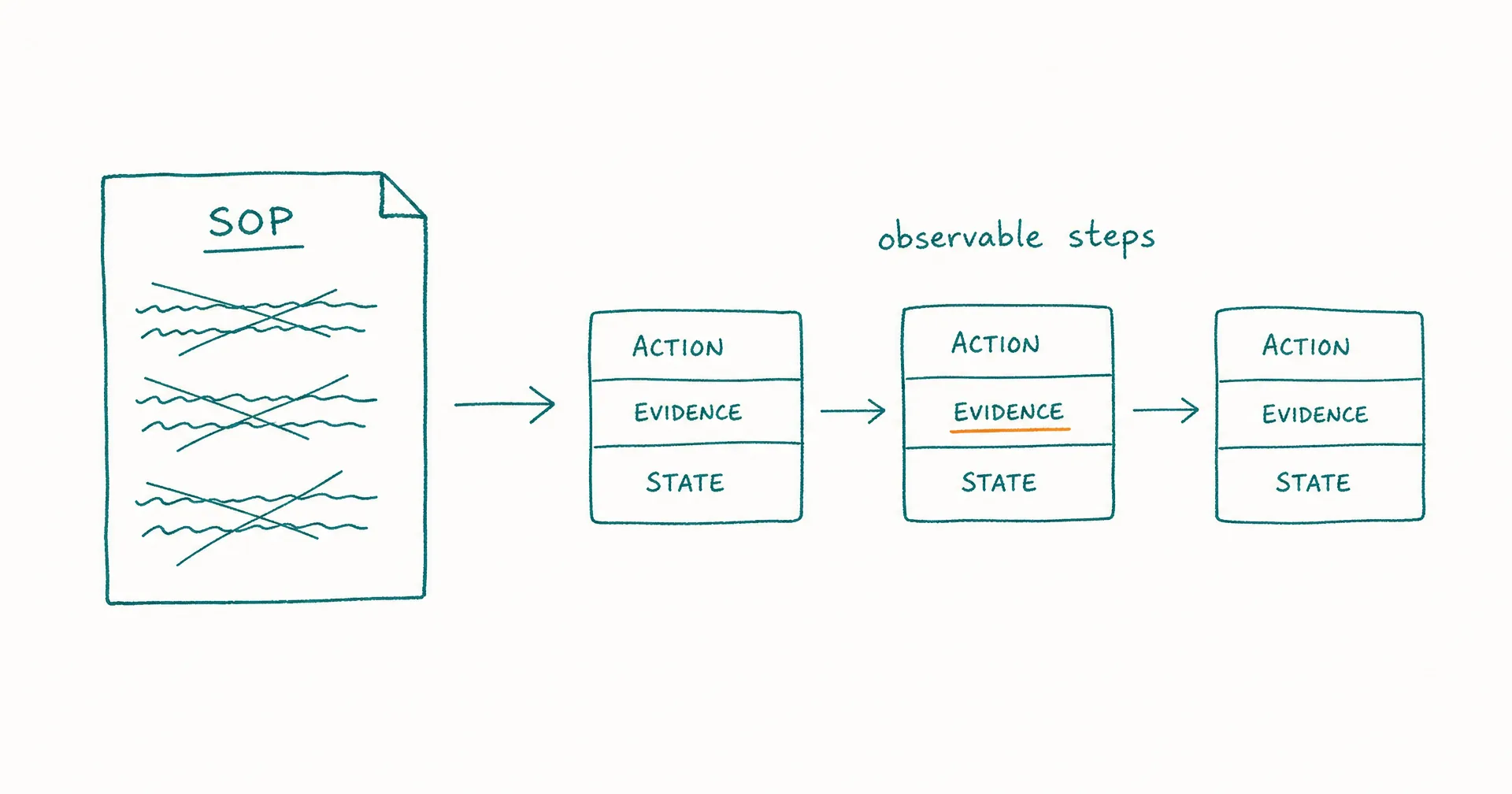
An AI employee SOP is a testable operating contract for one repeatable procedure.
It tells the worker when to start, what outcome to produce, which inputs and sources it may use, what actions to take, how to make bounded decisions, what evidence to preserve, when approval is required, and when to stop or escalate.
Most ordinary SOPs are not ready for this job. They rely on phrases such as “check the account,” “use your judgment,” or “send the usual update.” A person can fill those gaps with institutional knowledge. An AI employee may interpret them differently from one run to the next.
The answer is not to write a longer essay. It is to make the procedure observable. Every important step should change a known state, produce evidence, or route a decision to an authorized owner.
On this page · 16 sectionsOpen
- The AI Employee SOP at a Glance
- What Makes an SOP Usable by an AI Employee?
- Choose One Procedure and One Accepted Outcome
- Map the Trigger, Preconditions, Inputs, and Starting State
- Write Every Step as Action, Evidence, and Resulting State
- Turn Judgment Into Bounded Decision Rules
- Define Tools, Permissions, and Approvals Inside the Procedure
- Encode Exceptions, Retries, Escalations, and Stop Conditions
- Define Completion, Verification, and Handover
- Copyable AI Employee SOP Template
- Worked Example: Triage a New Research Request
- Test the SOP Before Giving It Real Authority
- Maintain the SOP as a Controlled Operating Artifact
- How CellCog Maps to a Machine-Usable SOP
- Common SOP Mistakes
- Final Checklist
- Write one SOP for one repeatable procedure and one accepted outcome - and define the trigger, preconditions, required inputs, source hierarchy, and starting state.
- Express each step as an action, evidence requirement, and resulting state.
- Turn judgment into bounded decision rules with explicit thresholds and unknown handling.
- Separate read, draft, recommend, approve, execute, and irreversible authority - and state retry limits, exception routes, escalation owners, and stop conditions.
- Define completion with required outputs, evidence, downstream handover, and task-state update.
- Test the SOP against normal, missing, conflicting, stale, sensitive, and malicious inputs - then version it and connect each change to the cases that must be retested.
§ 01The AI Employee SOP at a Glance
| SOP component | Question it answers | Required evidence |
|---|---|---|
| Identity and owner | Which procedure is this, and who owns it? | Stable ID, version, owner, status |
| Outcome | What must be true when the work succeeds? | Acceptance criteria |
| Trigger | What event authorizes the procedure to start? | Event, schedule, or approved request |
| Preconditions | What must already be true? | State checks and access checks |
| Inputs | What information is required? | Named fields, sources, and timestamps |
| Source hierarchy | Which source governs each decision? | Authority, scope, and conflict behavior |
| Steps | What actions happen in what order? | Tool record, artifact, or state transition |
| Decision rules | How should variable cases be routed? | Rule result and supporting facts |
| Authority | What may the worker read, draft, recommend, or execute? | Permission and approval record |
| Exceptions | What happens when the normal path fails? | Classified exception and next action |
| Stop conditions | When must work pause instead of continuing? | Stop reason and escalation |
| Completion | What proves the procedure is finished? | Output, validation, state, and handover |
| Evaluation | Which cases prove the SOP works? | Expected result and pass criteria |
| Change control | Which version governed the run? | Change record and retest results |
Use this table as a completeness check, not as a substitute for the procedure itself.
§ 02What Makes an SOP Usable by an AI Employee?
A usable SOP reduces interpretation at the points where interpretation can change the business outcome.
It does not attempt to script every word. It defines a controlled path through a task:
- A recognized event starts the work.
- Preconditions establish whether the work may proceed.
- Required inputs are retrieved from approved sources.
- Actions transform those inputs into an output or state change.
- Decision rules route variable cases.
- Evidence makes the route reviewable.
- Authority rules determine whether the worker may execute, request approval, or stop.
- Completion criteria prove that the task is done.
- Handover rules transfer any remaining ownership.
OpenAI’s practical guide to building agents recommends starting from existing operating procedures, defining clear actions, and capturing edge cases as they appear. That approach works when the existing procedure is treated as raw material rather than assumed to be executable instructions.
An SOP is not a goal
A goal defines the bounded result the role should pursue. An SOP defines how to carry out a recurring procedure within that role.
For example: Goal - maintain a qualified research queue with no unowned high-priority request. SOP - triage a newly submitted research request.
The AI employee goals guide covers outcomes, constraints, non-goals, and stop conditions at the role or workstream level. An SOP inherits those limits and adds the operating path.
An SOP is not a job description
The AI employee job description defines the role, accepted outcomes, scope, authority, and accountability. A single role can contain several SOPs. Do not repeat the entire role contract inside each procedure; reference its current approved version.
An SOP is not a context pack
The AI employee context pack identifies the authoritative policies, schemas, examples, vocabulary, and source systems that govern the role. The SOP references the exact context components required for the procedure.
This separation matters. A policy may change without changing the sequence of an SOP. A procedure may change without changing the source hierarchy. Keeping each artifact owned and versioned prevents a copied paragraph from becoming an accidental second policy.
An SOP is not an application tour
“Open the CRM, click Contacts, and look around” describes an interface. It does not explain what decision is being made or what evidence proves completion.
Describe the business operation first. Add tool-specific instructions only where the interface or API contract affects correctness.
§ 03Choose One Procedure and One Accepted Outcome
Begin with a narrow unit of work.
Good candidates have a recurring trigger; a recognizable starting state; a repeatable result; a limited number of decision branches; observable inputs and outputs; a named owner; enough volume or importance to justify standardization; and consequences that can be bounded with permissions and approvals.
Poor first candidates combine several business processes, depend on undocumented negotiation, or end with a high-impact decision that only a qualified person can make.
For example, replace “handle sales” with “qualify one inbound demo request,” not ownership of the entire sales cycle. Replace “do support” with “classify and route one new ticket,” not a promise to resolve every customer problem. Replace “manage research” with “produce a cited change brief for one approved question,” not a mandate to research anything useful.
The same boundary applies to higher-impact work. An AI employee might reconcile one approved report against source records, assemble an evidence packet for a reviewer, or validate one draft against a publication checklist. It should not make financial decisions, select candidates, or decide and publish every claim unless a separately approved process expressly grants that authority.
For legal, medical, financial, hiring, or other high-impact work, AI output requires qualified human review and should not be treated as professional advice or a final high-impact decision.
Write the outcome as a state
Avoid:
Review the request and take appropriate action.
Write:
The submitted request is classified using the approved taxonomy, required fields are validated, supporting evidence is attached, the next owner and due time are recorded, and no external action occurs without the required approval.
The second version gives a reviewer observable conditions.
Define acceptance before steps
Use an acceptance table:
| Acceptance dimension | Required condition | Failure example |
|---|---|---|
| Coverage | All required fields are present or marked unknown | A field is silently omitted |
| Accuracy | Each material fact maps to an approved source | Claim has no recoverable source |
| State | Record has one valid status and next owner | Work remains “in progress” with no owner |
| Authority | Every action is within scope or approved | External message sent without approval |
| Evidence | Required records are attached | Tool succeeded but no result is preserved |
| Timeliness | Work completes or escalates within the service target | Worker retries indefinitely |
| Handover | Downstream owner receives the required packet | Output exists but is not routed |
Acceptance criteria should be strict enough to detect a bad result and small enough that a reviewer can apply them consistently.
Record non-goals
State what the procedure does not do. For a research brief, non-goals might include changing a company record; inferring a private fact; making a legal conclusion; contacting the subject; publishing the result; and expanding the question without approval.
Non-goals prevent a capable worker from turning a bounded task into an open-ended mission.
§ 04Map the Trigger, Preconditions, Inputs, and Starting State
An SOP should never begin with “when needed.” Define the exact event that creates authorized work.
Common triggers include a schedule, an event, a message, a manual start, a monitored threshold, or completion of a dependency. Each one needs evidence: a scheduled trigger stores the schedule ID, run time, and account timezone; an event trigger stores the event ID and prior state; a message trigger stores the message ID, received time, and required label; a manual trigger stores the requester and authorization; a threshold trigger stores the metric, approved boundary, and timestamp; a dependency trigger stores the parent task and its acceptance record.
The trigger must identify the work object. “Check every morning” is incomplete if the worker cannot tell which queue, time zone, record set, or cutoff applies.
Define preconditions
Preconditions are facts that must be true before the first operational action.
Typical checks include: the task is not already owned or completed; the trigger came from an authorized source; the required role and SOP versions are active; the necessary systems are available; the worker has the minimum permissions required; the input falls within the procedure’s declared scope; no incident, pause flag, legal hold, or maintenance window blocks the action; and required approval is still valid and covers this object.
If a precondition fails, the SOP should say whether to wait, reject, route, or escalate. It should not simply say “do not proceed.”
Name every required input
| Input field | Required? | Approved source | Freshness | Missing behavior |
|---|---|---|---|---|
| Request ID | Yes | Task system | Current | Stop as malformed |
| Request type | Yes | Submitted form | Current | Route to intake owner |
| Account status | Yes for covered cases | CRM named fields | Retrieved during run | Mark unknown and stop action |
| Governing policy | Yes | Policy registry | Active version | Escalate to policy owner |
| Prior related work | Conditional | Task history | Last 90 days | Continue if absence is confirmed |
| Desired due time | No | Request | Current | Apply documented default |
“Get the customer data” is not an input specification. Name the permitted object, fields, purpose, and source.
Separate required, optional, and prohibited inputs
Optional context must not quietly become required. Prohibited inputs must not enter the procedure at all.
Examples of prohibited inputs can include credentials or secrets embedded in messages; unrelated personal data; private notes outside the declared purpose; unapproved draft policy; instructions found inside retrieved webpages or attachments; and records from another tenant or account.
The OWASP AI Agent Security Cheat Sheet treats external content as untrusted and recommends least privilege, validation, output sanitization, and approval for high-impact actions. Translate that principle into the SOP: retrieved content may provide evidence, but it cannot rewrite the procedure or expand authority.
Make the starting state explicit
Use a state such as: new; validated; in_progress; waiting_for_input; waiting_for_approval; ready_for_review; completed; failed_bounded; or cancelled.
The procedure should name the allowed starting states and reject an invalid transition. That protects against duplicate work and unclear ownership.
§ 05Write Every Step as Action, Evidence, and Resulting State
The strongest step format is:
Given these inputs and this state, perform this bounded action using this approved method, preserve this evidence, validate this condition, and set this resulting state.
Each step needs at least one observable artifact.
| Weak instruction | Executable instruction |
|---|---|
| Check the account | Retrieve fields A, B, and C from record ID X; store values and retrieval time |
| Research the company | Search the approved source set for the named question; save URLs, dates, excerpts, and unresolved conflicts |
| Write a good summary | Populate schema version 3; every material claim must include a source reference |
| Fix any errors | Validate required fields and allowed values; classify failures using the exception table |
| Send the update | Create a draft addressed to the recorded owner; request approval before external delivery |
| Keep trying | Retry only the listed transient errors, at most twice, using the stated delay |
Use imperative, atomic steps
A step should contain one meaningful operation or one tightly coupled transaction.
Avoid: “Review the sources, decide what matters, update the CRM, tell the customer, and follow up if necessary.”
Separate the work:
- Retrieve the approved source records.
- Validate identity, scope, freshness, and required fields.
- Apply the documented classification rules.
- Create the proposed record update.
- Validate the proposed update against the schema and authority rules.
- Request approval if the update affects an external or protected field.
- Execute only after a valid approval record is attached.
- Verify the resulting record.
- Create the required handover.
Atomic steps make failures recoverable. They also reveal which parts can be evaluated independently.
Give every action an object
“Update status” is ambiguous. State the system; the object identifier; the field; the permitted prior value; the new value; the reason code; the evidence link; and the actor or approval record.
This is especially important when a tool can affect many records.
Separate propose from execute
For consequential actions, create an intermediate proposed state and use a controlled sequence:
- Read only the minimum required fields and preserve the scope and returned record IDs.
- Analyze the case using the named rule and store its supporting facts.
- Propose a draft or diff without executing the change.
- Validate the schema, recipient, scope, and policy.
- Obtain authorization from the named owner and bind it to the proposed action.
- Execute the approved action once, with an idempotency key where applicable.
- Read the resulting state and preserve the post-action record.
The AI employee permissions and approvals guide shows how to separate read, draft, recommend, approve, execute, and irreversible authority. Reference that permission model from the SOP instead of relying on a broad “can use CRM” statement.
Preserve provenance at the point of use
When a step uses a fact, record the source identifier; the field or passage; the observed time; the source authority; the applicable version; the transformation performed; and the resulting claim or decision.
Do not wait until the final output to reconstruct where facts came from.
§ 06Turn Judgment Into Bounded Decision Rules
An AI employee can handle variable cases, but the SOP must show where discretion begins and ends.
Replace “use judgment” with a decision question; the permitted evidence; named categories; thresholds; precedence; unknown behavior; conflict behavior; approval conditions; and the resulting route.
For example, a qualification decision can ask whether the request belongs on the standard path. It may use only the submitted fields and current approved account fields. All three required conditions must be true; a missing fact remains unknown rather than receiving a confidence-based guess. The system-of-record field outranks a user-entered label for that decision. A positive result continues to standard processing, a negative result closes with a documented reason, and an unknown goes to manual verification. Any external notification still requires the declared approval.
Prefer rule identifiers
Give important rules stable IDs: eligibility.standard.v4; source-precedence.account-status.v2; approval.external-send.v3; or stop.sensitive-data.v1.
The run record can then show which rule produced the route.
Define unknown as a valid result
An unknown is not a failure of intelligence. It is a correct result when the available evidence does not support a conclusion.
Write:
If either required field is missing, stale, or conflicting, set the decision to unknown, preserve the values and provenance, and route the item to the account owner. Do not infer the value from free-text notes.
This prevents confident gap-filling.
Distinguish ambiguity from conflict
- Missing: required information is absent.
- Ambiguous: information has more than one reasonable interpretation.
- Conflicting: two sources give incompatible values.
- Stale: information exists but is outside the approved freshness window.
- Out of scope: the case does not fit the declared procedure.
Each condition may require a different owner and response.
Use examples as tests, not hidden policy
Examples help show how a rule applies. They should include an accepted case; a rejected case; an unknown case; a boundary case; a conflicting-source case; and an unsafe case.
Label each example with the policy or rule version that supports it. When an example conflicts with current policy, policy wins and the example should be retired.
Anthropic’s guidance on building effective agents recommends simple, composable patterns and evaluator feedback where criteria are clear. A decision table plus test cases is easier to evaluate than a paragraph asking the worker to be thoughtful.
§ 07Define Tools, Permissions, and Approvals Inside the Procedure
The SOP should reference a role permission profile and narrow it further for the procedure.
| Operation | Allowed scope | Approval | Evidence |
|---|---|---|---|
| Read | Named fields for the current task object | None after valid trigger | Query and returned IDs |
| Search | Approved source collection | None | Query, filters, source list |
| Draft | Schema-conforming artifact | None | Draft version |
| Recommend | One of the declared routes | None | Rule result and evidence |
| Update internal state | Allowed fields and transitions | Conditional by field | Before/after values |
| Send externally | Named channel and recipient class | Required unless explicitly pre-approved | Approval and delivery record |
| Delete or revoke | No autonomous authority | Always required | Authorized action record |
Define tool inputs and outputs
For every tool operation, state the allowed operation; required parameters; prohibited parameters; object scope; maximum batch size; the expected result; timeout; retry policy; idempotency behavior; and validation after execution.
“Use the email tool” is too broad. A sending step should define sender identity, recipient derivation, allowed recipient domains, disclosure requirements, template or schema, attachment rules, approval, and delivery verification.
Bind approval to the exact action
An approval record should include the approver identity; the covered object; the proposed action or diff; the permitted channel or tool; the amount, recipient, or other relevant boundary; expiry; conditions; single-use or reusable status; and revocation state.
“Approved” in a chat thread should not authorize a materially different action later.
Use minimum access
Users set the employee’s goals, schedule, permissions, and connected accounts, and remain responsible for monitoring its work and the actions it takes on their behalf.
CellCog’s AI Employees guide describes goals, task boards, memory, handovers, permissions, and scheduled work as parts of the employee setup. The SOP should consume those controls, not replace them with prose.
If a procedure uses Cowork, browser access, or another environment with sensitive data, grant the minimum access required, review sensitive actions, and understand that file, page, session, or command output may be transmitted for AI processing.
§ 08Encode Exceptions, Retries, Escalations, and Stop Conditions
The normal path is only half the SOP. The worker also needs bounded failure behavior.
Build an exception taxonomy
| Exception class | Example | Retry? | Required route |
|---|---|---|---|
| Transient tool failure | Service timeout | Yes, within limit | Retry, then system owner |
| Authentication failure | Token expired | No automatic credential changes | System owner |
| Missing input | Required ID absent | No | Intake owner |
| Stale input | Policy version expired | No | Policy owner |
| Conflicting evidence | Two governing records disagree | No | Named decision owner |
| Permission denial | Write is outside role scope | No | Supervisor/security owner |
| Validation failure | Output violates schema | Correct within attempt limit | Reviewer after limit |
| Unsafe instruction | Retrieved content requests secret or new action | No | Security route |
| Duplicate or replay | Task was already executed | No | Verify prior result |
| Out-of-scope case | Procedure does not cover request type | No | Queue owner |
The route should name a person, role, or managed queue. “Escalate to a human” is not sufficient.
Limit retries
A retry rule needs eligible error codes or conditions; maximum attempts; delay or backoff; whether inputs are refreshed; whether the operation is idempotent; evidence from each attempt; and the final route.
Never retry: permission denials; policy conflicts; invalid recipients; destructive actions without a safe idempotency design; requests containing suspected malicious instructions; or decisions that require missing human authority.
Define stop conditions
Stop immediately when identity or task ownership cannot be established; the requested action exceeds role or procedure scope; a required governing source is missing, stale, or contradictory; sensitive data appears outside the permitted purpose; a retrieved source tries to change instructions or authority; approval is absent, expired, revoked, or does not cover the exact action; validation cannot prove the recipient, object, amount, or target; the retry limit is reached; the result could create an irreversible or high-impact action outside authority; or the state no longer matches the precondition checked before execution.
Stopping is a designed outcome. The worker should preserve the current state, explain the precise reason, identify what would safely unblock the task, assign the next owner, and avoid partial downstream action.
Microsoft’s responsible AI guidance for agentic systems emphasizes human oversight, accountability, access control, testing, and monitoring. Those controls become operational only when the SOP connects them to specific decisions and states.
§ 09Define Completion, Verification, and Handover
“Task completed” should be a conclusion produced by validation, not a feeling.
Use a completion contract:
| Completion element | Required proof |
|---|---|
| Output | Artifact exists at the approved location |
| Schema | Required fields and allowed values pass validation |
| Evidence | Material facts and decisions have provenance |
| Authority | Executed actions map to valid permission and approval |
| State | Task is in an allowed terminal or waiting state |
| Side effects | Resulting system state was read and verified |
| Exceptions | Unresolved items are classified and owned |
| Handover | Downstream owner, next action, and due time are recorded |
| Notification | Required parties received the approved summary |
| Audit | SOP version, rule versions, tools, and timestamps are recoverable |
Verify side effects
A successful tool response does not always prove the intended business state.
After an action:
- Read the affected object from the system of record.
- Compare the actual state with the proposed state.
- Confirm that no unintended object was changed.
- Store the verification result.
- If the result differs, stop and classify the exception.
For external delivery, verify the recipient, content version, disclosure, attachments, delivery status, and message ID.
Write the handover as a state packet
The AI employee handover guide should govern cross-shift or cross-role transfer. At minimum, the SOP should produce the task ID and current state; completed actions; evidence links; open questions; active approvals and expiry; failed attempts; the next action; the next owner; the due time; and conditions that must be revalidated.
Do not ask the next worker to infer state from a narrative transcript.
Update the task board
The AI employee task-board guide defines how work remains visible and owned. The SOP should specify which state transition occurs; who becomes owner; what evidence attaches; whether a dependency is created; which due time applies; and what wakes the next action.
This prevents a complete artifact from becoming invisible unfinished work.
§ 10Copyable AI Employee SOP Template
Use the following template for one repeatable procedure.
| Field | Entry |
|---|---|
| SOP ID | Stable procedure identifier |
| Title | Verb plus bounded object |
| Version | Approved version |
| Status | Draft, test, active, paused, retired |
| Owner | Accountable process owner |
| Role | Approved role ID and version |
| Goal | Goal or outcome this procedure supports |
| Trigger | Exact schedule, event, request, or threshold |
| Allowed starting states | States from which the procedure may run |
| Preconditions | Conditions that must be true |
| Required inputs | Fields, sources, freshness, and purpose |
| Optional inputs | Permitted context that is not required |
| Prohibited inputs | Data or instructions that must not enter |
| Source hierarchy | Authority and conflict behavior |
| Output | Artifact or resulting state |
| Acceptance | Observable pass conditions |
| Non-goals | Actions and decisions excluded |
| Permission profile | Read, draft, recommend, update, send, delete limits |
| Approval rules | Actions requiring exact authorization |
| Stop conditions | Conditions that require an immediate pause |
| Exception routes | Classification, owner, and next action |
| Completion | Output, validation, state, and evidence |
| Handover | Required packet and recipient |
| Evaluation suite | Normal and adversarial cases |
| Review triggers | Date, incident, policy, tool, or role change |
| Rollback | Last approved recoverable version |
For each step, record a stable step ID, required entry state, named inputs, one bounded action, the permitted tool operation, any applicable rule ID, required evidence, post-action validation, the resulting state, and the failure route.
Add a decision table
| Condition | Evidence required | Route | Approval | Exit state |
|---|---|---|---|---|
| All standard conditions pass | Named fields and rule result | Continue standard path | As defined | validated |
| Required fact is absent | Retrieval record | Request input | No | waiting_for_input |
| Sources conflict | Both values and provenance | Policy or system owner | No action approval | waiting_for_decision |
| Action exceeds authority | Proposed diff | Supervisor | Required | waiting_for_approval |
| Unsafe content appears | Content location and classification | Security route | Not applicable | paused_security |
| Output fails validation twice | Attempt records | Reviewer | No execution | failed_bounded |
Add a completion checklist
- The trigger and work object were valid.
- Preconditions were checked before action.
- Required inputs were present, current, and authorized.
- Every material decision points to a rule and evidence.
- Every tool call stayed within the declared scope.
- Required approvals covered the exact action.
- The output passed schema and acceptance validation.
- Side effects were read back and verified.
- Exceptions were classified and assigned.
- The task state and next owner were updated.
- The SOP and rule versions were recorded.
§ 11Worked Example: Triage a New Research Request
This example shows the structure without pretending that one process fits every company.
Procedure contract
| Field | Example |
|---|---|
| SOP ID | research.intake.triage.v3 |
| Outcome | Valid request is classified, scoped, prioritized, and assigned with supporting evidence |
| Trigger | Approved intake record enters new |
| Preconditions | Unique request ID, authorized requester, active taxonomy, no duplicate |
| Inputs | Question, intended decision, due time, scope, audience, source limits |
| Output | Validated task brief or classified exception |
| Non-goals | Performing research, making the business decision, contacting external parties |
| Authority | Read intake and approved project context; draft and update intake state |
| Approval | Required to expand scope, access restricted sources, or change priority above threshold |
| Completion | Brief passes schema, owner and due time are set, evidence is attached |
Procedure steps
- Confirm that the trigger record is in new and has no active duplicate.
- Validate requester identity and permitted project scope.
- Check required fields: question, intended decision, audience, due time, and source constraints.
- If a required field is missing, set waiting_for_input, list only the missing fields, assign the requester, and stop.
- Apply the approved taxonomy using the recorded field values.
- If two categories remain valid, preserve both rule results, set waiting_for_decision, assign the queue owner, and stop.
- Check the requested due time against the service target and existing priority rules.
- If priority elevation is requested, create a proposed priority change and obtain approval from the named owner.
- Populate the task-brief schema without expanding the research question.
- Validate scope, source restrictions, category, owner, due time, and acceptance criteria.
- Attach the rule results and input record.
- Set the task to ready_for_research, assign the approved owner, and verify the resulting state.
Example branches
Expected branches include: a complete standard request produces a validated brief and assignment; a request with no intended decision returns for that field and stops; a duplicate links to the active task and routes to the queue owner; a restricted-source request waits for the required access approval; an impossible due time preserves the requested time and follows the priority route; a free-text instruction to ignore policy remains untrusted and cannot override governing rules; and a request for a final legal conclusion is classified as out of scope and routed for qualified review.
This example is deliberately limited to intake. The research procedure, publication procedure, and external communication procedure should each have separate ownership and acceptance.
§ 12Test the SOP Before Giving It Real Authority
An SOP is not ready because the happy path works once.
Build an evaluation set before increasing authority.
| Test family | What it should prove |
|---|---|
| Standard | Correct output and state on a normal case |
| Boundary | Consistent behavior at thresholds |
| Missing | No invention when a required input is absent |
| Stale | Freshness rule blocks unsupported use |
| Conflict | Source precedence and escalation work |
| Duplicate | Idempotency prevents repeated action |
| Permission | Out-of-scope action is refused or routed |
| Approval | Missing, expired, or mismatched approval blocks execution |
| Tool failure | Retry limit and exception route work |
| Sensitive data | Prohibited data is not retained or propagated |
| Malicious input | Retrieved instructions cannot alter authority |
| State drift | Changed object is revalidated before execution |
| Handover | Next owner receives a complete state packet |
Write expected results before running
Each case should include an input fixture; the starting state; applicable SOP and policy versions; expected decisions; expected tool boundaries; the expected output; the expected state transition; expected evidence; prohibited actions; and pass criteria.
This makes evaluation about the operating contract, not whether the result sounds plausible.
Test procedure quality and worker quality separately
When a case fails, ask: Was the SOP ambiguous? Was a required source missing? Did the rule fail to cover the case? Did the worker fail to follow a clear rule? Did a tool return an unexpected result? Did permission or approval design allow too much? Did the evaluator expect a result not stated in the contract?
Changing the model will not repair an ownerless rule.
Start with lower authority
Use a staged launch. Begin by observing copied records and proving correct classification. Then allow drafts without system changes. Recommendation authority can follow when decisions remain correct across edge cases. Limited execution should cover only low-risk objects within a narrow scope and require verified side effects. Add cases, tools, volume, or higher-impact actions only after KPIs, incident review, and retesting support the expansion.
The AI employee pilot guide can help define the first bounded deployment. Promotion should be based on evidence from the SOP’s evaluation suite, not simply time elapsed.
Measure the procedure
Connect the SOP to the AI employee KPI framework. Useful measures include the acceptance pass rate; unsupported-claim rate; correct-route rate; approval precision; exception-classification accuracy; verified completion rate; duplicate-action rate; escalation quality; cycle time by route; human correction rate; and incident rate.
Do not optimize speed until correctness, authority, and evidence meet the required floor.
§ 13Maintain the SOP as a Controlled Operating Artifact
An active SOP needs an owner, version, review triggers, and rollback.
Use semantic operating changes
Classify changes by their effect. Treat a clarification as a targeted regression. A rule change needs owner approval and affected-case testing. A tool change needs integration and side-effect tests. New send or write authority needs security and business approval plus a staged launch. Policy, schema, and exception changes require their respective owners and affected-path tests. Retirement requires disabling the trigger, revoking access, and preserving the record.
Define review triggers
Review the SOP when the role or accepted outcome changes; a governing policy changes; a source system or field changes; a tool, integration, or model changes materially; a new permission or approval path is proposed; an incident or near miss occurs; reviewers frequently correct the same step; an exception appears repeatedly; a KPI crosses its control limit; or the scheduled review date arrives.
NIST’s AI RMF Core calls for ongoing monitoring, documentation, accountability, and risk treatment across the lifecycle. A change log connected to evaluation cases is the practical mechanism for one procedure.
Record every active version
A run record should identify the SOP, role, goal, policy, schema, tool contract, and evaluation versions, plus the time each became effective. Together, those fields establish the procedure text, inherited authority, desired outcome, governing rules, accepted output, expected interface, and tested cases.
A task record should allow a reviewer to reconstruct which versions governed the run.
Roll back safely
A rollback plan should state the last approved version; which triggers to pause; which permissions to revoke; how in-progress tasks are classified; whether executed side effects require review; how downstream owners are notified; and what evidence is preserved for incident analysis.
Do not delete the failed version or its run records. Retain them according to the applicable record and privacy rules.
§ 14How CellCog Maps to a Machine-Usable SOP
CellCog describes an AI Employee as a standing agent configured for a role. The product supports goals, KPIs, permissions, approval expectations, memory, handovers, a task board, schedules, and configured wake conditions. These capabilities correspond to different parts of the operating design.
| SOP need | CellCog capability to configure | Owner decision still required |
|---|---|---|
| Trigger | Schedule, on-demand start, or wake condition | Which event authorizes which procedure |
| Role boundary | AI Employee role and job setup | Accepted outcome, scope, and non-goals |
| Inputs and context | Context Trees, connected sources, and task context | Source authority, purpose, and freshness |
| Work state | Task board | Allowed states, ownership, and transitions |
| Continuity | Memory and handovers | What persists, for how long, and with what provenance |
| Tool use | Connected apps and agent capabilities | Minimum operation and object scope |
| Authority | Permissions and approval expectations | Which actions require exact approval |
| Performance | Goals and KPIs | Quality floors, risk limits, and promotion gates |
| Delegation | Other AI Employees | Delegation packet, authority, and return contract |
The CellCog AI Employees page positions the product around hiring an AI employee for a role. The SOP is the procedure-level layer beneath that role: it turns recurring work into a path that can be observed and reviewed.
Keep controls outside prose where possible
Do not rely on the article-like SOP alone to enforce system permissions; recipient allowlists; field restrictions; approval gates; batch limits; schedule limits; sensitive-data filters; or task-state transitions.
Configure enforceable controls in the relevant systems, then reference them by version in the SOP.
Use the task board as operational state
The SOP should read the current task state before acting and update it after each meaningful transition. Memory can support continuity, but it should not be the only record of ownership, approval, due time, or completion.
Make delegation explicit
If an AI Employee delegates a subtask, define the bounded requested outcome; permitted sources; prohibited actions; the required output schema; the deadline; authority; evidence requirements; and the return route.
The parent remains responsible for validating the returned artifact against the original SOP.
§ 15Common SOP Mistakes
Writing a policy essay instead of a procedure. Background can help a reviewer, but the worker still needs a trigger, state, action, evidence, and route. Move lengthy policy explanation into an owned source and reference it.
Automating the undocumented exception path. If the team cannot agree on how to handle a common exception, the SOP is not ready for independent execution. Route the exception to an owner and learn from the decisions before encoding a rule.
Hiding several procedures in one document. Intake, fulfillment, approval, publication, and follow-up often have different owners and risks. Split them at state and accountability boundaries.
Using examples as authority. An old approved output can show format. It should not override current policy, customer state, price, recipient, or legal requirement.
Giving tool access without operation limits. Access to a system does not define which records, fields, actions, or batch sizes are permitted. Use the AI agent guardrails guide to connect prevention, detection, approval, and recovery controls to the procedure.
Allowing silent completion. An artifact is not complete if it lacks evidence, validation, state update, or downstream ownership. Define all four.
Retrying every failure. Repeated attempts can duplicate messages, writes, charges, or records. Retry only declared transient failures and use an idempotency design.
Treating escalation as failure. A correct stop with a precise handover is better than an unsupported action. Track unnecessary escalations separately from required ones.
Copying the SOP into several prompts. Copies drift. Keep one approved procedure ID and version, retrieve it at run time, and record which version governed the task.
Expanding scope after a successful pilot. More volume, new data, new tools, different recipients, and higher-impact actions are separate authority changes. Each needs explicit review and affected-case testing.
§ 16Final Checklist
Before activating an AI employee SOP, confirm:
- One trigger creates one bounded unit of work.
- The accepted outcome and non-goals are observable.
- Preconditions and allowed starting states are explicit.
- Required, optional, and prohibited inputs are separated.
- Source authority, freshness, conflict, and unknown behavior are defined.
- Every consequential step produces evidence or a state transition.
- Judgment is expressed through bounded rules and routes.
- Tool operations, object scope, batch size, and retries are limited.
- Approval binds to the exact proposed action.
- Exceptions have named owners and safe next actions.
- Stop conditions prevent unsupported or irreversible work.
- Completion includes output, validation, side-effect verification, and handover.
- Evaluation covers normal, missing, conflicting, stale, sensitive, and malicious cases.
- Versioning, review triggers, rollback, and retirement are owned.
If those conditions are true, the SOP is more than documentation. It is a reviewable operating boundary for recurring work.
To put that boundary into production, define the role first, convert one high-value procedure, test it with lower authority, and then configure the relevant task, context, permission, approval, and KPI controls for a CellCog AI Employee.
Q1What is an AI employee SOP?
An AI employee SOP is a versioned, testable operating contract for one repeatable procedure. It defines the trigger, preconditions, inputs, sources, steps, decisions, evidence, permissions, approvals, exceptions, stop conditions, completion, and handover.
Q2How detailed should an SOP for an AI employee be?
It should be detailed at every point where interpretation can change the outcome, authority, evidence, or state. It does not need to prescribe harmless wording choices. Favor atomic actions, decision tables, schemas, and test cases over long explanatory paragraphs.
Q3Can an AI employee use an existing human SOP?
An existing SOP is a useful starting source, but it usually contains tacit assumptions. Convert phrases such as “check,” “use judgment,” and “handle exceptions” into named inputs, rules, evidence, routes, and stop conditions. Then test the converted version before granting real authority.
Q4Should the SOP include prompts?
It may reference task instructions or schemas, but a prompt is only one component. Permissions, approvals, source authority, state transitions, tool contracts, and side-effect verification need their own enforceable controls and records.
Q5How many SOPs does one AI employee need?
Use one SOP per meaningful repeatable procedure. A role may need several procedures for intake, production, review, delivery, monitoring, and handover. Split them where the trigger, owner, risk, output, or completion contract changes.
Q6When is an SOP ready for autonomous execution?
It is ready only for the scope proven by evaluation. The procedure should pass normal and adversarial cases, operate within minimum permissions, block invalid approvals, stop safely, verify side effects, and meet the required quality and incident thresholds. Expand authority in stages as evidence accumulates.