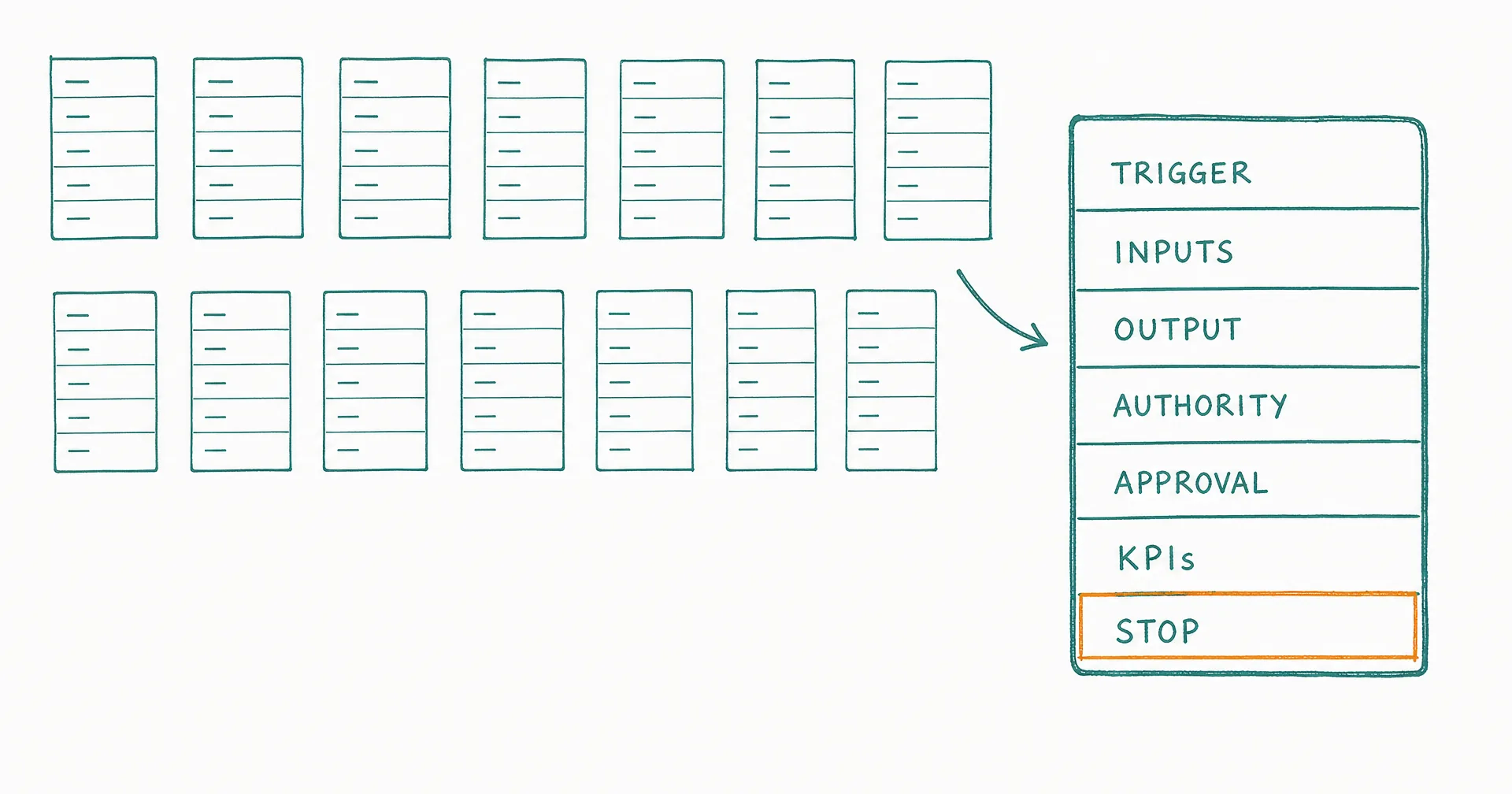
The most useful AI employee examples do not begin with a job title. They begin with a recurring outcome, the evidence required to accept it, and the boundary where software must stop.
“AI marketer” is not an operating example. “Prepare a source-backed weekly campaign brief, route every external asset for approval, and update the performance queue after launch” is closer.
This guide gives 15 examples across executive support, research, content, sales, support, operations, data, finance, recruiting, legal, and community work. Each example includes a trigger, inputs, an output, permitted actions, human approval, success measures, and stop conditions.
Use them as role-design patterns, not promises that every organization or platform can safely perform the work.
On this page · 21 sectionsOpen
- What Makes an AI Employee Example Credible?
- 1. Executive Briefing Employee
- 2. Market Research Employee
- 3. Content Operations Employee
- 4. SEO Monitoring Employee
- 5. AI SDR Research and Handoff Employee
- 6. Customer Support Triage Employee
- 7. Project Risk Review Employee
- 8. KPI Reporting Employee
- 9. Operations Exception Employee
- 10. Recruiting Research Employee
- 11. Bookkeeping Preparation Employee
- 12. Legal Document Preparation Employee
- 13. Community Listening Employee
- 14. Social Content Queue Employee
- 15. Inbox and Calendar Employee
- Seven Example Patterns to Reject
- How to Choose the First Example for Your Company
- How to Turn an Example Into a Role Contract
- How CellCog Maps Examples to Roles
- Final Recommendation
- A credible AI employee example needs seven objects: recurring outcome, trigger, approved inputs, observable output, bounded authority, human exception path, and accepted-outcome metrics.
- Strong first roles prepare, monitor, reconcile, draft, classify, or escalate. They do not begin with unrestricted publication, payment, hiring, legal, medical, security, or account authority.
- The role title is secondary. “Research assistant” can contain ten different jobs; only the operating contract tells you what the worker owns.
- Start in read-only or draft mode, test representative normal and adverse cases, and expand one reversible action at a time.
- Measure accepted outputs, quality, correction time, cycle time, appropriate escalation, cost, and incidents - not prompts, messages, or tasks started.
- CellCog AI Employees can be configured for standing roles with inboxes, shifts, wake conditions, memory, task boards, KPIs, permissions, approvals, and handovers.
§ 01What Makes an AI Employee Example Credible?
Use this seven-part contract.
| Contract field | Question | Weak answer | Stronger answer |
|---|---|---|---|
| Outcome | What remains owned? | “Help with sales” | Maintain approval-ready account-research packets |
| Trigger | What begins or resumes work? | “Be proactive” | New assigned account or Thursday 2:00 p.m. queue review |
| Inputs | Which sources are allowed? | “Use company data” | CRM fields, approved account list, public sources, exclusion policy |
| Output | What can a reviewer inspect? | “Find opportunities” | Source-linked account brief in the task record |
| Authority | What may the role read or change? | “Use our tools” | Read CRM; write draft notes; no external send |
| Escalation | When must a person decide? | “Ask if unsure” | Identity conflict, restricted account, unsupported claim, or contact request |
| Measurement | What proves useful work? | “Leads found” | Accepted briefs, evidence completeness, correction minutes, handoff acceptance |
The five-part AI employee definition determines whether the operating machinery is present. The task-suitability guide determines whether the proposed work should be delegated.
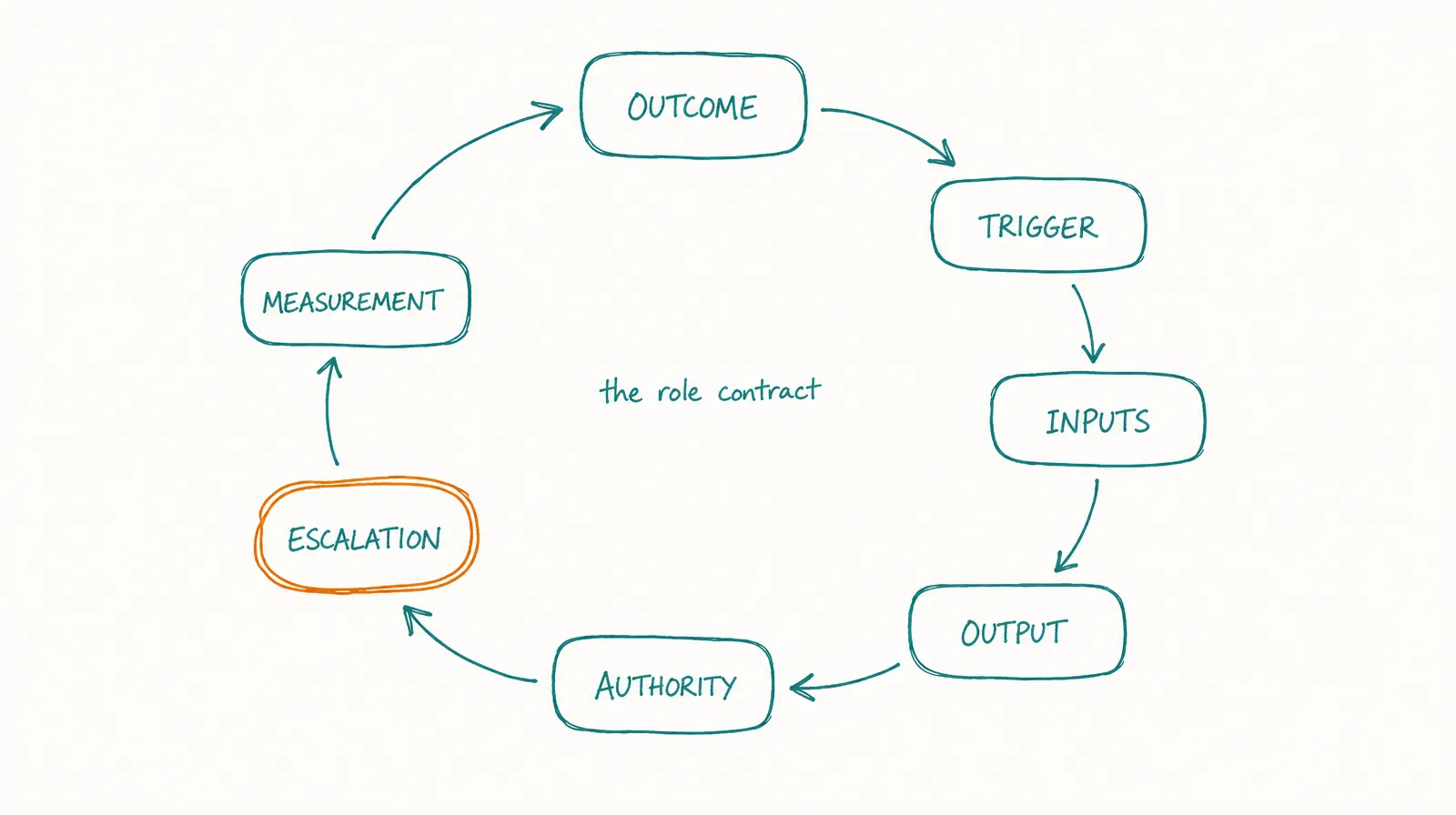
Use roles to group work, not hide scope
A role can contain several tasks when they share:
- outcome;
- sources;
- permissions;
- evaluator;
- exception owner; and
- operating cadence.
Split the role when tasks require conflicting goals, unrelated context, different data boundaries, or independent approval.
Every example still needs local validation
Before launch, verify source availability, platform capability, connector behavior, data handling, permissions, applicable law and policy, reviewer capacity, failure recovery, and economics in the real environment.
OpenAI’s agent-building guide recommends starting with focused systems and using guardrails and human intervention for high-risk or failure conditions. Anthropic’s engineering guidance similarly recommends adding agentic complexity only when simpler approaches do not perform well enough.
§ 021. Executive Briefing Employee
Recurring outcome. Deliver a reviewed executive brief that surfaces decisions and material exceptions rather than summarizing every update.
Trigger. A weekday schedule, a leadership request, or a material event in an approved monitored source.
Approved inputs. Calendar; assigned email or internal updates; approved KPI sources; project status; the decision log; the previous brief; and named public sources where relevant.
Observable output. Top decisions required; material changes; source links; owners and deadlines; conflicts or unknowns; proposed questions; and an appendix of lower-priority updates.
Authority. Read approved sources; write the draft brief; update its task state; request missing internal evidence; and never send executive commitments or change priorities without approval.
Success measures. Source completeness; material-exception recall; accepted brief rate; correction minutes; on-time delivery; false urgency; and decisions captured after review.
Stop conditions. Conflicting source-of-truth data; a sensitive employee or legal matter; missing KPI lineage; a proposed external commitment; or no accountable owner.
The detailed AI executive briefing workflow expands this example from signal collection through human-reviewed action capture.
§ 032. Market Research Employee
Recurring outcome. Maintain a source-backed answer to a bounded market question and update it when material evidence changes.
Trigger. A new approved research question; a monthly refresh; a monitored competitor change; or a request from another role.
Approved inputs. Primary company and government sources; official product documentation; reputable research; approved databases; the previous report; customer evidence where permitted; and source-quality rules.
Observable output. A scoped question; a source ledger; claims with citations; contradictions; dated findings; implication by buyer or segment; confidence and unknowns; and the reviewed report.
Authority. Research public and approved private sources; create project artifacts; request clarification; no unsupported market claim; no purchase, outreach, or publication.
Success measures. Citation coverage; primary-source rate; contradiction detection; accepted findings; correction rate; freshness; and reviewer time.
Stop conditions. The question requires confidential or prohibited data; current evidence is insufficient; sources materially conflict; legal or financial advice is implied; or scope expands beyond the approved research decision.
Use the AI market-research workflow for the complete question, source, contradiction, synthesis, and review loop.
§ 043. Content Operations Employee
Recurring outcome. Move approved content from source pack to reviewed draft while preserving evidence, status, and human publication authority.
Trigger. An approved brief enters Ready; the source pack changes; an editor returns feedback; or a scheduled queue review.
Approved inputs. Content strategy; the brief; the company knowledge base; the source ledger; the brand guide; product claims; the approved internal-link map; and editor feedback.
Observable output. A content plan; a source-backed draft; a claim and link audit; a visual brief; a revision log; a status update; and repurposing candidates after approval.
Authority. Read strategy and sources; write drafts; update the content task board; request evidence; no publication, invented claim, or unsupported customer story.
Success measures. Brief compliance; sourced-claim coverage; first-pass acceptance; revision cycles; sentence and structural quality; on-time delivery; and post-publication performance after enough data exists.
Stop conditions. An unsupported product claim; a missing decision-critical source; intent conflicts with an existing page; a legal or medical claim; private analysis appears in the draft; or editor approval is absent.
The AI content-operations workflow owns the full brief, evidence, draft, review, visual, distribution, and learning loop.
§ 054. SEO Monitoring Employee
Recurring outcome. Maintain a prioritized, evidence-backed SEO issue and opportunity queue without making uncontrolled production changes.
Trigger. A weekly crawl; a search-performance data refresh; a deployment; a ranking or traffic exception; or an assigned page review.
Approved inputs. A verified site crawl; the search-performance platform; analytics; sitemap and indexation data; the release log; the approved keyword map; and the current content inventory.
Observable output. The issue with the affected URL; evidence and timestamp; severity; likely cause; recommended change; owner; validation step; and next review.
Authority. Read the site and approved analytics; create tickets and draft fixes; run non-destructive validation; no mass URL, canonical, redirect, robots, schema, or content changes without review.
Success measures. True-positive issue rate; material issue detection time; accepted recommendations; reopened tickets; regression rate; reviewer time; and validated outcomes after changes.
Stop conditions. An access or data anomaly; a changed measurement definition; a recommendation that affects many URLs; a migration or legal requirement; or a cause that cannot be supported.
CellCog lists an AI SEO Specialist role; verify the exact data access, write controls, and deployment process for the intended site.
§ 065. AI SDR Research and Handoff Employee
Recurring outcome. Prepare evidence-backed account and contact research and transfer only sales-ready work under an approved qualification contract.
Trigger. An approved account assignment; inbound interest; a CRM stage change; an engagement threshold; or a scheduled queue review.
Approved inputs. The target account list; the CRM; public company sources; approved contact data; the exclusion and consent policy; qualification fields; and prior interactions.
Observable output. Account-fit evidence; contact-role evidence; the trigger event; personalization facts; known exclusions; a draft outreach or handoff note; source links; and acceptance status.
Authority. Research; draft; update approved research fields; place a task in review; no fabricated personalization, restricted-contact outreach, unlimited sending, or autonomous commercial commitment.
Success measures. Accepted research packets; evidence completeness; false qualification; rejected handoffs; correction time; consent or exclusion adherence; downstream meeting acceptance; and deliverability incidents where sending is authorized.
Stop conditions. Identity uncertainty; a restricted geography or account; an unsupported contact claim; legal or consent ambiguity; a negative response; an active human-owned opportunity; or no credible reason to contact.
The AI SDR to human handoff contract defines qualification, evidence, acceptance, rejection, and feedback.
§ 076. Customer Support Triage Employee
Recurring outcome. Classify new support requests, prepare policy-backed answers, resolve approved low-risk categories, and escalate uncertainty or consequence.
Trigger. A new assigned message; a ticket update; a customer reply; a service event; or an aging threshold.
Approved inputs. Authenticated customer and account context; the current support policy; product documentation; prior case history; service status; the escalation policy; and prohibited-data rules.
Observable output. Intent and priority; the cited policy or documentation; a draft or permitted response; actions taken; remaining uncertainty; the next owner; and a resolved, waiting, or escalated state.
Authority. Read assigned case data; draft answers; tag and route; perform only explicitly approved low-risk actions; no identity, refund, security, legal, account-ownership, or policy exception decision.
Success measures. Accepted resolution; first-response time; correct escalation; reopened cases; source accuracy; customer satisfaction where measured appropriately; correction effort; and incident severity.
Stop conditions. An identity conflict; repeated failed resolution; a security concern; a legal threat; a financial exception; a vulnerable user; missing policy; or high negative sentiment plus consequence.
The AI customer-support escalation guide provides mandatory stop and handoff triggers.
§ 087. Project Risk Review Employee
Recurring outcome. Prepare a weekly source-linked project-risk review that distinguishes reported status from evidence and assigns every exception an owner.
Trigger. The weekly review; a milestone change; an overdue dependency; a status conflict; a material issue; or an owner request.
Approved inputs. The task system; approved meeting notes; the release or delivery plan; the dependency register; budget or scope data where permitted; decisions; and the prior risk review.
Observable output. A risk statement; evidence and date; impact; a probability rubric; the owner; mitigation; next action; review date; and any unresolved conflict.
Authority. Read assigned project sources; create proposed risk items; request status evidence; update review artifacts; no unilateral deadline, scope, budget, staffing, or commitment change.
Success measures. Material-risk recall; false-positive rate; evidence completeness; stale-risk rate; owner acceptance; mitigation follow-through; on-time review; and reopened risk.
Stop conditions. A source conflict that cannot be resolved; a confidential personnel issue; an unapproved scope change; a financial or legal consequence; no named owner; or an unavailable system of record.
CellCog’s AI Project Manager is a role-specific product path; test it against deliberately conflicting and incomplete project evidence before granting write access.
§ 098. KPI Reporting Employee
Recurring outcome. Turn validated data into a recurring KPI report with lineage, exceptions, and owner-ready actions.
Trigger. The reporting schedule; a source refresh; a material threshold; a data-quality alert; or a review request.
Approved inputs. Named systems of record; the metric dictionary; calculation logic; the prior approved period; thresholds; the ownership map; and reconciliation rules.
Observable output. The metric and period; source lineage; the validated calculation; variance; material exceptions; explanations with evidence; the owner; the proposed action; and reviewer status.
Authority. Read approved data; run documented calculations; update draft dashboards and reports; no silent metric redefinition, source substitution, or business action.
Success measures. Reconciliation pass; source completeness; calculation accuracy; exception precision and recall; report timeliness; reviewer corrections; action acceptance; and cost per accepted report.
Stop conditions. A source mismatch; a changed metric definition; a missing period; an unexplained data correction; personally sensitive analysis; or an action that crosses approval authority.
Use the AI KPI reporting workflow for extraction, validation, variance, evidence, narrative, review, and action assignment.
§ 109. Operations Exception Employee
Recurring outcome. Maintain one operational exception queue and prepare resolution packets without bypassing transaction controls.
Trigger. A failed workflow; a reconciliation mismatch; an SLA threshold; an inventory or order exception; an assigned incident; or a scheduled queue review.
Approved inputs. Process logs; system records; the approved SOP; prior resolved cases; relevant communication; the action policy; and recovery procedures.
Observable output. The exception class; source evidence; affected objects; actions already attempted; the recommended resolution; the approval need; the owner; retry status; and closure evidence.
Authority. Investigate; propose corrections; execute only preapproved reversible recovery classes; never alter payments, access, deletion, compliance status, or customer commitments without authorization.
Success measures. Accepted resolutions; exception aging; repeat-failure rate; reviewer minutes; correct routing; postcondition reconciliation; recovery time; and incident severity.
Stop conditions. An unknown exception; a partial transaction; duplicate risk; a financial or security effect; a missing rollback; a conflicting policy; or repeated retry.
CellCog’s AI Operations Manager is relevant when the role needs recurring reporting, process artifacts, dashboards, and issue flagging across digital tools.
§ 1110. Recruiting Research Employee
Recurring outcome. Prepare evidence-backed candidate research and outreach drafts for a human-owned recruiting process.
Trigger. An approved requisition; a sourcing batch; a candidate response; pipeline aging; or a recruiter assignment.
Approved inputs. Job requirements; legal and company hiring policy; approved sourcing platforms; candidate-provided information; public professional information where lawful; exclusion rules; and communication templates.
Observable output. Job-relevant evidence; requirement match and gaps; source links; uncertainty; a draft outreach; response status; and a recruiter decision task.
Authority. Research approved sources; draft; update non-decision pipeline fields; no final screening, ranking based on protected traits, rejection, compensation commitment, reference judgment, or autonomous outreach unless law and policy permit.
Success measures. Evidence completeness; recruiter acceptance; correction rate; prohibited-inference rate; response handling; candidate experience; consent and policy adherence; and incidents.
Stop conditions. Protected or sensitive information; identity uncertainty; legal ambiguity; an unsupported inference; an accommodation or complaint; compensation negotiation; or a rejection decision.
AI can support preparation, but qualified people should own high-impact hiring decisions and review outputs for discrimination and policy risk.
§ 1211. Bookkeeping Preparation Employee
Recurring outcome. Prepare categorized, reconciled bookkeeping work and exception packets for authorized financial review.
Trigger. A bank or transaction refresh; the month-end schedule; a new receipt or invoice; a reconciliation mismatch; or reviewer feedback.
Approved inputs. Read-only financial records; the chart of accounts; approved categorization rules; receipts and invoices; prior reviewed entries; the close checklist; and accounting policy.
Observable output. The proposed category; the source record; the matched document; confidence or rule; the reconciliation result; unresolved exceptions; review state; and an audit reference.
Authority. Read; prepare proposed entries; attach evidence; reconcile in a review environment; no payment, bank-detail change, final journal posting, tax treatment, or financial advice without authorized human review.
Success measures. Proposal acceptance; reconciliation difference; missing-document detection; correction time; duplicate detection; close timeliness; unresolved exceptions; and incident severity.
Stop conditions. A missing source; a related-party or unusual transaction; tax ambiguity; a fraud signal; a bank-detail change; a material adjustment; or an account access anomaly.
The role should prepare evidence, not assume the authority of a bookkeeper, accountant, controller, or tax professional.
§ 1312. Legal Document Preparation Employee
Recurring outcome. Organize approved legal source material and prepare review-ready summaries or drafts for a qualified human.
Trigger. An assigned document set; an approved template request; a contract renewal date; a new version; a clause-review task; or counsel feedback.
Approved inputs. Signed or draft documents; the approved template library; clause guidance; matter-specific instructions; version history; jurisdiction and date; and authorized legal sources.
Observable output. A document inventory; a version comparison; clause locations; extracted obligations; dates and owners; questions and unknowns; a draft based on an approved template; and counsel-review status.
Authority. Read assigned matter files; organize and summarize; prepare draft language; no legal advice, final interpretation, negotiation, signature, filing, privilege decision, or external representation.
Success measures. Completeness; citation to source text; version accuracy; missed-obligation rate; reviewer correction; turnaround; confidentiality adherence; and incidents.
Stop conditions. Conflicting versions; missing jurisdiction; a privileged or restricted access concern; requested final advice; signature or filing; a high-stakes deadline; or an instruction outside counsel-approved scope.
CellCog’s AI Legal Assistant should be used only with qualified legal review and matter-specific access boundaries.
§ 1413. Community Listening Employee
Recurring outcome. Maintain a source-linked community issue and opportunity brief without impersonating members or making unapproved public commitments.
Trigger. A scheduled review; an approved channel event; a sentiment or volume threshold; a new product release; a moderator assignment; or an escalating issue.
Approved inputs. Designated community channels; moderation rules; product documentation; the announcement calendar; known issues; the escalation policy; and privacy rules.
Observable output. The theme; representative source references; volume and time range; urgency; the likely user need; a proposed response or content; the owner; and escalation state.
Authority. Read designated channels; categorize; draft; update internal issue queues; no removal, ban, public promise, identity inference, sensitive profiling, or crisis response without approval.
Success measures. Material-theme recall; duplicate consolidation; correct escalation; response-draft acceptance; source coverage; false urgency; resolution follow-through; and trust incidents.
Stop conditions. Harassment or a safety threat; a legal allegation; a security disclosure; personally sensitive information; coordinated manipulation; a crisis; or unclear moderation authority.
This role supports human community leadership; it does not replace accountable moderation and relationship work.
§ 1514. Social Content Queue Employee
Recurring outcome. Maintain an approved social-content queue from source-backed ideas through human-reviewed assets and performance learning.
Trigger. An approved content brief; the publication calendar; a source asset approval; editor feedback; a campaign event; or a performance review.
Approved inputs. Source content; the brand guide; approved claims; platform rules; the content calendar; prior results; rights-cleared media; and the exclusion list.
Observable output. A platform-specific draft; source and claim references; a visual brief; approval state; a scheduled proposal; response guidance; a performance note; and the next experiment.
Authority. Draft and organize; resize or repurpose approved assets; update queue state; no publication, reply, paid spend, licensed-media use, or crisis communication without permission.
Success measures. Content acceptance; factual correction; brand adherence; production cycle time; rights issues; approval delay; meaningful engagement after publication; and business outcome where attribution is defensible.
Stop conditions. An unsupported claim; missing asset rights; a sensitive event; a legal or policy concern; a customer complaint; impersonation risk; or no publication approval.
The employee should optimize the production process before it optimizes for platform activity.
§ 1615. Inbox and Calendar Employee
Recurring outcome. Deliver a decision-ready inbox and calendar queue with routine drafts, protected priorities, and explicit human exceptions.
Trigger. A new assigned email; a calendar request; the weekday morning review; an unanswered commitment; a deadline; or a supervisor request.
Approved inputs. The designated inbox; the calendar; contact and priority rules; the scheduling policy; tone examples; current commitments; travel or focus constraints; and the escalation list.
Observable output. A categorized inbox; routine drafts; protected or urgent items; proposed meeting changes; unresolved conflicts; follow-up tasks; commitments and dates; and an owner-ready daily brief.
Authority. Read assigned messages; draft; propose schedule; update internal tasks; no sensitive reply, external commitment, payment instruction, account change, or unrestricted send.
Success measures. Correct routing; missed urgent items; false urgency; draft acceptance; calendar conflicts; follow-up completion; review time; and access incidents.
Stop conditions. A legal, security, financial, hiring, health, or confidential issue; identity uncertainty; an ambiguous external commitment; a protected focus conflict; a sensitive attachment; or no approved response source.
The AI employee versus virtual assistant guide helps decide which parts belong with software and which require human representation or judgment.
§ 17Seven Example Patterns to Reject
Some role descriptions sound ambitious because they hide the work needed to make them safe and measurable.
1. “Run the department”
The instruction contains no bounded outcome, source boundary, authority, accepted artifact, or human owner.
Replace it with one recurring service: prepare the weekly department-risk review from approved systems, assign every evidence-backed exception an owner, and stop before changing scope, budget, or staffing.
2. “Do anything needed to hit the KPI”
An outcome without constraints invites goal drift. The system may optimize activity, volume, or a proxy while harming quality, consent, trust, or cost.
Add non-goals; allowed actions; prohibited actions; quality floors; a spend limit; escalation; and consequence-weighted stop criteria.
3. “Remember everything”
Unlimited memory is not useful continuity. It can retain stale, sensitive, incorrect, or irrelevant material and make later action harder to explain.
Specify allowed memory classes; source and owner; task or role scope; freshness; correction; expiry; deletion; and records that must never persist.
4. “Use all our tools”
Integration breadth is not an operating requirement. Broad access increases confusion and blast radius.
Map: role to task to tool to object to action to approval to evidence. If a tool is not required for an approved task, do not connect it.
5. “Ask a human when uncertain”
The worker needs observable triggers, not a vague feeling.
Define escalation for a missing required source; conflicting evidence; identity uncertainty; policy ambiguity; an out-of-scope request; an irreversible action; a high-impact decision; a failed retry; a spend or time limit; and a suspected incident.
6. “Improve from feedback”
Feedback can update instructions, examples, source material, memory, evaluation, or the underlying model. Those changes have different risk and rollback behavior.
Record the feedback; the proposed change; the affected scope; the approver; the version; regression tests; the effective date; and the rollback. Do not let one reviewer comment silently rewrite future policy.
7. “Measure productivity”
The metric is too vague and often becomes tasks, messages, tokens, or hours “saved.”
Declare the accepted unit: a reviewed brief; a resolved case; a validated report; an approved research packet; a reconciled exception; or a published asset after editor approval. Then measure quality, cycle time, intervention, cost, and risk around that unit.
The rejection test
Reject or redesign an example when any answer is missing:
- Who owns the outcome?
- What starts the work?
- Which source is authoritative?
- What artifact or state proves completion?
- What may the software change?
- Which decision remains human?
- How does the role stop?
- How can the work be corrected or recovered?
An appealing role title is not evidence that the job is ready.
Also reject the role when the organization cannot supply a reviewer. Human oversight is not a sentence in the configuration; it is available capacity with the authority, evidence, and response time to make a decision. If 200 exceptions can arrive overnight and one owner can review only 20, the design will either stall or normalize rubber-stamp approval. Narrow intake, reduce autonomy, add deterministic filters, or change the service level before launch.
The queue forecast belongs in the role contract: expected volume, peak volume, exception rate, approval demand, reviewer capacity, and the safe default when capacity is exhausted.
That forecast turns oversight from a promise into an operating constraint the team can test in practice.
§ 18How to Choose the First Example for Your Company
Score each candidate from 1 to 5.
| Factor | 1 | 5 |
|---|---|---|
| Recurrence | Rare | Daily or weekly |
| Digital input | Scattered or unavailable | Approved and accessible |
| Output observability | Subjective or hidden | Clearly inspectable |
| Path variability | Fixed rule | Meaningful but bounded judgment |
| Authority boundary | Broad or unclear | Action-specific |
| Recoverability | Irreversible | Easy to correct or roll back |
| Escalation | No available owner | Named person and response target |
Interpret the total:
- 28-35: strong pilot candidate.
- 21-27: narrow the role or use a hybrid.
- 14-20: prefer workflow automation, a copilot, or human-led work.
- 7-13: do not assign as a standing AI role.
One severe risk can override the total.
Prefer preparation before execution
The strongest first version often reads; organizes; reconciles; drafts; proposes; flags; routes; and records.
It does not publish; pay; delete; grant access; sign; reject a candidate; diagnose; provide final professional advice; or make an irreversible commitment.
§ 19How to Turn an Example Into a Role Contract
Use this template:
- Role:
- Human owner:
- Recurring outcome:
- Trigger(s):
- Approved inputs:
- Required output:
- Acceptance criteria:
- Permitted read actions:
- Permitted write actions:
- Approval-required actions:
- Prohibited actions:
- Escalation conditions:
- Task states:
- Handover format:
- KPIs:
- Cost limit:
- Stop criteria:
- Review date:
Then run the AI employee risk assessment and build an action-specific permission matrix before connecting live systems.
§ 20How CellCog Maps Examples to Roles
CellCog currently publishes role pages for executive assistant, marketing manager, project manager, research assistant, content writer, SEO specialist, social media manager, community manager, legal assistant, receptionist, SDR, customer support, data analyst, bookkeeper, recruiter, virtual assistant, and operations manager.
The role library is a starting point, not proof that every task is appropriate. Buyers still need to define the exact outcome; source access; actions; approvals; KPIs; the human owner; platform capability; data handling; and failure response.
CellCog’s standing-work mechanics - shifts, wake conditions, inboxes, memory, tasks, KPIs, permissions, approvals, and handovers - are relevant when the selected example needs continuity and follow-through.
§ 21Final Recommendation
Choose one example with a recurring digital outcome, an observable artifact, reversible first actions, and a named human exception owner.
Write the role around what the business will accept, not what the model can generate.
Start in observation or draft mode. Measure quality, correction, follow-through, escalation, cost, and incidents. Expand only after the evidence supports one more bounded action.
Explore CellCog AI Employee roles, then turn the most relevant example into a role contract before connecting production systems.
Q1What is the best first AI employee example?
A source-backed recurring briefing, draft-only triage queue, or reconciled KPI report is often a strong first pattern because the output is visible and early actions can remain reversible. The right choice still depends on available inputs, risk, reviewer capacity, and value.
Q2Can an AI employee send emails?
Technically, some platforms can. Operationally, start with classification and drafts. Grant sending only for narrowly defined low-risk categories after representative testing, identity and disclosure review, approval design, logging, and recovery.
Q3Can an AI employee make financial decisions?
Use AI to gather evidence, reconcile records, detect exceptions, and prepare recommendations. Keep payments, bank changes, material postings, tax treatment, lending, investment, and other consequential decisions with authorized qualified people.
Q4How many tasks should one AI employee own?
Group tasks that share one outcome, context, permissions, evaluator, cadence, and exception owner. Split tasks when they introduce conflicting goals, unrelated data, different authority, or independent accountability.
Q5How do you measure an AI employee?
Measure accepted outcomes, first-pass quality, source completeness, cycle time, correction minutes, correct escalation, reopened work, cost per accepted outcome, and consequence-weighted incidents. Activity metrics explain usage but do not prove value.
Q6Do AI employees replace human roles?
They can automate or augment parts of work, but software does not reproduce human legal status, accountability, relationships, lived experience, licensed expertise, or physical presence. Decompose the role and keep people wherever those qualities are part of the outcome.