Elon Musk made Grok Bot users a promise on October 15, 2026. A user had posted that Grok Bot booked a flight on a confusing airline site from a photo of a credit card. Musk replied at 05:57 UTC: “This works well. If Grok @Bot makes a mistake with a purchase or leaks your card (never happened yet), SpaceX will make you whole.” The post passed 2.3 million views within a day.
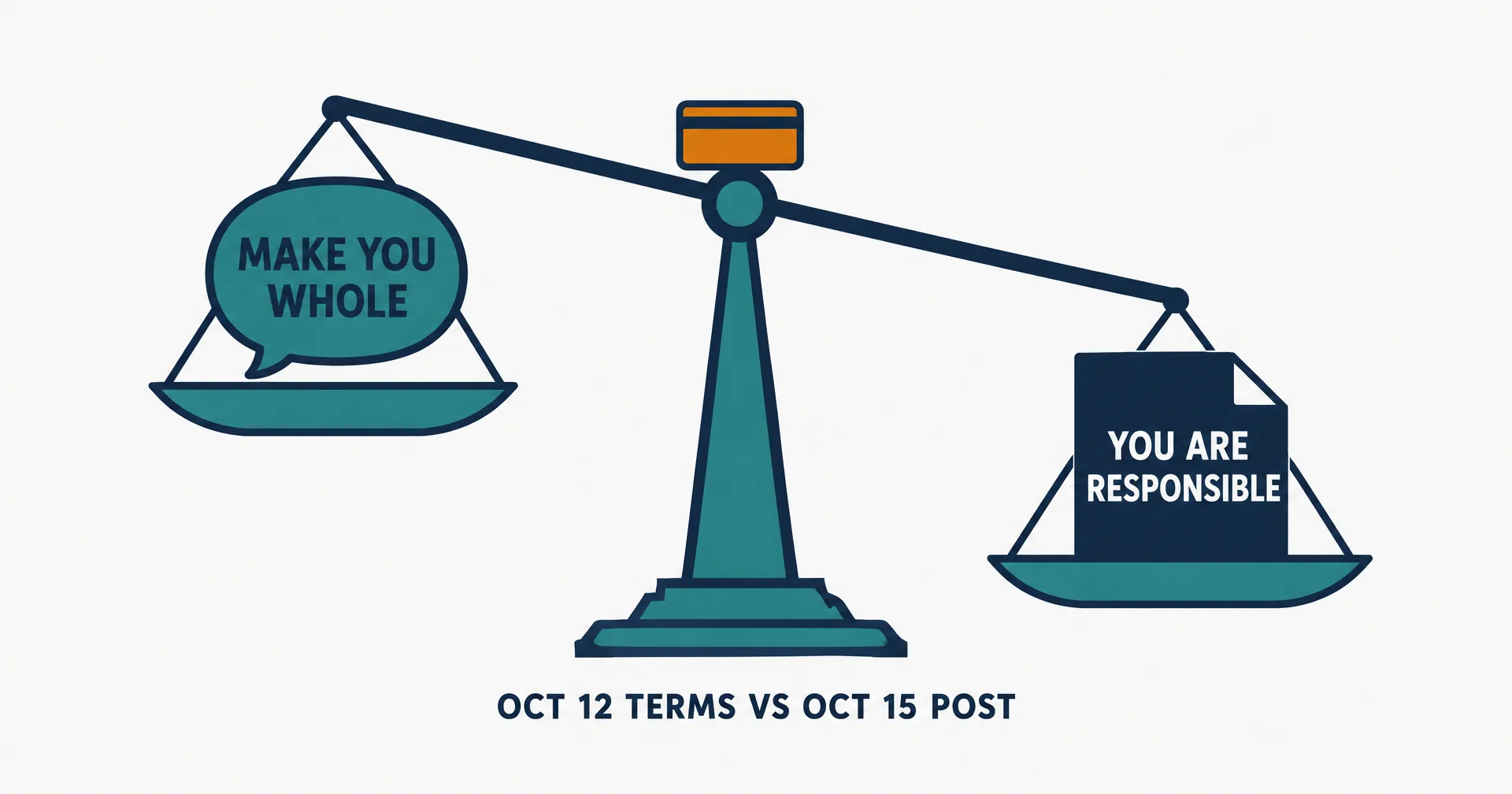
Three days earlier, xAI had updated its terms of service. They say something close to the opposite. This page puts the promise, the terms and Grok Bot’s own approval docs side by side, so you can see what is written down and what is not.
On this page · 6 sectionsOpen
 On October 15, 2026 at 05:57 UTC, Elon Musk replied to a user whose Grok Bot booked a flight from a photo of a credit card: “If Grok @Bot makes a mistake with a purchase or leaks your card (never happened yet), SpaceX will make you whole.” The post passed 2.3 million views.
 xAI’s terms of service, updated October 12, 2026, say the opposite in writing: Grok can take “Agentic Actions” including interactions with financial institutions, and “You are responsible for User Content and Agentic Actions”, including any costs or liabilities.
 Grok Bot’s own docs treat purchases as something you fence yourself: they list purchases and financial transfers among the actions to give explicit boundaries, and say sensitive actions can stop for approval when your Auto Review rules require it.
 Two details in the docs matter for money. An approval from a routine or trigger expires after about 10 minutes, and an approval does not reverse work already completed. A pledge on X is not in either document.
 The practical reading: until xAI writes the pledge into its terms, treat it as goodwill. If you let any agent spend money, set the approval rule before the first purchase, not after the first mistake.
§ 01The promise and the terms, side by side
| Source | Date | What it says about purchases |
|---|---|---|
| Musk on X | October 15, 2026 | SpaceX “will make you whole” if Grok Bot makes a mistake with a purchase or leaks your card |
| xAI terms of service | Updated October 12, 2026 | xAI is “not responsible” for Agentic Actions; the user is responsible for them and their costs |
| Grok Bot approvals doc | Current | Purchases and financial transfers are among the actions to give explicit boundaries |
| Grok Bot FAQ | Current | Sensitive actions “can stop for approval”, depending on the tool, the risk and your rules |
The terms define the category plainly. Grok can take autonomous actions on your behalf, “Agentic Actions”, which include “interactions with third-party services, including financial institutions.” Then: “We are not responsible for User Content or Agentic Actions. You are responsible for User Content and Agentic Actions, including ensuring that it does not violate any applicable law or these Terms and any consequences, costs, or liabilities arising therefrom.”
Musk’s reply does not say what counts as a mistake, how you would claim, or whether it covers purchases a user approved. Business Insider reported that Musk did not set out the scope of the pledge, and that none of the major agents publishes an explicit reimbursement pledge like the one he described.
§ 02How Grok Bot actually guards a purchase
The guard is an approval, and it is yours to configure. Grok Bot’s approvals guide tells you to set boundaries in the request and lists “Purchases and financial transfers” among the actions that deserve them. When an action needs approval, the chat shows the proposed operation and its inputs, and you choose Allow once, Always allow or Deny.
| Rule | What the docs say |
|---|---|
| When an approval appears | Depends on the tool, the risk of the action and, when enforcement is on, your Auto-review rules |
| Approvals you are not there for | From a routine, a trigger or another Bot, they expire after about 10 minutes and the action does not run |
| What an approval cannot do | “An approval controls the proposed action. It does not reverse work already completed.” |
| Who shares the computer | “All of your Bots can access the same cloud computer assigned to your account” |
Two of those rows change how much a promise is worth. “Always allow” saves a rule, so after one tap the next purchase of that kind may not stop at all. And an approval is a gate before the action, not an undo after it. If the card details leak or the wrong seat is booked, the FAQ and the terms point to you, and the pledge points to a post on X.
§ 03Why the gap matters
The gap is not unusual. Product leaders often promise more on social media than the legal team writes into the terms, and the terms usually decide a dispute. What is unusual is the stakes: an agent that books flights from a photo of a card is moving real money on its own judgment, and most users will never read the terms that decide who pays for its mistakes.
For anyone letting an agent spend, three habits hold whatever the vendor promises:
- Set the purchase rule before the first purchase. Use an Ask first rule for buying, not Always allow.
- Give the agent a payment method with a ceiling: a virtual card, a low limit or a one-time card.
- Keep a receipts trail. Ask the agent to report every purchase with merchant, amount and confirmation.
§ 04Where CellCog stands
Our conflict, declared: we build CellCog, where businesses hire AI employees, and our employees can also buy things. The design is narrower on purpose. A CellCog AI employee can pay only from your own Link wallet, you approve each purchase in Link at the exact total and merchant, and the one-time card it gets works once, only at that merchant, for that amount. Spend is off until you turn it on. The full mechanics are in our Spend post.
§ 05What we are watching for
- The terms. Whether xAI writes Musk’s pledge into its terms of service or a Grok Bot help page, and with what limits.
- A first claim. The first public case of a user asking SpaceX to make them whole, and what happens.
- Defaults. Whether purchases become an Ask first action by default in Grok Bot.
§ 06Sources
- Elon Musk on X, October 15, 2026, 05:57 UTC.
- xAI, Terms of Service, updated October 12, 2026, read October 16, 2026.
- xAI, Grok Bot: Approvals, security, and privacy and FAQ, read October 16, 2026.
- Business Insider, Elon Musk says SpaceX will pay users back for Grok purchase mistakes, October 15, 2026.
Q1Is Musk's Grok Bot purchase pledge legally binding?
We are not lawyers and this is not legal advice. What we can say is where it lives: in a reply on X. xAI’s written terms, updated October 12, 2026, still say the user is responsible for agentic actions and their costs. Until the terms change, the written document is the one to plan around.
Q2Does Grok Bot ask before it buys something?
It can. Grok Bot’s docs say sensitive or consequential actions can stop for approval depending on the tool, the risk and your Auto Review rules, and they recommend narrow Ask first rules for purchasing. They do not say every purchase always stops for approval.
Q3What happens to an approval when I am not in the chat?
Per the docs, an approval from work that started without you, such as a routine, a trigger or a message from another Bot, expires after about 10 minutes and the action does not run. An approval also does not reverse work already done.
Q4How do other agents handle purchases?
Approaches differ. Business Insider reports Meta says Muse requires approval before purchases. On CellCog, an AI employee can spend only from your own Link wallet, you approve each exact purchase in Link, and a one-time card works once, at that merchant, for that amount.