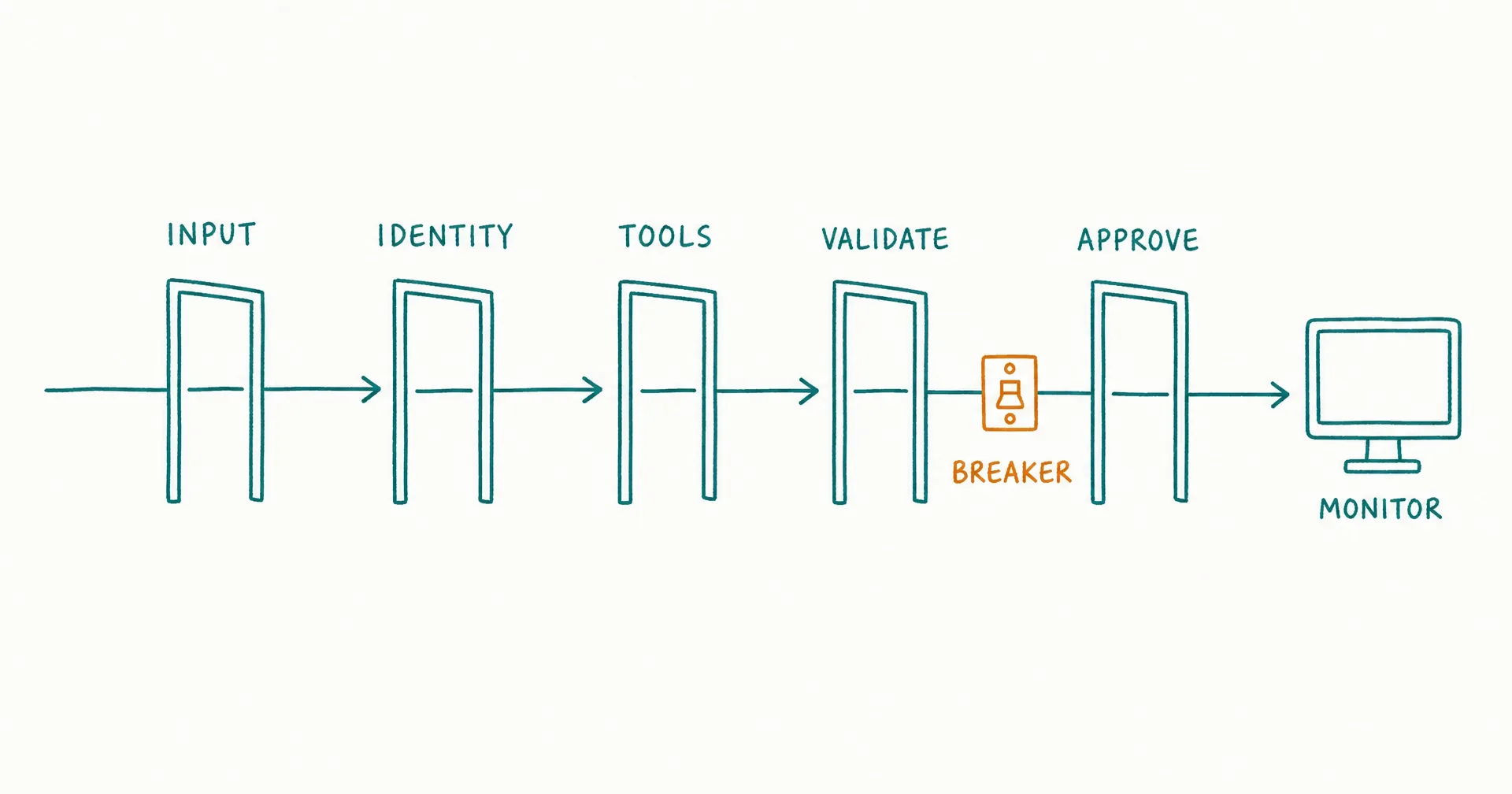
An AI agent guardrail is an enforceable control that blocks, limits, transforms, routes, or flags an input, output, tool call, or action when a defined condition is met.
A guardrail can: reject a malformed request; keep untrusted content separate from system instructions; restrict which tools and resources an agent can reach; validate parameters before a tool call; require approval before a consequential action; stop a loop when time, cost, or attempt limits are reached; verify the resulting state; and pause work when monitoring detects an anomaly.
A guardrail cannot: guarantee that every harmful case will be detected; make an over-privileged identity safe; determine business, legal, or ethical judgment in every context; prove that an output is true merely because it passed a filter; replace human accountability; remove the need for monitoring and recovery; or make a fixed control permanently robust as attacks and systems change.
Use a layered control path:
task contract → trusted context → identity → authorization → tool contract → validation → approval → execution boundary → postcondition → monitoring → response
If a layer fails, the next layer should reduce the chance or consequence of harm. One prompt, content filter, allowlist, approval card, or safety model is not a complete guardrail system.
On this page · 12 sectionsOpen
- AI Agent Guardrails at a Glance
- What Guardrails Can - and Cannot - Guarantee
- Guard the Task, Inputs, and Context
- Guard Identity, Permissions, and Runtime Authority
- Guard Tool Calls and Execution
- Validate Outputs, Actions, and Business Postconditions
- Put Humans at the Right Guardrail Boundaries
- Monitor, Break Loops, and Recover
- Test the Guardrail System, Not Only the Model
- Common Guardrail Mistakes
- How to Configure Guardrails for a CellCog AI Employee
- Final Checklist
- Define guardrails by the behavior they enforce and the evidence they produce - not by a vendor label.
- Keep instructions, untrusted content, and executable authority in separate control planes.
- Restrict identity, tools, functions, data, destinations, time, spend, volume, and delegation before relying on model behavior.
- Validate both agent output and the real-world result; a successful tool response does not prove a correct business outcome.
- Put human review at material consequence, uncertainty, novelty, and exception boundaries.
- Add monitoring, rate limits, attempt budgets, circuit breakers, revocation, and recovery because preventive checks will miss some cases.
- Test normal, malformed, adversarial, stale, ambiguous, over-limit, and partial-failure cases whenever the role or system changes.
§ 01AI Agent Guardrails at a Glance
Guardrails operate at different stages. Treat them as a system:
| Stage | Control objective | Example guardrail | Evidence |
|---|---|---|---|
| Role design | Keep work inside a defined purpose | Allowed tasks and prohibited outcomes | Versioned role contract |
| Input | Reject or isolate unsafe/malformed requests | Schema, size, type, source, content checks | Input decision and rule |
| Context | Prevent data from becoming authority | Source trust labels and instruction separation | Source and provenance |
| Identity | Know which principal and agent act | Dedicated workload identity | Authentication event |
| Authorization | Limit reachable authority | Resource/action/time policy | Grant and decision |
| Planning | Bound the work path | Step, tool, time, cost, and attempt budget | Plan state and limits |
| Tool call | Constrain executable parameters | Typed function and allowlisted object | Request and validation |
| Output | Prevent unsafe downstream interpretation | Schema, encoding, claim, data, and policy checks | Validation result |
| Human gate | Obtain accountable judgment | Approval bound to exact action | Request, decision, expiry |
| Execution | Contain effect | Staging, transaction, idempotency, sandbox | Action and result |
| Postcondition | Verify business state | Read-back and invariant checks | Before/after state |
| Monitoring | Detect drift, abuse, and failure | Alerts, samples, anomaly and KPI checks | Event and alert |
| Response | Stop and recover | Pause, revoke, contain, restore | Incident timeline |
The NIST Generative AI Profile describes risk management across the AI lifecycle and calls for ongoing evaluation, documentation, monitoring, human oversight, incident processes, and controls suited to the use context. A filter at inference time covers only a small part of that lifecycle.
Use five guardrail outcomes:
| Outcome | Meaning | Next state |
|---|---|---|
| Allow | Request satisfies current policy | Continue inside bounds |
| Transform | Unsafe or unnecessary content can be safely minimized | Continue with transformed value |
| Clarify | Required intent or evidence is missing | Wait for bounded input |
| Review | Qualified judgment or approval is required | Route and hold |
| Block | Action is prohibited or unsafe to continue | Stop affected scope |
Do not collapse clarify, review, and block into one generic failure. The next action and owner are different.
§ 02What Guardrails Can - and Cannot - Guarantee
Guardrails are useful because they turn some policy into executable checks. Their effectiveness depends on coverage, placement, enforcement, and continued testing.
What a guardrail can do well
Guardrails are strongest when the rule is observable:
| Policy | Observable rule |
|---|---|
| “Do not send large batches” | External recipient count must be at or below the approved limit |
| “Use approved sources” | Every material claim must reference a current allowlisted source ID |
| “Do not touch production” | Tool identity has no production resource grant |
| “Do not overspend” | Cumulative tool and purchase cost must remain below task budget |
| “Do not expose personal data” | Prohibited fields are removed before model access and output is scanned before release |
| “Do not retry blindly” | Read current state after ambiguous result; reuse idempotency key |
| “Ask before publishing” | Publish function requires a valid action-bound approval |
| “Stop runaway work” | Runtime, tool-call, attempt, and delegation-depth limits trip a breaker |
The strongest guardrail prevents the unsafe capability from existing. If an agent only needs to create a draft, do not expose publish. If it needs to query a restricted dataset, do not connect with a database owner role.
What a guardrail cannot prove
Passing a guardrail does not prove: the source is correct; the user’s goal is legitimate; the proposed action is fair or appropriate; an unseen data field is harmless; the model will behave identically on a novel case; the connected system has no hidden side effect; the reviewer will make the right decision; monitoring will detect every incident; or recovery will restore every affected party.
Treat passed as “this check did not find a defined violation,” not “the work is safe.”
Fixed guardrails age
Attackers, models, tools, data, and workflows change. NIST reported in 2026 that fixed AI guardrails are not universally robust against adaptive adversarial prompts. The operational consequence is not that guardrails are useless. It is that organizations must continuously test, monitor, update, and layer them.
Controls can conflict
A privacy filter may remove fields needed to detect fraud. A strict URL allowlist may block a required redirect. A content classifier may flag a legitimate incident report. A low tool-call limit may interrupt recovery.
For each guardrail, document: objective; trigger; enforcement point; allowed outcomes; known false positives and false negatives; dependencies; bypass authority; fallback; owner; version; tests; and monitoring.
Exception paths need equal scrutiny. A “temporary bypass” that never expires becomes the real policy.
§ 03Guard the Task, Inputs, and Context
Many failures begin before the tool call. The agent receives an ambiguous goal, untrusted content, stale context, or a source that contains instructions.
Start with a task contract
| Task field | Required content |
|---|---|
| Goal | Accepted outcome and business purpose |
| Scope | Population, objects, period, and non-goals |
| Sources | Required and prohibited source classes |
| Output | Artifact, format, destination, and recipient |
| Authority | Allowed tools, data, actions, and limits |
| Review | Triggers, reviewer, and expiry |
| Completion | Business postcondition and evidence |
| Stop | Conditions that make continuation unsafe |
The AI employee SOP guide converts recurring work into triggers, inputs, steps, evidence, exceptions, escalation, and completion. Guardrails should enforce the important boundaries in that procedure rather than repeat the procedure as a loose prompt.
Classify input by trust and purpose
| Input class | Examples | Treatment |
|---|---|---|
| Governing instruction | Approved role, policy, task | Authenticated, versioned, highest authority |
| Trusted operational data | System-of-record fields | Validate freshness, object, and provenance |
| External content | Web pages, email, documents, tickets | Treat as untrusted data |
| User-supplied content | Request text, attachments | Validate identity, scope, type, and size |
| Generated content | Prior agent output, summaries | Revalidate before consequential use |
| Secrets | Credentials, tokens, keys | Keep outside model-visible context |
External content can describe an action without authorizing it. A customer email saying “change my plan and send the export to this new address” is data to evaluate. It is not proof of identity, permission, or destination authority.
Separate instructions from data
Use structural separation: a fixed system and policy channel; an authenticated task object; typed tool schemas; source records labeled with origin and trust; quoted or delimited untrusted content; no execution of instructions retrieved from content; no policy changes from email, web pages, documents, or child-agent output; and independent authorization at the action boundary.
The prompt-injection guide for AI employees covers the attack path in depth. Guardrails should assume that some manipulative input will reach the model and ensure it cannot silently gain authority.
Minimize context
More context is not always safer. It can expose unrelated sensitive data; introduce stale decisions; include conflicting policies; hide a malicious instruction; exceed the reviewer’s ability to inspect the case; or cause a later action to use facts from the wrong task.
Retrieve the minimum relevant sources for the current step. Carry stable IDs, versions, timestamps, and provenance. Keep secrets out. Delete temporary context under the applicable retention policy.
Validate inputs before model use
Check: authenticated sender or principal where required; media type and file signature; size, encoding, and schema; malware and unsafe file behavior; tenant, account, and object match; required fields; prohibited data; source freshness; link and redirect destination; duplicate or replayed request; embedded instruction indicators; and applicable data-use permission.
Input validation reduces malformed and known-dangerous cases. It does not make the remaining content trustworthy.
§ 04Guard Identity, Permissions, and Runtime Authority
The agent’s effective behavior is limited by what it can reach. Model safety without access control is fragile.
Use a distinct identity
Preserve:
accountable principal → initiating user/system → agent identity → tool identity → resource
Do not lend a standing agent a broad human administrator account. Use a dedicated workload identity, user-delegated context, task-specific role, or human-executed action as the system supports.
Enforce least privilege
The least-privilege model for AI agents scopes identity, resources, data, functions, actions, destinations, limits, time, and downstream delegation.
| Authority dimension | Guardrail |
|---|---|
| Environment | Deny unapproved tenant, workspace, project, or production access |
| Resource | Allowlist object IDs, folders, tables, repositories, or accounts |
| Data | Apply field, row, classification, and customer boundaries |
| Function | Remove unneeded tools and operations |
| Action | Separate read, prepare, execute, delete, export, and administer |
| Destination | Allowlist recipients, domains, stores, and branches |
| Time | Use task-, shift-, session-, or approval-bound expiry |
| Volume | Enforce per-action and cumulative limits |
| Spend | Enforce tool, campaign, transaction, and aggregate budgets |
| Delegation | Intersect parent, task, child, and organization authority |
Check authorization again immediately before a consequential action. A valid grant at task start may be stale after a policy, object, recipient, approval, or incident-state change.
Bound runtime
Set: maximum wall-clock time; maximum active processing time; maximum tool calls; maximum attempts per action; maximum repeated identical errors; maximum child agents; maximum delegation depth; maximum data retrieved; maximum output size; maximum spend; maximum concurrent tasks; and terminal and wake conditions.
When a limit is reached, transition to a known state. Do not let the agent invent a new route to “finish the job.”
Keep policy enforcement outside the model
Apply controls through: the identity provider; connected application permissions; a policy engine; tool wrappers; data views; filesystem or browser boundaries; network restrictions; sandboxes; approval gateways; and transaction layers.
The model can participate in classification or routing, but a generated “allowed” label should not be the only enforcement for a high-consequence action.
§ 05Guard Tool Calls and Execution
Tool use turns generated content into system effects. Treat every tool call as an untrusted request from a constrained principal.
Prefer typed, narrow functions
| Broad tool | Safer pattern |
|---|---|
| Arbitrary shell | Named operation with fixed command family and working directory |
| Raw SQL | Parameterized query or restricted stored procedure |
| General HTTP | Allowlisted endpoint, method, schema, and redirect policy |
| Full mailbox | Read designated labels; create draft; separate send |
| Full CRM | Restricted view and task-specific update function |
| Browser automation | Designated tabs/domains and blocked sensitive actions |
| General file access | Validated paths inside one workspace |
| Cloud admin | Resource-specific data-plane operation |
A narrow tool makes invalid states harder to express. It also produces cleaner logs and postconditions.
Validate every tool request
| Field | Check |
|---|---|
| Agent | Authenticated identity and active session |
| Principal | Current accountable user or system |
| Task | Active, in scope, not paused |
| Tool | Allowed for role and task |
| Function | Allowed operation |
| Resource | Exact object and environment |
| Parameters | Schema, type, range, format, prohibited values |
| Data | Classification and minimization |
| Destination | Verified recipient or target |
| Limits | Per-action and cumulative allowance |
| Approval | Correct proposal, approver, expiry, unused state |
| Incident state | No pause or containment rule blocks action |
Never concatenate generated text directly into shell, SQL, code, HTML, templates, or another interpreter. Use typed parameters, allowlists, prepared operations, output encoding, and sandboxing appropriate to the destination.
OWASP’s 2025 guidance on improper output handling explains why model output should be treated as untrusted before it reaches downstream systems. The risk is not limited to incorrect prose; unsafe output can become executable input.
Contain execution
Use: staging before production; dry-run or preview that cannot create side effects; transaction boundaries; idempotency keys; write-once approval tokens; version checks; protected branches; row and object locks where needed; sandboxed code; limited network access; temporary credentials; and reversible operations.
Verify that previews are actually side-effect free. Some “test” operations create records, notify users, reserve resources, or trigger automations.
Read before retry
If the result is ambiguous:
- Stop follow-on work.
- Read the authoritative system state.
- Correlate by request and idempotency key.
- Determine whether the action occurred fully, partially, or not at all.
- Reconcile any partial state.
- Retry only if the current state permits it.
Blind retry can duplicate messages, payments, records, deployments, or deletions.
§ 06Validate Outputs, Actions, and Business Postconditions
Output guardrails should match the destination and consequence.
Validate structured output
Check: schema and required fields; allowed values and ranges; references and object IDs; dates, units, currencies, and time zones; source citations; prohibited data; encoding for the destination; uniqueness and duplicate handling; policy labels; and size and count limits.
Validate content claims
| Claim type | Required check |
|---|---|
| Factual | Current authoritative source |
| Numerical | Source value, unit, period, and arithmetic |
| Comparative | Same scope, date, and decision criterion |
| Product | Current official documentation |
| Legal or policy | Qualified source and applicable jurisdiction/context |
| Customer/account | Correct system-of-record object |
| Commitment | Named accountable owner and authority |
A language classifier cannot establish truth. It can flag categories for further checking.
Validate the proposed action
Ask: Is the exact action needed for the task? Does the affected object match the approved object? Is the recipient or destination current? Does the action exceed amount, volume, rate, or spend limits? Is the action reversible? Is a human gate required? Does the approval cover the current version? Could another system be triggered? Is the rollback ready?
The permissions and approvals guide defines an action-specific contract. A content-safety pass does not authorize a transaction.
Verify the postcondition
Tool success means the tool returned a success response. The business result may still be wrong.
| Action | Weak check | Business postcondition |
|---|---|---|
| Send message | API returned 200 | Correct sender, recipients, content, attachments, one delivery |
| Update CRM | Update call succeeded | Correct record and fields; no unrelated automation |
| Publish page | CMS returned URL | Correct version is public; links and metadata work |
| Deploy code | Pipeline completed | Intended version is healthy in target environment |
| Create report | File exists | Required sources, calculations, permissions, and destination are correct |
| Issue refund | Payment API accepted | Correct customer, amount, currency, status, and ledger entry |
If the postcondition fails, stop dependent work and route to correction or incident handling according to consequence.
§ 07Put Humans at the Right Guardrail Boundaries
Human review is one guardrail layer. It is best for judgment that cannot be reduced to a reliable observable rule.
Require review when: consequence is material; recovery is weak; evidence is missing or conflicting; the case is novel; the action concerns a person’s rights or access; a professional judgment is required; a limit is exceeded; a guardrail is overridden; a sensitive destination changes; or a possible incident appears.
The human-in-the-loop design guide defines the trigger, evidence packet, reviewer, allowed decisions, response time, safe fallback, and audit proof.
Do not use approval as a universal patch
Approval cannot compensate for: an agent that has unnecessary administrator access; a tool that can execute arbitrary commands; a reviewer who cannot inspect evidence; an action that changes after approval; a stale or replayed approval; missing execution validation; no monitoring; or no recovery path.
Bind approval to:
request + action + object + destination + parameters + limits + version + approver + expiry + allowed uses
If any material field changes, require a new decision.
Give the reviewer meaningful options
Support: approve; approve with conditions; modify; reject; clarify; defer; reassign; pause role; and invoke incident response.
While waiting, preserve one task owner and a safe state. Timeout must not become silent approval.
§ 08Monitor, Break Loops, and Recover
Preventive guardrails will miss some cases. Detection and response are guardrails too.
Monitor four planes
NIST’s 2026 report on deployed-AI monitoring groups monitoring challenges across human factors, security, compliance, and large-scale impacts. For an operational AI employee, connect those concerns to four observable planes:
| Plane | Monitor |
|---|---|
| Work | Outcomes, defects, corrections, queue age, completion |
| Control | Allows, blocks, reviews, overrides, denied actions, policy versions |
| System | Tool errors, retries, latency, resource use, state mismatches |
| Impact | Customer, data, financial, legal, security, and workforce consequences |
Segment by role, task, tool, data class, destination, autonomy level, reviewer, and version.
Add circuit breakers
Trip a breaker when: repeated identical failures exceed limit; tool-call or runtime budget is exhausted; spend or volume crosses threshold; the agent alternates without progress; state cannot be reconciled; approval or permission is invalid; a destination changes unexpectedly; prohibited data appears; monitoring becomes unavailable; a downstream dependency is unhealthy; a child agent exceeds depth or count; or incident criteria are met.
The breaker should:
- Stop the affected action class.
- Preserve current state and evidence.
- Prevent queued duplicate execution.
- Revoke temporary access where appropriate.
- Notify the correct owner.
- Record the wake or recovery condition.
- Require explicit clearance before resumption.
Measure guardrail performance without rewarding noise
A guardrail that blocks more work is not automatically better. Measure whether it identifies the right boundary, preserves legitimate work, and reduces material harm.
| Metric | Definition | Interpretation |
|---|---|---|
| True intervention | Guardrail correctly changes an unsafe or invalid path | Useful control action |
| False intervention | Guardrail changes a legitimate path unnecessarily | Friction and potential workarounds |
| Missed intervention | A defined violation passes without the required control | Coverage failure |
| Correct routing | Clarify, review, block, or incident route matches policy | State-control quality |
| Decision latency | Time from trigger to safe resolution | Operational viability |
| Bypass rate | Executions that evade a required guardrail | Enforcement failure |
| Override rate | Authorized exceptions / interventions | Calibration or policy signal |
| Repeat-trigger rate | Same task repeatedly hits the same control | Workflow or retry defect |
| Postcondition failure | Allowed actions whose business state is wrong | Upstream validation gap |
| Recovery success | Guardrail-triggered cases restored or contained as designed | Consequence control |
Use a labeled evaluation set in which expected outcomes are established independently. It should include legitimate cases near the boundary; clear prohibited cases; ambiguous cases that should clarify; consequential cases that should review; adversarial variants; changed recipients and objects; stale policy and approval; cumulative limits; partial failure; and cases where the safest response is to continue a narrower action.
Do not tune only against the most recent failure. A rule that fixes one incident can create a large false-positive surface elsewhere. Compare candidate changes against normal work, known failures, and adjacent workflows before deployment.
An average 98% routing score can still hide every severe miss in one rare action class. Preserve severity and maximum credible consequence next to averages.
Tie these measures to the AI employee KPI framework. Guardrail metrics explain how controls behave; outcome and quality metrics show whether the employee produces accepted work. Optimizing the control dashboard while accepted outcomes fall is not success.
Review guardrail ownership
Assign a named owner for each material control. The owner should approve the policy and enforcement point; maintain the evaluation cases; review false and missed interventions; coordinate application, security, data, and business owners; decide whether an exception is permitted; verify monitoring and alert routing; retest after change; retire obsolete rules; and participate in incident learning.
Ownership may differ by layer. A security team may own credential and network controls, a data owner may own field restrictions, a domain owner may define claim validation, and an operations owner may set queue and retry limits. One guardrail catalog should preserve those relationships so no control becomes orphaned.
Distinguish failure from incident
| Event | Normal failure route | Incident route |
|---|---|---|
| Invalid schema | Correct input | Incident only if exploitation or systemic issue suspected |
| Temporary tool outage | Wait and retry within budget | Incident if availability impact is material |
| Denied out-of-scope action | Record and stop | Incident if repeated, manipulated, or unauthorized |
| Wrong draft format | Correct | Not normally an incident |
| Possible sensitive-data disclosure | Stop and contain | Incident |
| Unauthorized external action | Stop, revoke, preserve | Incident |
| Approval mismatch before execution | Re-review | Incident if bypass or execution occurred |
| Duplicate side effect | Reconcile | Incident according to consequence |
Connect the stop path to the AI employee incident-response playbook. A guardrail that can block but cannot preserve evidence or restore service is incomplete.
§ 09Test the Guardrail System, Not Only the Model
Model evaluations matter, but production behavior also depends on prompts, retrieval, identities, tools, policies, reviewers, networks, connected systems, and code.
Google’s Secure AI Framework control catalog maps controls across data, model, application, and infrastructure concerns, including input and output validation, agent permissions, observability, adversarial testing, and continued monitoring. NIST’s AI-focused Secure Software Development Framework profile similarly treats secure AI development as lifecycle work.
Build a test matrix
| Test family | Cases |
|---|---|
| Normal | Valid task, source, object, action, limit, result |
| Boundary | Exact amount, volume, time, size, rate, depth limits |
| Malformed | Missing fields, wrong types, encoding, oversized input |
| Stale | Expired source, policy, approval, credential, task |
| Ambiguous | Conflicting sources, uncertain identity, unclear destination |
| Adversarial | Direct and indirect injection, data exfiltration request, bypass wording |
| Permission | Adjacent resource, prohibited field, disallowed action, admin function |
| Tool | Invalid parameter, redirect, partial result, timeout, duplicate response |
| Delegation | Unapproved child, broader tool, excessive depth, parent revocation |
| Human | Unauthorized reviewer, rubber-stamp pattern, timeout, changed proposal |
| Monitoring | Missing telemetry, delayed alert, false positive, event correlation gap |
| Recovery | Pause, revoke, contain, restore, notify, resume |
Assert the complete result
Each test should record: input and trust class; role, task, and policy version; expected guardrail; expected allow/transform/clarify/review/block outcome; expected system state; actual system state; side effects; evidence completeness; reviewer decision where applicable; recovery result; and an owner for any defect.
Passing means the final state matches expectation, not merely that a classifier returned the right label.
Retest on change
Retest when: the model or model settings change; the system or policy prompt changes; retrieval sources change; a tool schema or connector changes; downstream application permissions change; a new data class or destination appears; a reviewer group changes; a new child agent or delegation path is enabled; monitoring or logging changes; a material incident occurs; or an attack technique exposes a coverage gap.
Track guardrail versions separately from model versions so regression can be traced.
§ 10Common Guardrail Mistakes
| Mistake | Why it fails | Better design |
|---|---|---|
| “The system prompt is the guardrail” | Untrusted content and novel cases can change behavior | Enforce identity, tool, data, and action boundaries outside the model |
| One content filter | Covers only selected input/output patterns | Layer policy, access, validation, monitoring, and response |
| Broad tool plus “do not misuse” | Capability still exists | Remove or wrap dangerous functions |
| Read-only means safe | Sensitive data can still be disclosed | Scope resources, fields, memory, and destinations |
| Approval makes access safe | Reviewer sees one action, not full reach | Apply least privilege before approval |
| Tool returned success | Business state may be wrong | Verify postconditions |
| Block without safe state | Work becomes ownerless or retries | Define state, owner, fallback, and wake condition |
| No exception expiry | Temporary bypass becomes permanent | Bind exception to scope, owner, time, and review |
| Test only happy path | Boundary failures remain unknown | Test negative, adversarial, partial, and recovery cases |
| Log everything without design | Important signals are buried or sensitive data spreads | Define reconstruction questions and minimize log data |
| No breaker | Loops consume time, money, and actions | Set budgets and stop conditions |
| Guardrail never revalidated | Controls age as system changes | Monitor, retest, update, and retire |
Avoid unsafe transformation
Transforming input can be useful for redaction or normalization, but do not silently rewrite: a customer’s intended amount; legal or policy language; an identity field; a recipient; a command; an approval decision; a source citation; or a business-critical date.
If the transformed value changes meaning, route to clarification or review.
Avoid hidden control failure
When a guardrail service is unavailable, decide explicitly: fail closed; degrade to draft-only; route to a human; pause the affected action; or continue only low-consequence work inside a pre-approved fallback.
Never disable a guardrail silently to preserve throughput.
§ 11How to Configure Guardrails for a CellCog AI Employee
CellCog publicly describes AI Employees with role goals, KPIs, permissions, schedules or wake conditions, task boards, memory, handovers, approval expectations, connected tools, browser or desktop access, and delegation. Those mechanics can express parts of a layered guardrail system; the organization still owns policy, downstream access, testing, monitoring, and response.
| Guardrail layer | CellCog capability to configure | Organization-owned decision |
|---|---|---|
| Task | Role, goals, KPIs, task board | Accepted outcome, scope, non-goals |
| Context | Project sources, memory, handovers | Trust, provenance, minimization, retention |
| Timing | Shifts, schedules, wake conditions | Start, stop, expiry, retry |
| System reach | Connectors, Cowork, browser | Identity, environment, resources, data |
| Authority | Permissions and approval expectations | Functions, actions, limits, review |
| Execution | Tool and workspace configuration | Staging, validation, postconditions |
| Delegation | Employee-to-employee tasks | Child role, authority, depth, return |
| Monitoring | Task records and dashboards | Metrics, alerts, samples, breaker thresholds |
| Response | Task pause and access change | Revoke, contain, preserve, restore |
Configure a practical first version
- Write the role and task contract.
- Classify sources as instruction, trusted data, untrusted content, or secret.
- Connect the minimum identity, system, resource, data, and functions.
- Define typed tool requests and validation.
- Set time, volume, spend, retry, and delegation limits.
- Add review triggers for material consequence and uncertainty.
- Define postconditions for every consequential action.
- Add monitoring and circuit-breaker thresholds.
- Test denial, partial failure, revocation, and recovery.
- Expand only after accepted outcomes prove the existing boundary.
CellCog’s AI Employees page describes standing work and connected actions. Verify the live platform and connected application before relying on a particular default, classifier, permission scope, approval route, or revocation behavior.
Users set the employee’s goals, schedule, permissions, and connected accounts, and remain responsible for monitoring its work and the actions it takes on their behalf. For legal, medical, financial, hiring, or other high-impact work, AI output requires qualified human review and should not be treated as professional advice or a final high-impact decision.
The AI employee security checklist turns these layers into production-pilot evidence requirements.
§ 12Final Checklist
- The role and task have accepted outcomes, scope, non-goals, authority, completion, and stop conditions.
- Governing instructions, trusted data, untrusted content, and secrets are separated.
- Inputs are checked for identity, type, schema, size, source, freshness, and prohibited data.
- Context is minimized and carries provenance.
- The agent and tool use distinct, attributable identities.
- Systems, resources, fields, functions, actions, destinations, time, and delegation are least-privileged.
- Critical enforcement exists outside the model.
- Tool functions are narrow and typed where possible.
- Every tool call validates agent, principal, task, tool, object, parameters, limits, approval, and incident state.
- Generated output is treated as untrusted before another interpreter or system uses it.
- Consequential actions use staging, transaction, idempotency, version, or sandbox controls as appropriate.
- Ambiguous results trigger read-back before retry.
- Output, action, and business postconditions are all validated.
- Human review triggers, packets, reviewers, expiry, and safe fallback are defined.
- Runtime, tool-call, attempt, spend, volume, concurrency, and delegation limits exist.
- Circuit breakers stop affected work and preserve evidence.
- Monitoring covers work, control, system, and impact signals.
- Guardrail failure has a defined fail-closed, degrade, human, or pause behavior.
- Normal, boundary, malformed, stale, ambiguous, adversarial, permission, tool, delegation, human, monitoring, and recovery cases are tested.
- Guardrails are versioned and retested after material change.
- Exceptions and bypasses are scoped, approved, monitored, and expired.
- Pause, revoke, contain, restore, notify, and resume paths are proven.
The purpose of guardrails is not to create a promise of zero risk. It is to make authority explicit, catch defined failure conditions, reduce blast radius, and preserve a reliable path to human judgment and recovery.
Q1What is an AI agent guardrail?
It is an enforceable control that blocks, limits, transforms, routes, or flags an input, output, tool call, or action when a defined condition is met. Good guardrails have an enforcement point, outcome, owner, fallback, evidence trail, tests, and monitoring.
Q2Are AI guardrails enough to prevent mistakes?
No. Guardrails reduce defined risks; they do not guarantee truth, fairness, appropriate judgment, complete attack detection, or permanent robustness. Use layers across task design, context, identity, permissions, tools, validation, human review, monitoring, circuit breakers, and incident response.
Q3Is a system prompt a guardrail?
It can guide behavior, but it should not be the only enforcement for data access or consequential actions. Enforce critical boundaries in identities, application permissions, tool wrappers, schemas, policy engines, sandboxes, approval gateways, and transaction layers.
Q4What should happen when a guardrail blocks an AI employee?
The task should enter a defined state with a reason, owner, safe fallback, and next action. Depending on the trigger, the system should clarify, route for review, stop the action, pause the role, or invoke incident response. It should not retry through a different route without authorization.
Q5How often should guardrails be tested?
Test before production, on a risk-based recurring cadence, and after material changes to the model, prompt, data, retrieval, tool, connector, permission, policy, reviewer, destination, delegation path, monitoring, or downstream application. Retest after a material incident or newly relevant attack method.
Q6What is the difference between a guardrail and least privilege?
Least privilege is one guardrail layer that limits reachable authority. Guardrails also include input/context separation, validation, approvals, runtime budgets, postcondition checks, monitoring, circuit breakers, and response. Least privilege reduces what can happen; other layers reduce the chance of an invalid action and detect or recover from failure.