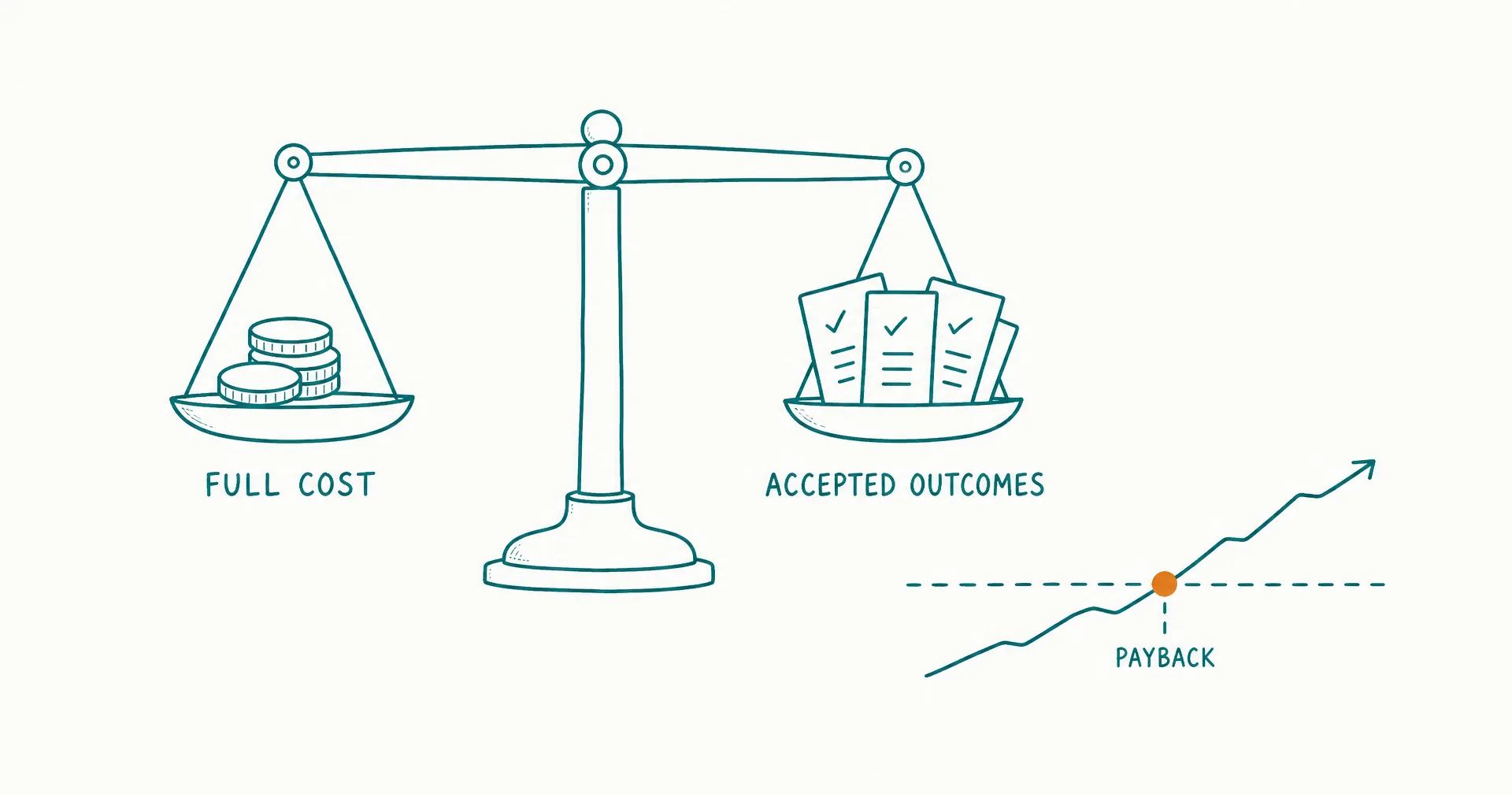
AI employee ROI is the incremental value created by a defined AI-assisted role, minus its full operating cost, divided by that full cost.
The calculation is easy to write and easy to distort.
AI employee ROI = (risk-adjusted incremental benefit - total AI employee cost) ÷ total AI employee cost
The difficult work is defining the baseline, measuring accepted outcomes, pricing human review, distinguishing released capacity from cash savings, and including correction and failure costs. If those inputs are missing, a large ROI percentage is usually a story about assumptions rather than an investment result.
A practical business case therefore needs 4 views:
- a baseline for the current process;
- a benefits model tied to accepted outcomes;
- a complete cost model that includes people and risk; and
- low, base, and high cases with a clear payback gate.
Use the model below for one bounded role. Do not calculate ROI for “an AI employee” in the abstract.
On this page · 13 sectionsOpen
- What Does AI Employee ROI Actually Measure?
- What Baseline Should the ROI Model Use?
- Which Benefits Belong in an AI Employee Business Case?
- Which Costs Must Be Included?
- How Should Human Review Enter the ROI Calculation?
- How Do You Calculate ROI, Payback, and Cost per Accepted Outcome?
- What Does a Worked AI Employee ROI Example Look Like?
- How Do Low, Base, and High Cases Prevent False Precision?
- How Should Risk and Failure Exposure Be Valued?
- What Should an AI Employee ROI Calculator Contain?
- How Should a Pilot Validate the Business Case?
- What Common ROI Mistakes Should Buyers Reject?
- A Decision-Ready AI Employee ROI Checklist
- Start with a measured current-state baseline. A weak baseline makes every later percentage unreliable.
- Count value only when the work produces an accepted outcome, releases usable capacity, prevents a measurable loss, or contributes to incremental margin.
- Apply a realization factor to time released. Ten hours saved is not automatically ten hours of payroll removed or ten hours of revenue created.
- Include the full 7-layer AI employee cost: platform, usage, setup, integrations, review, correction, and operations plus failure exposure.
- Keep human review visible. Review can be a control, a source of learning, and a real operating cost at the same time.
- Build low, base, and high cases. The low case should reflect weaker adoption, lower acceptance, more review, and higher correction - not merely a smaller benefit number.
- Approve a pilot when it can answer a purchase decision, not when it can produce an impressive demo.
§ 01What Does AI Employee ROI Actually Measure?
AI employee ROI measures the return from changing a business process, not the apparent intelligence of a model and not the amount of content it generates.
The unit of analysis should be a role with a defined task, owner, workload, acceptance standard, authority boundary, and review policy. Examples include:
- qualifying a bounded set of inbound leads;
- producing a weekly research brief from approved sources;
- preparing first-draft support responses for human approval;
- reconciling structured records and escalating exceptions;
- monitoring a queue and assembling an evidence packet; or
- converting approved source material into channel-specific drafts.
Those are measurable. “Improve marketing with AI” is not.
| ROI layer | Question | Required evidence | Weak substitute |
|---|---|---|---|
| Scope | What process is changing? | Role charter and task boundary | Job title |
| Baseline | What happens without the AI role? | Time, volume, quality, delay, cost | Memory or opinion |
| Benefit | What becomes better or more valuable? | Accepted outcomes and attributable change | Generated output count |
| Cost | What resources does the new process consume? | Vendor and internal operating costs | Subscription price |
| Risk | What failure can create loss? | Incident classes, frequency, impact | “Human in the loop” |
| Timing | When does value arrive? | Ramp, adoption, and payback schedule | Annualized first-week result |
| Confidence | How uncertain are the inputs? | Ranges and sensitivity analysis | One precise forecast |
The return belongs to the process change. That distinction matters because the AI role may create value through several mechanisms:
- reducing active handling time;
- increasing throughput without increasing the team;
- shortening cycle time;
- improving consistency;
- reducing avoidable errors;
- increasing coverage outside ordinary hours;
- improving conversion or retention;
- enabling work that was previously uneconomic; or
- giving specialists more time for high-value exceptions.
Not every mechanism creates cash. Some create capacity, speed, resilience, or option value. Keep those categories separate so the business case remains auditable.
§ 02What Baseline Should the ROI Model Use?
Use the process that would actually continue if the investment were rejected.
That might be the current human workflow, a contractor, traditional automation, a smaller software change, a different AI platform, or no action. It is not always a fully loaded employee. The fair comparison is the next-best feasible way to produce the same accepted outcome.
The AI employee versus human employee cost comparison should therefore compare capacity options rather than imply that software is legal labor or a complete substitute for a person.
Build a 4-week baseline
For recurring work, collect at least one representative operating cycle before the pilot. Four weeks is a practical starting point when volume is reasonably stable; seasonal or infrequent work needs a longer window.
Record:
| Baseline field | Definition | Collection method |
|---|---|---|
| Eligible volume | Items that fit the proposed task boundary | Queue or workflow count |
| Completed volume | Items completed under the current process | System of record |
| Accepted volume | Items that pass the same standard used for AI work | Reviewer decision |
| Active handling time | Human minutes actively spent per item | Time sample or workflow log |
| Waiting time | Time between task states | Timestamps |
| Correction time | Minutes spent fixing rejected or incomplete work | Reviewer log |
| Escalation rate | Share requiring specialist intervention | Case label |
| Error/defect rate | Share failing the defined rubric | Quality sample |
| Downstream impact | Conversion, resolution, margin, loss, or delay | Business system |
| Current direct cost | Labor, contractor, software, and transaction cost | Finance records |
Use the same inclusion rules before and after deployment. If the baseline counts easy and difficult cases but the pilot accepts only easy ones, its apparent improvement is not comparable.
Separate active time from elapsed time
An AI role may reduce elapsed time without reducing much active labor. It may also reduce active handling while a queue still waits for approval.
Track both:
Cycle time = completion timestamp - entry timestamp
Active handling time = minutes of direct human work
The economic meaning differs. Faster cycle time can improve customer experience or reduce delay cost. Lower active time can release capacity. Neither should be converted into dollars without a stated value mechanism.
Freeze the baseline before reading pilot results
Define the baseline period, exclusions, acceptance rubric, and calculation before the team sees the AI result. Otherwise, teams tend to choose a favorable comparison after the fact.
The U.S. Government Accountability Office’s Cost Estimating and Assessment Guide is designed for larger programs, but its disciplines transfer well: define scope and a technical baseline, state assumptions, collect data, analyze sensitivity and risk, document the estimate, and update it with actual costs.
§ 03Which Benefits Belong in an AI Employee Business Case?
Count a benefit only when you can describe its economic path.
| Benefit type | Operational change | Economic path | Evidence |
|---|---|---|---|
| Cashable cost reduction | An external or avoidable expense stops | Lower spend | Invoice, contract, headcount plan |
| Capacity release | People spend less active time | More useful work within the same team | Time study plus reassignment |
| Throughput increase | More accepted work is completed | More service, sales, or production capacity | Accepted volume |
| Cycle-time improvement | Work reaches the next state sooner | Faster revenue, service, or decision | Timestamps and downstream result |
| Quality improvement | Fewer defects or corrections | Lower rework, credits, refunds, or loss | QA and incident records |
| Incremental margin | More attributable business is won or retained | Added gross contribution | Experiment or attribution rule |
| Risk reduction | Expected frequency or impact falls | Lower expected loss | Control evidence and incident model |
| Option value | New work becomes feasible | Strategic capability | Separate qualitative case |
Time released is not automatically money saved
Suppose a role releases 100 human hours per month and the relevant loaded labor rate is $50 per hour. The theoretical capacity value is $5,000.
That is not necessarily a $5,000 benefit.
If only 60% of the released time is consistently reassigned to useful work, use a 60% realization factor:
Realized capacity value = hours released × loaded hourly rate × realization factor
100 × $50 × 60% = $3,000
Use a realization factor of 0% for time that is fragmented, cannot be reassigned, or has no valuable alternative use. Use 100% only when the business can demonstrate that the capacity displaces an avoidable cost or produces equivalent incremental value.
Revenue is not the same as contribution
If the AI-assisted process contributes to additional sales, value the incremental gross contribution rather than gross revenue:
Incremental contribution = attributable incremental revenue × gross margin
Then apply an attribution or confidence factor when several changes affect the outcome:
Risk-adjusted contribution = incremental contribution × attribution factor
Do not count both the sales team’s released time and all revenue closed during that time unless those are genuinely separate benefits.
Research results are priors, not your forecast
Published studies show why measurement is worth doing, but their results should not be pasted into a CellCog ROI spreadsheet as assumed performance.
An NBER field study, Generative AI at Work, examined a generative AI assistant used by 5,179 customer-support agents and reported an average productivity increase of about 14%, with materially different effects across worker experience levels. A preregistered experiment summarized by Stanford’s SCALE Initiative found lower completion time and higher rated quality on selected professional writing tasks.
Those findings are task-, tool-, population-, and study-specific. Use them to justify testing heterogeneous effects. Use your baseline and pilot to forecast your return.
§ 04Which Costs Must Be Included?
Begin with the complete AI employee cost framework, then classify each cost as one-time, fixed recurring, variable, human operating, or risk.
| Cost category | Typical items | Timing | ROI treatment |
|---|---|---|---|
| Platform | Subscription, workspace, support tier | Recurring | Full period cost |
| Variable usage | Credits, tokens, runs, tools, media, compute | Usage-based | Cost at measured volume |
| Setup | Process mapping, role design, context pack, evaluation | One-time | Cash flow or amortized view |
| Integration | Authentication, APIs, data cleanup, workflow changes | One-time + recurring | Include internal and external labor |
| Review | Approval, sampling, specialist checks, exceptions | Recurring | Minutes × loaded rate |
| Correction | Rework, repeated runs, rollback, downstream fixes | Variable | Per rejected/defective outcome |
| Operations | Monitoring, access review, model/workflow change, support | Recurring | Named owner and time |
| Failure exposure | Expected cost of incidents and material errors | Expected loss | Probability × impact |
| Transition | Training, dual running, adoption, change management | Ramp period | Show by month |
| Exit/switching | Export, migration, retraining, contract overlap | Scenario cost | Include when decision-relevant |
Price internal labor
Setup and review do not become free because salaried employees perform them.
Use a loaded hourly rate appropriate to the person doing the work:
Loaded hourly rate = annual employer cost ÷ productive annual hours
Employer cost may include salary, benefits, payroll costs, equipment, and relevant overhead according to the organization’s finance policy. Productive hours should exclude non-working time according to the same policy.
Consistency matters more than choosing an artificially low or high rate. Use the same convention for the baseline and the AI-assisted process.
Attribute shared costs
One platform plan may support several roles. One integration may support several workflows. Attribute shared cost with a documented rule:
- role-attributed credits or runs;
- active task volume;
- dedicated storage or tools;
- direct usage;
- equal allocation when no better driver exists; or
- incremental cost caused by the role.
Avoid allocating all shared platform cost to the first pilot and then treating later roles as free. Show both incremental and fully allocated views when the distinction affects the decision.
Google Cloud’s AI and ML cost-optimization guidance recommends defining both resource costs and business value, tracking expenses granularly, and using budgets and monitoring. AWS guidance similarly identifies invocation volume, prompt size, retrieval scope, tool calls, retries, and unbounded loops as agentic cost drivers.
§ 05How Should Human Review Enter the ROI Calculation?
Human review belongs in the model as a designed operating activity, not a footnote.
The amount of review should depend on the consequence of an error, reversibility, audience, data sensitivity, novelty, and observed performance. A public claim, payment, permission change, customer commitment, or destructive action deserves a different control than a low-risk internal draft.
The human oversight framework for AI employees should define which outputs require approval, which can be sampled, what evidence the reviewer sees, and how exceptions escalate.
Calculate review cost from actual behavior
Use:
Monthly review cost = reviewed items × average review minutes ÷ 60 × reviewer loaded hourly rate
If review varies by risk class, calculate each class separately:
| Output class | Monthly items | Review rule | Minutes per reviewed item | Monthly review hours |
|---|---|---|---|---|
| Low-risk internal draft | 600 | 10% sample | 3 | 3.0 |
| External routine response | 180 | 100% approval | 5 | 15.0 |
| High-impact recommendation | 20 | Specialist approval | 18 | 6.0 |
| Exception | 25 | Full investigation | 24 | 10.0 |
| Total | 825 | Mixed | - | 34.0 |
Do not estimate review as “a few minutes.” Instrument it.
Review has more than one economic effect
Review can:
- prevent a costly action;
- detect weak output before release;
- supply correction data;
- slow cycle time;
- consume scarce specialist capacity;
- create queues;
- reveal that the task boundary is too broad; or
- support gradual movement from approval to sampling.
This means the goal is not zero review. The goal is the least review that keeps residual risk within the organization’s tolerance while maintaining acceptable quality.
AWS’s agentic AI economics guidance on human feedback explicitly treats human effort as a cost and ties human-in-the-loop operation to situations where failure cost exceeds review cost.
Model review decay as a scenario, not a promise
If the base case assumes review falls from 100% to 25%, state:
- the evidence threshold for the change;
- the minimum sample size;
- the maximum defect rate;
- the risk classes that remain fully approved;
- who authorizes the change; and
- what result returns the role to full review.
Until those gates are met, the financial model should carry the higher review cost.
§ 06How Do You Calculate ROI, Payback, and Cost per Accepted Outcome?
Use 3 complementary measures.
1. ROI
ROI = (benefit - cost) ÷ cost
If monthly risk-adjusted benefit is $7,150 and monthly total cost is $4,560:
($7,150 - $4,560) ÷ $4,560 = 56.8%
That result means the modeled net benefit is 56.8% of the cost for the stated period. It does not mean revenue grew 56.8%, labor fell 56.8%, or the result will recur indefinitely.
2. Payback period
Payback asks how long recurring net contribution takes to recover one-time investment:
Payback months = one-time implementation cost ÷ monthly recurring net contribution
If implementation costs $6,000 and recurring monthly benefit minus recurring monthly operating cost is $3,340:
$6,000 ÷ $3,340 = 1.8 months
Do not include the same setup cost in both the numerator and recurring monthly denominator.
3. Cost per accepted outcome
Cost per accepted outcome = total operating cost ÷ accepted outcomes
This is often the clearest unit-economics measure because it includes rejection, retries, and correction in the numerator while counting only accepted work in the denominator.
The full AI employee cost-per-outcome method is essential when platforms use different pricing units or when quality changes with volume.
| Metric | Best question | Main strength | Main weakness |
|---|---|---|---|
| ROI | Is value larger than cost? | Executive summary | Sensitive to benefit valuation |
| Net monthly benefit | How much value remains? | Easy to interpret | Ignores capital timing |
| Payback | How quickly is setup recovered? | Useful pilot gate | Ignores benefits after payback |
| Cost per accepted outcome | Is unit economics improving? | Quality-aware comparison | Requires a stable acceptance rule |
| Cycle time | Is the process faster? | Operationally observable | Not automatically financial |
| Acceptance rate | Is output useful on first review? | Exposes quality | Can be gamed by weak rubrics |
Use ROI for the business decision, payback for timing, and cost per accepted outcome for ongoing control.
§ 07What Does a Worked AI Employee ROI Example Look Like?
Consider an illustrative research-and-qualification role processing 800 eligible items per month. The numbers below are examples, not CellCog performance claims. CellCog’s published capability evidence lives on the dated DeepResearch Bench standings page - a scoped research benchmark, which is a different kind of claim from an ROI promise.
Step 1: Baseline
| Baseline measure | Current process |
|---|---|
| Eligible monthly items | 800 |
| Accepted monthly items | 720 |
| Active handling time per item | 18 minutes |
| Monthly active handling time | 240 hours |
| Correction time | 30 hours |
| Median cycle time | 3.2 days |
| Loaded reviewer/operator rate | $45/hour |
Step 2: Pilot result
| Pilot measure | AI-assisted process |
|---|---|
| Eligible monthly items | 800 |
| AI-processed items | 760 |
| Accepted outcomes after review | 700 |
| First-pass acceptance rate | 82% |
| Human review time | 36 hours |
| Human correction time | 12 hours |
| Median cycle time | 0.9 days |
The process releases 192 active hours relative to the 240-hour baseline:
240 - 36 - 12 = 192 hours
If only 50% can be reassigned to valuable work:
192 × $45 × 50% = $4,320 realized capacity value
Assume the business also observes:
- $2,000 in attributable incremental gross contribution after its attribution rule;
- $750 in avoided correction or service loss; and
- $80 in another non-overlapping measurable benefit.
Total risk-adjusted monthly benefit:
$4,320 + $2,000 + $750 + $80 = $7,150
Step 3: Full monthly cost
| Cost item | Monthly amount | Basis |
|---|---|---|
| Platform and usage | $700 | Measured role-attributed spend |
| Setup amortization | $750 | $6,000 over 8 months |
| Integration/admin | $250 | Attributed internal/tool cost |
| Human review | $1,620 | 36 hours × $45 |
| Correction | $540 | 12 hours × $45 |
| Monitoring and operations | $300 | Named owner time and tooling |
| Expected failure cost | $400 | Incident-class model |
| Total monthly cost | $4,560 | Full-cost view |
Monthly result:
Net benefit = $7,150 - $4,560 = $2,590
ROI = $2,590 ÷ $4,560 = 56.8%
The conclusion is conditional: this role produces a modeled 56.8% monthly return if the workload, acceptance rule, realization factor, attribution, operating cost, and risk assumptions hold.
Step 4: Recurring payback view
For payback, remove the $750 setup amortization from recurring monthly cost:
Recurring operating cost = $4,560 - $750 = $3,810
Recurring net contribution = $7,150 - $3,810 = $3,340
Payback = $6,000 ÷ $3,340 = 1.8 months
If adoption takes 2 months or the benefit ramps gradually, use monthly cash flows rather than this steady-state shortcut.
§ 08How Do Low, Base, and High Cases Prevent False Precision?
A single forecast hides uncertainty. Use linked operating assumptions so each case describes a coherent world.
| Assumption | Low case | Base case | High case |
|---|---|---|---|
| Eligible monthly volume | 650 | 800 | 950 |
| AI coverage | 75% | 95% | 98% |
| First-pass acceptance | 68% | 82% | 90% |
| Capacity realization | 30% | 50% | 70% |
| Monthly review hours | 55 | 36 | 24 |
| Monthly correction hours | 24 | 12 | 7 |
| Monthly risk-adjusted benefit | $5,200 | $7,150 | $9,500 |
| Monthly full cost | $5,000 | $4,560 | $4,200 |
| Net benefit | $200 | $2,590 | $5,300 |
| ROI | 4.0% | 56.8% | 126.2% |
The low case is not pessimism for its own sake. It tests whether the investment remains acceptable when adoption is slower, output needs more review, acceptance is lower, and operating cost is higher.
Run one-way sensitivity tests
Change one material input at a time:
- acceptance rate;
- review minutes;
- correction minutes;
- usage per run;
- eligible volume;
- capacity realization;
- attribution factor;
- loaded labor rate;
- incident probability; and
- incident impact.
Record the break-even value for each.
If ROI becomes negative when review rises from 4 to 5 minutes, the business case is fragile. If it remains positive across a wide range of review time and acceptance, it is more resilient.
For rate-based inputs, test at least a 5%, 10%, 20%, and 30% adverse movement when those changes are plausible for the role.
Use break-even equations
Break-even monthly benefit:
Break-even benefit = total monthly cost
Break-even accepted outcomes when value per accepted outcome is known:
Break-even accepted outcomes = total monthly cost ÷ value per accepted outcome
Break-even capacity realization:
Required realization factor = benefit gap ÷ (hours released × loaded hourly rate)
These thresholds turn uncertainty into an operating question the pilot can answer.
§ 09How Should Risk and Failure Exposure Be Valued?
Use expected loss for recurring scenarios and a separate tail-risk discussion for severe events.
Expected failure cost = probability of event × financial impact
Calculate by incident class:
| Incident class | Monthly probability | Estimated impact | Expected monthly cost |
|---|---|---|---|
| Routine incorrect output caught in review | 20% | $250 | $50 |
| External correction or service recovery | 5% | $2,000 | $100 |
| Unauthorized or harmful action | 0.5% | $30,000 | $150 |
| Material data or compliance event | 0.1% | $100,000 | $100 |
| Total modeled expected loss | - | - | $400 |
These figures are illustrative. Use incident history, control testing, domain expertise, contractual exposure, and finance-approved assumptions.
Expected loss does not make a catastrophic event acceptable. A low-probability event may still exceed the organization’s risk tolerance or require a hard control, insurance, contractual treatment, or prohibition.
The AI employee security checklist and incident-response playbook help connect preventive and recovery controls to the cost model.
NIST’s AI Risk Management Framework describes risk in terms of likelihood and consequence and calls for contextual measurement, documented limitations, monitoring, and repeatable evaluation. Its Measure function also emphasizes performance benchmarks and uncertainty. Those practices support a more credible ROI model because unmeasured risk is not zero risk.
Avoid double counting
If a control’s cost is in the operating model and its benefit is lower expected loss, that is valid. If the baseline already includes average loss from the same incidents, do not also add the full expected-loss reduction as a separate benefit without reconciling the two.
Maintain a benefits-and-risk ledger with one owner for every line.
§ 10What Should an AI Employee ROI Calculator Contain?
A useful calculator is an auditable workbook, not one box for salary and one box for subscription price.
Inputs
| Input group | Required fields |
|---|---|
| Workload | Eligible volume, case mix, seasonality, operating days |
| Baseline | Accepted volume, handling time, correction, cycle time, direct cost |
| AI performance | Coverage, first-pass acceptance, final acceptance, retries, escalation |
| Human work | Review minutes, correction minutes, monitoring hours, loaded rates |
| Vendor cost | Plan, usage, tools, storage, support, overage |
| Implementation | Setup, integration, evaluation, training, transition |
| Value | Realization factor, contribution, avoided cost, delay value |
| Risk | Incident classes, probability, impact, residual exposure |
| Timing | Ramp, useful life, monthly cash flows, decision horizon |
| Confidence | Source, owner, date, low/base/high value |
Outputs
The calculator should produce:
- full monthly cost;
- recurring monthly cost;
- one-time investment;
- risk-adjusted monthly benefit;
- net monthly benefit;
- ROI;
- payback period;
- cost per accepted outcome;
- break-even acceptance rate;
- break-even review time;
- low/base/high cases; and
- actual-versus-plan variance.
Evidence column
Add a source column beside every assumption:
| Input | Base value | Evidence | Owner | Last updated |
|---|---|---|---|---|
| Eligible volume | 800/month | Queue export | Operations | July 2026 |
| Review minutes | 5/item | Pilot timestamps | QA lead | July 2026 |
| Loaded rate | $45/hour | Finance policy | Finance | July 2026 |
| Capacity realization | 50% | Approved work plan | Department lead | July 2026 |
| Incident probability | 0.5% | Test + incident class | Security | July 2026 |
If the source is “estimate,” identify who made it and what observation will replace it.
For vendor cost, use the current CellCog pricing page on the day the model is approved. Do not copy an old plan price into an evergreen calculator and assume it remains current.
§ 11How Should a Pilot Validate the Business Case?
The AI employee pilot should be designed backward from a go, revise, stop, or expand decision.
Before the pilot
- Select one of the best bounded tasks for AI employees.
- Freeze the baseline window and eligible case definition.
- Define the acceptance rubric and independent reviewer.
- Establish the authority and permission boundary.
- Price reviewer and operator time.
- List failure classes and controls.
- Set low/base/high assumptions.
- Define the minimum sample and decision date.
During the pilot
Track every eligible item, not only successful demonstrations.
| Event | Required record |
|---|---|
| Task entered | Eligibility, type, complexity, timestamp |
| AI run | Usage, tools, retries, latency |
| Review | Decision, minutes, defect category |
| Correction | Owner, minutes, reruns |
| Escalation | Reason, destination, resolution |
| Acceptance | Final status and timestamp |
| Downstream result | Revenue, service, quality, or other value |
| Incident | Severity, containment, recovery, impact |
Shadow mode is useful when the role would otherwise create external or irreversible actions. Compare the AI recommendation with the live process without granting production authority.
For a 30-day recurring-work pilot, a simple measurement cadence is:
| Checkpoint | Review |
|---|---|
| Day 0 | Freeze baseline, scope, access, rubric, and assumptions |
| Days 1-5 | Confirm instrumentation and classify early failures |
| Days 6-10 | Review usage, retries, acceptance, and reviewer load |
| Days 11-20 | Test whether performance holds across the case mix |
| Day 21 | Recalculate the low, base, and high cases |
| Day 28 | Prepare the decision record and unresolved risks |
| Day 30 | Make the go, revise, stop, or expand decision |
At the decision gate
Approve expansion only when:
- final acceptance meets the threshold;
- residual risk is within tolerance;
- cost per accepted outcome is competitive;
- review demand fits available capacity;
- the base case is supported by observed data;
- the low case is tolerable;
- payback fits the investment horizon; and
- the operating owner accepts ongoing responsibility.
A pilot can be technically impressive and still fail the business gate. That is a useful result.
§ 12What Common ROI Mistakes Should Buyers Reject?
| Mistake | Why it fails | Better method |
|---|---|---|
| Comparing subscription price with salary | Omits most operating cost and mismatches capacity | Compare accepted outcomes under feasible options |
| Valuing every saved hour at 100% | Released time may not be usable or cashable | Apply a documented realization factor |
| Counting generated items | Output may be rejected, duplicated, or unnecessary | Count accepted outcomes |
| Ignoring review | Hides a recurring cost and operational bottleneck | Instrument approval and sampling time |
| Ignoring corrections and retries | Rewards low-quality volume | Include all rework and usage |
| Annualizing a short demo | Ignores ramp, seasonality, drift, and adoption | Use monthly cash flow and representative volume |
| Copying a research productivity rate | Study conditions differ from the role | Measure a local baseline and pilot |
| Counting revenue without margin or attribution | Inflates benefit | Use incremental contribution and an attribution rule |
| Excluding setup because employees did it | Treats scarce internal time as free | Price internal labor |
| Calling risk zero because a human reviews | Review can miss failures and creates its own limits | Model residual risk and controls |
| Using one precise forecast | Conceals uncertainty | Use low/base/high and break-even tests |
| Keeping a stale vendor price | Makes the model age silently | Verify current pricing and timestamp it |
Two further errors deserve attention.
First, do not claim that an AI role “replaces” a person when the process still depends on domain owners, reviewers, security, platform operations, and exception handlers. Model the operating system that produces the result.
Second, do not optimize ROI by weakening the acceptance rubric. If output becomes easier to accept because quality criteria were relaxed, the economic comparison has changed.
§ 13A Decision-Ready AI Employee ROI Checklist
Use this checklist before presenting the business case.
Scope and baseline
- One role and bounded task are named.
- The next-best alternative is defined.
- Eligible volume and case mix are measured.
- Baseline handling, waiting, correction, and quality are recorded.
- The same acceptance rule applies before and after.
Benefit
- Each benefit has a causal path and evidence source.
- Released time uses a realization factor.
- Revenue uses margin and an attribution rule.
- Benefits do not overlap.
- Qualitative option value is separated from financial return.
Cost
- Platform and usage are current and role-attributed.
- Setup and integration include internal labor.
- Human review and correction use observed minutes.
- Monitoring and change management have an owner.
- Expected failure exposure is included.
- One-time and recurring costs are separated.
Uncertainty and decision
- Low, base, and high cases change linked operating assumptions.
- Break-even acceptance, review time, and volume are visible.
- Payback uses monthly cash flow or a consistent shortcut.
- The pilot has go, revise, stop, and expand gates.
- Actual results will replace estimates on a defined schedule.
If several boxes remain unchecked, the model is not ready for an ROI claim. It may still be ready for a pilot whose purpose is to obtain the missing evidence.
Record the approval in one page
The final sign-off should make the decision reproducible. Put the following information on one page:
- decision and date;
- role, task boundary, and owner;
- current-state alternative;
- baseline period and sample;
- base-case ROI and payback;
- low-case ROI and the assumption that drives it;
- cost per accepted outcome;
- maximum permitted review demand;
- residual risks and accepted exceptions;
- evidence still missing;
- expansion ceiling; and
- next review date.
An expansion ceiling limits how far the team can scale before it must repeat the economic and control review. It can be expressed as monthly volume, number of connected systems, spend, audience, or authority. This prevents a successful bounded pilot from silently turning into a materially different deployment.
Assign each approval to a role:
| Sign-off role | What the person confirms |
|---|---|
| Process owner | The task is useful, the baseline is fair, and the operating team can absorb the new workflow |
| Finance | Cost conventions, benefit treatment, realization, and payback are consistent |
| Domain reviewer | The acceptance rubric reflects the quality needed by downstream users |
| Security or risk owner | Permissions, failure exposure, controls, and residual risk are acceptable |
| Platform owner | Usage, integrations, monitoring, support, and exit requirements are feasible |
| Executive sponsor | The return and remaining uncertainty justify the investment |
Approval is not a permanent declaration that the original forecast was correct. It authorizes a defined operating state under stated assumptions. If volume, pricing, review demand, acceptance, connected data, tools, or authority changes materially, reopen the model.
This review discipline also makes a negative decision constructive. A role that misses its gate can be narrowed, returned to shadow mode, assigned a different model, given better source data, or stopped. The spreadsheet should support those choices instead of pressuring the team to defend sunk cost.
Calculate the low, base, and high case for one role, verify the current platform cost, and decide what evidence the pilot must produce. That is a defensible AI employee business case.
Q1What is a good ROI for an AI employee?
There is no universal percentage. A good return exceeds the organization’s investment hurdle, remains acceptable in a credible low case, pays back within the relevant horizon, and does not rely on residual risk outside tolerance. Compare the role with the next-best capacity option, not with a generic benchmark.
Q2How do I calculate AI employee ROI when no one is laid off?
Measure realized capacity, throughput, cycle time, quality, and incremental contribution. Apply a conservative realization factor to hours released and document what useful work absorbs that capacity. Do not report released time as cash savings unless an avoidable expense actually falls.
Q3Should human review be counted as a cost?
Yes. Multiply reviewed volume by observed review minutes and the reviewer’s loaded hourly rate. Calculate high-risk approvals, low-risk samples, corrections, and exceptions separately when their effort differs.
Q4What is the difference between ROI and payback?
ROI compares net benefit with cost over a period. Payback estimates how long recurring net contribution takes to recover the one-time investment. A role can have a positive long-run ROI but an unacceptable payback period.
Q5How long should an AI employee ROI pilot run?
Long enough to cover a representative workload, case mix, review pattern, and operational cycle. Four weeks can be a starting point for stable recurring work, but seasonal, rare, or high-impact work needs a longer window or a larger controlled test set.
Q6Can I use a vendor's productivity claim in my ROI model?
Use it as a hypothesis, not as evidence of your return. Translate the claim into a measurable local assumption, test it against your baseline, record accepted outcomes and human effort, and replace the assumption with observed results before approving scale.