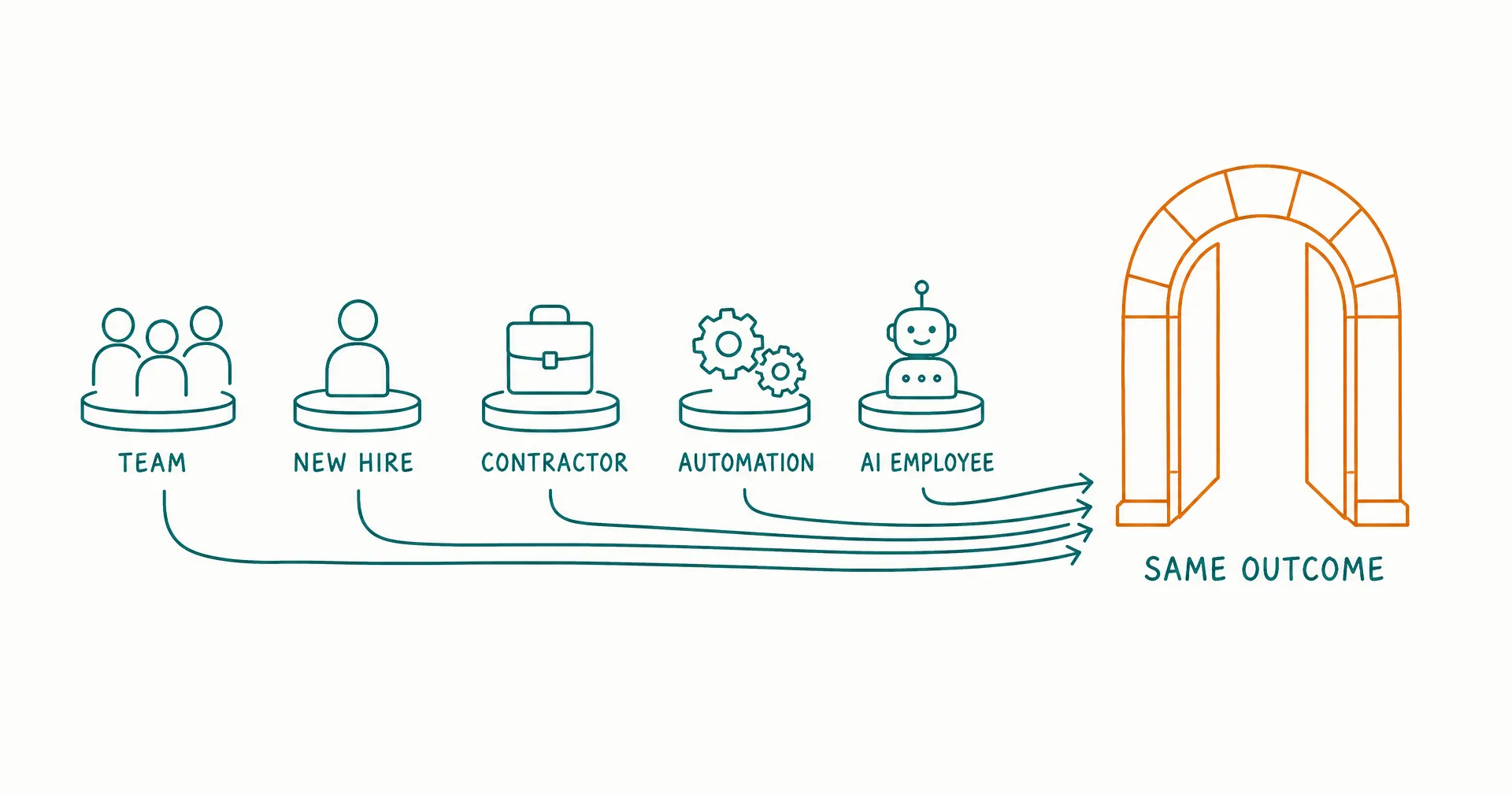
An AI employee is not cheaper than a human employee in the abstract. They are different capacity options with different capabilities, costs, constraints, and responsibilities.
Comparing a software subscription with a salary is not a business case.
A fair comparison starts with one bounded business outcome and asks how 5 feasible options would produce it:
- use available capacity in the existing team;
- hire an employee;
- engage a contractor or managed service;
- build or extend deterministic automation; or
- deploy an AI employee with defined human ownership.
For each option, calculate full cost, accepted outcomes, cycle time, quality, review and correction demand, scalability, continuity, and risk. Then choose the operating model that fits the work.
The goal is not to prove that software replaces a person. The goal is to buy the right mix of judgment, accountability, flexibility, and repeatable capacity.
On this page · 11 sectionsOpen
- What Is a Fair AI Employee vs Human Employee Comparison?
- Is an AI Employee a Legal Employee?
- How Do You Define the Same Work Before Comparing Cost?
- What Does a Human Employee Actually Cost?
- What Does Contractor or Managed-Service Capacity Cost?
- When Is Deterministic Automation the Better Cost Option?
- What Does an AI Employee Actually Cost?
- What Does a Worked Five-Option Comparison Look Like?
- How Do Time, Capacity, and Quality Change the Answer?
- When Should You Choose a Person, AI, Automation, or a Hybrid?
- How Do You Make the Final Capacity Decision?
- An AI employee is a product-category term for a persistent software role, not a claim that software is a legal employee.
- Compare the same accepted business outcomes - not titles, hours online, drafts generated, or the smallest advertised plan.
- Human employee cost includes compensation, recruiting, onboarding, equipment, management, coverage, and productive-capacity assumptions.
- AI employee cost includes platform, usage, setup, integrations, human review, correction, monitoring, and expected failure exposure.
- Contractors, managed services, existing-team capacity, and deterministic automation are often the real alternatives; include them.
- People are the stronger default for ambiguous responsibility, relationships, novel judgment, ethical accountability, and broad exception handling. AI is stronger for bounded, repeatable, observable, tool-supported work that can be reviewed and stopped.
- A hybrid model is frequently the economic answer: people own goals, judgment, approval, and exceptions while AI handles a measurable subset of execution.
§ 01What Is a Fair AI Employee vs Human Employee Comparison?
A fair comparison uses a common unit of useful work.
Examples:
- accepted support resolutions;
- qualified leads that meet a written rule;
- reconciled records;
- approved research briefs;
- complete evidence packets;
- correctly routed exceptions;
- published assets that pass the same review; or
- monitored cases with documented escalation.
Use:
Full cost per accepted outcome = total option cost ÷ accepted outcomes
Then keep consequence beside the average:
| Comparison dimension | Required measure | Why it matters |
|---|---|---|
| Output | Accepted outcomes | Excludes rejected or unnecessary work |
| Quality | First-pass acceptance and defect severity | Prevents volume from hiding weak work |
| Human demand | Review, correction, supervision, exception time | Makes support labor visible |
| Speed | Cycle time and queue age | Shows time-to-result |
| Reliability | Completion, reopen, and recovery | Tests continuity |
| Capability | Case types completed within scope | Prevents false equivalence |
| Authority | Actions allowed without approval | Connects autonomy with risk |
| Cost | Full cost and cost per accepted outcome | Normalizes economics |
| Risk | Incidents and worst-error severity | Preserves tail consequences |
| Flexibility | Ramp, resize, and exit time | Values changing demand |
Compare operating systems, not isolated workers
A person works inside management, policy, systems, team relationships, and organizational context. An AI role works inside prompts/instructions, connected systems, permissions, memory, schedules, evaluations, human review, monitoring, and incident response.
Neither is a standalone line item.
The right comparison is:
Human operating model vs AI-assisted operating model vs other feasible operating models
If the AI option requires a domain reviewer and platform owner, include them. If the human option requires management, software, training, and coverage, include them.
Preserve the next-best alternative
The alternative to AI may not be a new full-time hire. It may be:
- a queue remains slower;
- an existing employee stops lower-value work;
- a contractor handles a project;
- a traditional workflow automates structured steps;
- the business narrows the service; or
- no change is made.
Use the alternative leadership would actually choose if the AI proposal were rejected.
§ 02Is an AI Employee a Legal Employee?
In this article, “AI employee” describes software configured as a persistent role: it can retain role context, receive scheduled or event-driven work, use approved tools, produce artifacts, and operate under human accountability.
It does not mean the software is a person, a payroll employee, or the legal bearer of employment rights and duties.
The practical definition of an AI employee separates the functional product category from human employment status.
Keep people-related classification separate
If a business compares hiring an employee with engaging a human contractor, worker-classification law still applies to the person. A contract label alone does not settle that status.
The IRS’s current employee-versus-independent-contractor guidance discusses behavioral control, financial control, and the relationship of the parties for federal tax purposes. The U.S. Department of Labor’s current FLSA Fact Sheet 13 uses an economic-realities analysis under the FLSA and notes the current rulemaking and enforcement context.
Those are different legal frameworks, and state, local, sector, tax, privacy, discrimination, labor, and contractual rules may also matter. Verify current requirements with qualified advisors for the relevant jurisdiction and arrangement.
Do not use AI language to erase human responsibility
An AI role still needs people or accountable functions for:
- business goals;
- role scope;
- source and data authority;
- access approval;
- quality standards;
- consequential decisions;
- exception ownership;
- incident response;
- vendor and contract management; and
- final organizational accountability.
Calling software an employee does not transfer those obligations to the software.
§ 03How Do You Define the Same Work Before Comparing Cost?
Write a role card that every option must satisfy.
| Role-card field | Example |
|---|---|
| Outcome | Produce a complete evidence packet for an eligible case |
| Eligible volume | 400 cases/month |
| In scope | Approved sources, defined fields, normal cases |
| Out of scope | Legal judgment, policy exception, final external commitment |
| Acceptance | All required fields, linked evidence, correct classification |
| Service level | 90% within 1 business day |
| Escalation | Missing source, conflicting evidence, high-impact exception |
| Authority | Read approved sources; draft and save; no final external action |
| Retention | According to organization policy |
| Owner | Operations lead |
The best-task framework for AI employees helps identify work with recurring value, available inputs, observable quality, bounded action, and a clear escalation path.
Segment the case mix
Do not compare only easy work.
| Case class | Share | Expected treatment |
|---|---|---|
| Standard | 60% | Complete under normal workflow |
| Incomplete input | 15% | Request data or escalate |
| Conflicting evidence | 10% | Flag and route to specialist |
| Novel exception | 10% | Human judgment |
| High-impact | 5% | Mandatory approval |
Each option may cover a different share. Record coverage rather than pretending the capacities are identical.
Coverage rate = eligible cases the option can safely attempt ÷ eligible cases
Accepted-outcome rate = accepted outcomes ÷ eligible cases
An option that costs less but covers only standard cases may still be valuable. It should not be presented as equivalent to a person who owns the whole queue.
Use one acceptance rubric
The human, contractor, automation, and AI-assisted options should face the same outcome rubric. The production process can differ; the required result should not.
Record:
- accepted without correction;
- accepted after correction;
- correctly escalated;
- rejected;
- reopened;
- missed escalation; and
- incidents by severity.
This prevents a polished AI draft from being counted as complete while a human output must survive downstream review.
§ 04What Does a Human Employee Actually Cost?
Human employee cost begins with compensation and extends to the operating environment required for useful work.
Monthly employee cost = compensation + recruiting/onboarding amortization + equipment/software + management + training + coverage + other role-attributed cost
Compensation
Use the organization’s finance-approved loaded cost, not a universal multiplier.
Possible components include:
- wages or salary;
- employer payroll costs;
- health and insurance benefits;
- retirement contributions;
- paid leave;
- supplemental pay;
- legally required benefits;
- bonuses or commissions; and
- other employer-paid benefits.
The U.S. Bureau of Labor Statistics’ current Employer Costs for Employee Compensation reports national aggregate wages and benefit components by broad worker, occupation, and industry groups. It is useful context, not a substitute for the employer’s actual role, location, compensation policy, or benefit plan.
For market wage context, BLS’s May 2025 Occupational Employment and Wage Statistics provides occupation and geography data published in 2026. Use current local data and the specific level required; do not apply a national mean to every hire.
Hiring and ramp
Include:
- recruiting time and fees;
- interviewing;
- background or credential checks;
- onboarding;
- initial training;
- reduced early productivity;
- manager and peer support; and
- vacancy cost while the role is open.
Amortize one-time cost over the decision horizon:
Monthly hiring/ramp cost = one-time hiring and ramp cost ÷ expected months in analysis
Do not assume a person delivers full steady-state capacity on day 1.
Productive capacity
Paid hours and task hours are different.
Use:
Productive role hours = paid hours - leave - meetings - training - administration - unrelated work - expected interruption
This is not a criticism of human work. Meetings, learning, collaboration, mentoring, and organizational participation create value. The calculation identifies how much capacity is available for the bounded task being compared.
Management and coverage
Price:
- goal setting;
- one-to-ones and performance support;
- domain review;
- coordination;
- quality assurance;
- absence coverage;
- schedule coverage;
- turnover risk; and
- knowledge transfer.
Human employees also create value that may not belong in the task-level denominator: mentoring, trust, institutional learning, relationship ownership, improvisation, and cross-functional judgment. Keep that value visible rather than forcing it into a narrow cost-per-task comparison.
§ 05What Does Contractor or Managed-Service Capacity Cost?
A contractor or managed service can provide faster access to specialist or flexible capacity without being software.
Use:
Contractor cost = fees + buyer management + tools + review/correction + transition + classification/compliance administration
| Cost layer | Contractor | Managed service |
|---|---|---|
| Commercial unit | Hour, day, project, retainer | Volume, SLA, team, project |
| Recruiting | Sourcing and selection | Vendor selection |
| Management | Task direction and review | Service governance |
| Tools | Buyer or contractor | Often bundled, verify |
| Coverage | Individual availability risk | Provider staffing model |
| Knowledge | May stay with individual | May stay with provider |
| Flexibility | Often high | Contract-dependent |
| Exit | Notice and handover | Transition and data/export |
| Quality | Individual process | Service acceptance/SLA |
Do not assume the hourly rate is the full cost
Add:
- sourcing/procurement;
- statement-of-work design;
- access and security review;
- buyer-side coordination;
- correction;
- meetings;
- tool reimbursement;
- minimum hours;
- rush/after-hours fees;
- handover; and
- replacement or continuity cost.
Match the relationship to the law
Cost modeling is not worker classification. If the arrangement involves a person, determine status under applicable law and the actual relationship. Do not choose a contractor label simply because it makes the spreadsheet cheaper.
The comparison with a human virtual assistant is covered in the AI employee versus virtual assistant guide, which separates human judgment and relationship work from software-scale execution.
§ 06When Is Deterministic Automation the Better Cost Option?
Traditional workflow automation, scripts, rules, or RPA can be the best option when inputs, decisions, and outputs are stable and testable.
| Work characteristic | Deterministic automation fit | AI employee fit | Human fit |
|---|---|---|---|
| Structured input | Strong | Strong | Strong |
| Fixed decision rules | Strongest | Often unnecessary | Possible |
| Unstructured evidence | Limited without extraction | Stronger with controls | Strong |
| Novel exceptions | Weak | Limited/escalate | Strongest |
| Exact repeatability | Strongest | Variable | Variable |
| Relationship judgment | Weak | Weak | Strongest |
| High-volume stable steps | Strongest | Strong | Cost-dependent |
| Broad changing responsibility | Weak | Weak | Strongest |
Price deterministic automation across its lifecycle
Automation cost = build + infrastructure/licenses + maintenance + monitoring + exception handling + change cost + failure exposure
Include:
- process discovery;
- development/configuration;
- testing;
- integration;
- environment and deployment;
- maintenance;
- rule changes;
- upstream schema changes;
- exception queue;
- support;
- observability; and
- recovery.
The AI employee versus workflow automation comparison helps separate flexible reasoning work from stable rule execution.
Do not use AI where a rule is enough
If the work is “copy value A to field B when condition C is true,” a deterministic workflow may be cheaper, more predictable, easier to test, and easier to audit.
AI is useful when the bounded process needs interpretation across variable language, evidence, or cases. Even then, deterministic controls can govern identity, validation, routing, permissions, state transitions, and stop conditions around it.
§ 07What Does an AI Employee Actually Cost?
Use the full 7-layer AI employee cost model:
- platform;
- variable usage;
- setup and role design;
- integrations and data;
- human review;
- correction and rework; and
- monitoring plus failure exposure.
Vendor cost
The vendor may charge for subscription, seats, credits, tokens, tasks, runs, actions, conversations, or outcomes. The AI employee pricing-model guide normalizes those units to one workload.
Do not count the entry price as the role cost.
Setup and integration
Include:
- process and task mapping;
- role description;
- context and source hierarchy;
- acceptance rubric;
- evaluation cases;
- instruction design;
- tool configuration;
- identity and access;
- data preparation;
- integration;
- sandbox and tests;
- escalation;
- training for owners/reviewers; and
- launch/rollback.
Human operating cost
AI does not make domain, review, security, platform, and exception work disappear.
Use:
Review cost = reviewed items × review minutes ÷ 60 × loaded reviewer rate
Correction cost = corrected items × correction minutes ÷ 60 × loaded corrector rate
Add monitoring, change approval, access review, incident response, and vendor management.
Failure exposure
Use:
Expected failure cost = event probability × financial impact
Keep severe residual risk beside the expected average. A low-probability incident can still make the option unacceptable.
The AI option is strongest when tasks are bounded, results are observable, tools are limited, evidence is retained, people own consequential judgment, and the role can be paused or revoked.
§ 08What Does a Worked Five-Option Comparison Look Like?
Consider an illustrative evidence-packet workflow with 400 eligible cases per month. The business values a packet only when it passes the common rubric. The figures below are fictional and do not represent CellCog performance or universal labor cost.
Common operating requirement
| Requirement | Value |
|---|---|
| Eligible cases | 400/month |
| Standard + incomplete-input cases | 75% |
| Conflict, novel, or high-impact cases | 25% |
| Acceptance requirement | Complete fields, linked evidence, correct classification |
| Service target | 90% within 1 business day |
| Human-owned decisions | Exceptions and final consequential action |
Monthly cost by option
| Cost layer | Existing team | New employee | Contractor | Deterministic automation | AI employee |
|---|---|---|---|---|---|
| Direct capacity/platform | $8,500 | $7,500 | $7,800 | $2,500 | $1,200 |
| Benefits/fees/usage | $0 | $2,500 | $500 | $400 | $0 |
| Setup/ramp amortization | $300 | $1,000 | $300 | $2,500 | $1,500 |
| Management/integration | $700 | $750 | $700 | $900 | $1,000 |
| Review and correction | $500 | $300 | $800 | $800 | $3,300 |
| Monitoring/coverage | $300 | $250 | $300 | $500 | $400 |
| Expected failure cost | $200 | $200 | $300 | $400 | $400 |
| Full monthly cost | $10,500 | $12,500 | $10,700 | $8,000 | $7,800 |
The existing-team amount represents opportunity cost for capacity moved from other valuable work, not necessarily added payroll.
Output and unit economics
| Measure | Existing team | New employee | Contractor | Deterministic automation | AI employee |
|---|---|---|---|---|---|
| Cases attempted | 360 | 400 | 360 | 300 | 380 |
| Accepted without correction | 300 | 340 | 285 | 270 | 295 |
| Accepted after correction | 30 | 30 | 30 | 10 | 55 |
| Correctly escalated | 25 | 25 | 35 | 20 | 25 |
| Rejected/reopened | 5 | 5 | 10 | 0 | 5 |
| Accepted outcomes | 355 | 395 | 350 | 300 | 375 |
| Full cost/accepted outcome | $29.58 | $31.65 | $30.57 | $26.67 | $20.80 |
In this example, the AI-assisted model has the lowest cost per accepted outcome. That does not establish it as the best option.
The deterministic workflow attempts fewer cases because novel evidence is out of scope. The new employee covers the broadest queue and may create relationship, learning, and exception value outside the packet metric. The existing team has a lower cash-change requirement but sacrifices other work. The contractor can be flexible but depends on continuity and service terms. The AI model needs the most explicit review/correction labor.
Capability and risk view
| Dimension | Existing team | New employee | Contractor | Deterministic automation | AI employee |
|---|---|---|---|---|---|
| Novel judgment | Strong | Strong | Depends on specialist | Weak | Escalate |
| Relationship continuity | Strong | Builds over time | Contract-dependent | None | None |
| Structured volume | Moderate | Moderate | Moderate | Strongest | Strong |
| Rapid scaling | Limited | Slow | Moderate | Strong after build | Strong within capacity |
| Exact repeatability | Moderate | Moderate | Moderate | Strongest | Variable |
| Explainable ownership | Manager | Manager | Buyer + provider | System owner | Human role owner |
| Main failure risk | Overload | Ramp/turnover | Availability/quality | Rule brittleness | Variable output/action |
The decision needs both tables.
Show the arithmetic for every option
The monthly table should be reproducible.
Existing team. Assume 170 hours are moved from other work and finance values that productive capacity at $50/hour:
Opportunity cost = 170 × $50 = $8,500
Add $300 of workflow setup amortization, $700 of management, $500 of incremental review/correction, $300 of coverage, and $200 of expected failure cost:
$8,500 + $300 + $700 + $500 + $300 + $200 = $10,500
This is an economic view. If no payroll changes, the cash-change view may be only the incremental $2,000. Show both. The decision still needs to identify which existing work loses the 170 hours.
New employee. Assume $7,500 monthly salary plus $2,500 in employer-paid taxes and benefits under the company’s own finance convention. Add $1,000 of recruiting/onboarding amortization, $750 of management and tools, $300 of review/correction, $250 of coverage, and $200 of expected failure:
$7,500 + $2,500 + $1,000 + $750 + $300 + $250 + $200 = $12,500
This is not a national salary estimate. Replace every input with the role, level, geography, benefit plan, and recruiting conditions that apply.
Contractor. Assume 120 billable hours at $65/hour:
120 × $65 = $7,800
Add $500 of tools or fees, $300 of onboarding amortization, $700 of buyer management, $800 of review/correction, $300 of coverage/transition reserve, and $300 of expected failure:
$7,800 + $500 + $300 + $700 + $800 + $300 + $300 = $10,700
If the provider quotes a fixed project fee, retain the implied hours only as a reasonableness check; use the contract amount in cash flow.
Deterministic automation. Assume a $60,000 build is amortized across 24 useful months:
$60,000 ÷ 24 = $2,500/month
Add $2,500 of direct automation capacity and licenses, $400 of infrastructure, $900 of integration/maintenance, $800 of exception review, $500 of monitoring, and $400 of expected failure:
$2,500 + $400 + $2,500 + $900 + $800 + $500 + $400 = $8,000
The first $2,500 is the example’s “direct capacity/platform” line; the second is build amortization. Label those separately so the repeated amount is not mistaken for double counting.
AI employee. Assume $1,200 in attributed platform and usage, $1,500 in setup amortization, $1,000 in integration and administration, $3,300 in review/correction, $400 in monitoring, and $400 in expected failure:
$1,200 + $1,500 + $1,000 + $3,300 + $400 + $400 = $7,800
The human operating component is 42.3% of this illustrative full cost:
$3,300 ÷ $7,800 = 42.3%
That is why removing review from an AI-versus-person comparison can reverse the decision.
Separate cash flow from amortized economics
Amortization supports a comparable monthly view. It does not describe when cash leaves the business.
| Option | Upfront month-0 cash | Steady monthly cash | 12-month illustrative cash | Main timing issue |
|---|---|---|---|---|
| Existing team | $2,000 | $2,000 | $26,000 | Opportunity cost sits outside cash column |
| New employee | $12,000 | $11,500 | $150,000 | Recruiting and ramp precede full capacity |
| Contractor | $4,000 | $10,400 | $128,800 | Deposit, minimum, or notice may apply |
| Deterministic automation | $60,000 | $5,500 | $126,000 | Build cash precedes production value |
| AI employee | $12,000 | $6,300 | $87,600 | Setup and pilot precede scaled authority |
The figures are fictional. They also use simplified month-0 plus 12-month arithmetic and do not include discounting, taxes, financing, or terminal value.
For a decision, produce 2 outputs:
- Economic view: fully allocated cost per accepted outcome.
- Cash view: month-by-month payments and internal cash expenses.
An existing-team option can appear cheap in cash but expensive in opportunity. A build can appear expensive in month 0 but competitive over a stable multi-year process. An annual software commitment can have a different cash profile from monthly expense.
Calculate year-one accepted-output cost
Steady-state output may not begin in month 1. Assume these illustrative ramp profiles:
| Option | Month 1 accepted | Month 2 | Month 3 | Months 4-12 each | Year-1 accepted outcomes |
|---|---|---|---|---|---|
| Existing team | 280 | 330 | 355 | 355 | 4,160 |
| New employee | 120 | 240 | 320 | 395 | 4,235 |
| Contractor | 250 | 320 | 350 | 350 | 4,070 |
| Deterministic automation | 0 | 80 | 220 | 300 | 3,000 |
| AI employee | 180 | 300 | 350 | 375 | 4,205 |
Then:
Year-1 cash cost per accepted outcome = year-1 cash ÷ year-1 accepted outcomes
| Option | Year-1 illustrative cash | Year-1 accepted outcomes | Cash cost per accepted outcome |
|---|---|---|---|
| Existing team | $26,000 | 4,160 | $6.25 plus opportunity cost |
| New employee | $150,000 | 4,235 | $35.42 |
| Contractor | $128,800 | 4,070 | $31.65 |
| Deterministic automation | $126,000 | 3,000 | $42.00 |
| AI employee | $87,600 | 4,205 | $20.83 |
The existing-team cash number is not comparable until the $102,000 annualized opportunity value in this example is recognized:
$8,500 × 12 = $102,000
Adding it creates an economic cost of $128,000 and an economic cost per accepted outcome of:
$128,000 ÷ 4,160 = $30.77
This illustrates why the selected cost convention must remain visible.
Test break-even thresholds
The cheapest steady-state option can change when review, volume, or useful life changes.
For the AI option versus the $8,000 deterministic option:
AI cost headroom = $8,000 - $7,800 = $200/month
At a $50 loaded reviewer rate, only 4 additional hours of monthly review consume that headroom:
$200 ÷ $50 = 4 hours
For deterministic automation, a shorter useful life changes build amortization:
| Useful life | $60,000 build amortization/month | Total monthly automation cost |
|---|---|---|
| 36 months | $1,666.67 | $7,166.67 |
| 24 months | $2,500.00 | $8,000.00 |
| 18 months | $3,333.33 | $8,833.33 |
| 12 months | $5,000.00 | $10,500.00 |
For the new employee, accepted-outcome cost changes with usable role capacity:
| Monthly accepted outcomes | Monthly cost | Cost per accepted outcome |
|---|---|---|
| 250 | $12,500 | $50.00 |
| 300 | $12,500 | $41.67 |
| 350 | $12,500 | $35.71 |
| 395 | $12,500 | $31.65 |
| 450 | $12,500 | $27.78 |
This table does not value work beyond the measured packet process. If the employee produces material value outside that task, include it separately or do not use a single-task cost to judge the entire role.
Run sensitivity before ranking
At minimum, vary:
- accepted outcomes by -20%, -10%, +10%, and +20%;
- review and correction hours by +25%, +50%, and +100%;
- AI usage by +25%, +50%, and +100%;
- employee ramp by 1, 2, and 3 additional months;
- contractor rate and billable hours by +10% and +25%;
- automation useful life at 12, 18, 24, and 36 months; and
- failure exposure at 0.5x, 1x, 2x, and 5x the base estimate.
Rank the options only after the decision-maker can see which assumption changes the winner.
§ 09How Do Time, Capacity, and Quality Change the Answer?
Cost per month is not enough. Model ramp, throughput, utilization, and quality.
Time to usable capacity
| Option | Typical work before useful capacity |
|---|---|
| Existing team | Reprioritize, train, and protect time |
| New employee | Recruit, hire, onboard, learn context |
| Contractor | Source, contract, onboard, grant access |
| Automation | Design, build, integrate, test, deploy |
| AI employee | Configure role, sources, tools, controls, evaluate, pilot |
Do not use generic time claims. Estimate the actual organization’s path, dependencies, and approval steps.
Capacity elasticity
Ask:
- Can the option handle 50% more volume next month?
- What cost changes first?
- Does quality fall under peak load?
- Does work queue, stop, or spill into overage?
- Who handles exceptions?
- Can capacity shrink without stranded cost?
Software capacity can scale faster than hiring, but usage, rate limits, human review, tool throughput, data quality, and risk controls can become bottlenecks.
Quality-adjusted capacity
Use:
Quality-adjusted capacity = attempted cases × final acceptance rate
Do not report:
Capacity = paid hours or capacity = generated outputs
Two options that attempt 400 cases can create different accepted capacity if one causes more corrections, reopens, or severe errors.
Value outside the metric
People may create:
- trust;
- negotiation;
- empathy;
- leadership;
- mentoring;
- culture;
- cross-functional coordination;
- new problem discovery;
- ethical judgment; and
- accountable exception decisions.
An AI role may create:
- continuous scheduled coverage;
- consistent template use;
- fast retrieval and synthesis;
- low marginal replication;
- rapid iteration;
- parallel draft capacity; and
- detailed machine-captured activity.
Record strategic value separately. Do not invent a dollar value merely to force a preferred answer.
§ 10When Should You Choose a Person, AI, Automation, or a Hybrid?
Use task characteristics, not enthusiasm.
| Work pattern | Strong default |
|---|---|
| Broad, changing responsibility with accountable judgment | Human employee |
| Time-bounded specialist work | Qualified contractor/service |
| Stable rules and structured data at high volume | Deterministic automation |
| Bounded recurring work with variable language/evidence | AI-assisted role |
| High-impact decision or relationship | Human owner with AI support |
| Mixed queue with routine work and novel exceptions | Hybrid |
Choose a human employee when
- the role owns broad outcomes;
- responsibility changes frequently;
- relationships and trust are central;
- novel exceptions dominate;
- ethical or organizational judgment is core;
- mentoring and team participation matter;
- the work requires legal or professional responsibility; or
- the business needs an accountable person to integrate several ambiguous functions.
Choose a contractor or service when
- expertise is temporary or specialized;
- the deliverable is project-bounded;
- demand is uncertain;
- speed matters more than internal capability building;
- the provider has credible coverage; and
- the contract, classification, access, data, and transition fit.
Choose deterministic automation when
- rules are explicit;
- inputs are structured;
- exact repeatability matters;
- exceptions are narrow;
- high volume justifies build and maintenance; and
- the process changes slowly enough to maintain.
Choose an AI-assisted role when
- work recurs;
- the task can be bounded;
- required context can be supplied;
- output quality is observable;
- tools and permissions can be limited;
- errors are reversible or controlled;
- human review and escalation are available; and
- accepted outcomes justify the full cost.
Choose a hybrid when
Different task classes need different strengths.
Example:
| Workflow stage | Owner |
|---|---|
| Ingest and classify normal cases | Automation/AI |
| Retrieve and assemble evidence | AI |
| Validate required fields | Deterministic rule |
| Review high-impact packet | Person |
| Decide exception | Qualified person |
| Monitor queue and spend | System + human owner |
| Improve rubric and sources | Human owner |
The hybrid is not a compromise by default. It can be the designed operating model.
§ 11How Do You Make the Final Capacity Decision?
Run a bounded comparison before making a broad labor claim.
The U.S. Government Accountability Office’s Cost Estimating and Assessment Guide is written for program estimates, but its core disciplines apply here: define purpose and scope, document the technical baseline and assumptions, collect data, analyze sensitivity and risk, present the estimate, and update it with actual cost.
Build the cost sheet
For each option, record:
- one-time cash cost;
- recurring cash cost;
- internal labor;
- opportunity cost;
- accepted outcomes;
- first-pass quality;
- review/correction;
- cycle time;
- coverage;
- severe failure exposure;
- ramp time;
- expansion cost;
- contraction/exit cost; and
- evidence confidence.
Build low, base, and high cases
| Assumption | Low case | Base case | High case |
|---|---|---|---|
| Eligible volume | Lower | Expected | Peak |
| Case complexity | Favorable | Representative | Adverse |
| Acceptance | Lower | Observed | Better after evidence |
| Review/correction | Higher | Observed | Lower after gate |
| Human ramp | Slower | Expected | Faster |
| AI usage/retries | Higher | Observed | Optimized |
| Contractor availability | Constrained | Quoted | Available |
| Automation change rate | Frequent | Expected | Stable |
Do not make every high case favorable. “High” should mean high demand; operating results may become worse under pressure.
Run a pilot
The AI employee pilot guide provides the baseline, representative case pack, shadow mode, staged authority, evidence, and go/revise/stop decision.
For economic approval, require:
- a common acceptance rubric;
- representative easy and hard cases;
- recorded human time;
- actual platform usage;
- cost per accepted outcome;
- worst-error severity;
- workload and quality sensitivity;
- a named operating owner; and
- an exit path.
Apply the ROI gate
Use the AI employee ROI model to distinguish cash reduction, realized capacity, throughput, quality, margin, and risk reduction.
Time released is not automatically cash saved. A new hire avoided is not automatically a benefit if the organization would not have hired. Revenue is not gross contribution. Apply explicit realization and attribution factors.
Decision checklist
- We compare the same accepted outcome.
- We include existing-team, hire, contractor/service, automation, AI, and hybrid options where feasible.
- The role’s broad responsibilities are separated from the bounded task.
- Employee cost uses actual finance conventions.
- Contractor classification and terms receive qualified review.
- AI cost includes review, correction, operations, and failure exposure.
- Deterministic automation is considered where rules are sufficient.
- Quality and severe failure remain beside averages.
- Low, base, and high cases are coherent.
- The final decision names what people continue to own.
If the conclusion changes when one hidden cost is added, the comparison is fragile. If it remains sound across realistic scenarios and the capability boundary is explicit, it is ready for a decision.
Compare tasks before titles. Preserve human accountability, price every operating layer, and select the smallest capacity model that produces accepted work safely and reliably.
Q1Is an AI employee cheaper than hiring a human employee?
It can be cheaper for a bounded, recurring, observable subset of work. It is not a like-for-like replacement for broad human responsibility, relationships, judgment, or accountability. Compare full cost per accepted outcome and the capability each option covers.
Q2Should I compare an AI subscription with salary?
No. Add employee benefits, hiring, ramp, tools, management, and coverage to the human option. Add usage, setup, integration, review, correction, monitoring, and failure exposure to the AI option. Then compare the same outcome.
Q3Can an AI employee replace a full-time job?
Treat replacement as a task-and-operating-model question, not a title claim. Many roles combine routine production, relationships, judgment, exceptions, coordination, and accountability. AI may handle some tasks while people retain others.
Q4Is a contractor always cheaper than an employee?
No. Contractor economics depend on rate, volume, buyer management, tools, review, continuity, access, classification, and transition. A higher hourly rate can still be efficient for temporary expertise; a lower apparent rate can become expensive when coordination and correction rise.
Q5When is workflow automation better than an AI employee?
Use deterministic automation when rules, inputs, and outputs are stable and exact repeatability matters. Use AI-assisted execution when bounded work needs interpretation across variable language or evidence, with controls and escalation around it.
Q6What is the best metric for the comparison?
Use full cost per accepted outcome alongside coverage, cycle time, first-pass acceptance, review/correction hours, reliability, and worst-error severity. No single cost number captures broad capability or risk.