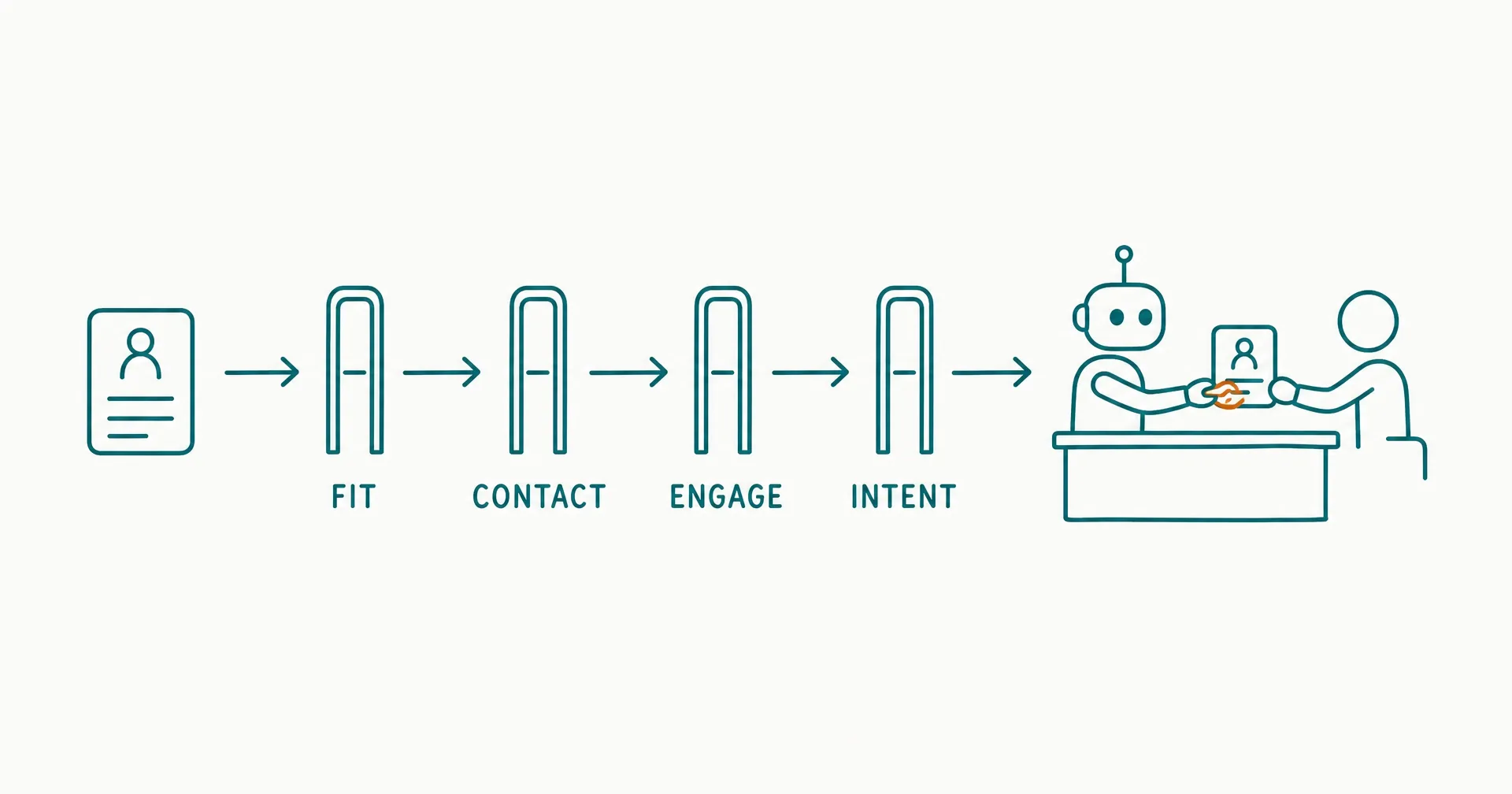
An AI SDR should not send a lead to a human merely because someone opened an email, matched a title, or received enough points.
A useful handoff says:
- which account and person were evaluated;
- why they fit the accepted market and role criteria;
- which evidence is current and attributable;
- what the person actually did or said;
- which need, timing, or decision signal is present;
- which exclusions were checked;
- which contact restrictions apply;
- what the AI SDR promised;
- what remains unknown;
- what the human seller should do next;
- who owns the record now; and
- how sales will accept, reject, or return it.
The handoff is therefore an acceptance contract between prospecting and sales - not a notification.
The operating pattern is:
Eligible account > verified contact > permitted engagement > observed intent > exclusion check > sales-ready decision > context packet > human acceptance > next action > disposition feedback
On this page · 11 sectionsOpen
- What Is an AI SDR-to-Human Handoff?
- What Should “Sales-Ready” Mean?
- What Evidence Should the AI SDR Use?
- How Should Fit, Engagement, and Intent Be Evaluated?
- Which Exclusions and Contact Rules Must Block a Handoff?
- What Must Be in the Human Handoff Packet?
- How Should Sales Accept or Reject a Handoff?
- Where Should Humans Intervene?
- What Should You Measure?
- What Does a Complete Handoff Look Like?
- How Do You Pilot and Scale the Handoff?
- Define sales-ready as evidence, conditions, exclusions, and an accepted next action - not a score alone.
- Keep account fit, contact fit, engagement, and buying intent separate. One cannot silently substitute for another.
- Treat channel permission, suppression, identity, privacy, and regional rules as hard gates set by qualified owners.
- Give the human seller a compact packet with source links, exact prospect language, interaction history, unknowns, promises, and a recommended next step.
- Require sales to accept, reject, or return every handoff with a reason so the AI SDR can be evaluated against downstream reality.
- Measure accepted-handoff yield, seller response time, rejection reasons, meeting quality, correction demand, escalation, cost, and severe incidents together.
- Begin in observation or draft mode. Expand only after representative cases show reliable qualification, routing, suppression, and record ownership.
§ 01What Is an AI SDR-to-Human Handoff?
An AI SDR-to-human handoff is a controlled transfer of a qualified prospect record, current conversation state, and next-action ownership to a named human seller.
It can happen after:
- a prospect asks for a conversation;
- a qualified account replies with a relevant problem;
- an inbound visitor requests evaluation;
- a buying committee member engages with a high-intent asset;
- a target account reaches an accepted combination of fit and intent;
- a prospect asks a question beyond the AI SDR’s authority;
- pricing, security, procurement, legal, or contractual detail appears;
- a complaint, opt-out, correction, or sensitive issue requires a person; or
- policy requires a person before any further contact.
The transfer is complete only when the receiving seller can understand the opportunity, decide whether to accept it, and take the correct next action without reconstructing the entire history.
Notification versus accepted handoff
| Dimension | Notification | Accepted handoff |
|---|---|---|
| Trigger | Score or isolated event | Fit, intent, evidence, and policy conditions |
| Record | Link to CRM object | Versioned packet with sources and unknowns |
| Owner | Ambiguous | Named sending and receiving owner |
| Prospect language | Often summarized loosely | Exact relevant wording preserved |
| Next action | “Follow up” | Specific action, channel, purpose, and deadline |
| Restrictions | Easy to omit | Suppression and permission state included |
| Receipt | Message delivered | Seller accepts, rejects, or returns |
| Learning | Open and reply counts | Disposition tied to original decision |
The AI employee examples guide shows the bounded AI SDR role. This article owns the complete sales-readiness and transfer mechanism.
Accepted outcome
One accepted handoff:
- references one canonical account and contact record;
- passes identity, eligibility, and suppression checks;
- satisfies the current sales-ready contract;
- distinguishes observed evidence from inference;
- contains the minimum context packet;
- preserves every material promise and objection;
- assigns a human owner and response deadline;
- receives an explicit sales disposition; and
- returns that disposition to the qualification system.
“Lead sent” is an intermediate event.
§ 02What Should “Sales-Ready” Mean?
Sales-ready should mean that a human conversation is the appropriate next step and that enough evidence exists for the seller to conduct it well.
It should not mean:
- the person resembles a past buyer;
- the company appears on a target list;
- the contact opened or clicked;
- the contact downloaded one asset;
- the account accumulated points;
- a model predicts a high probability;
- the AI SDR exhausted its sequence;
- the queue needs more records; or
- marketing wants credit for a handoff.
Sales-ready contract
| Field | Required definition |
|---|---|
| Account fit | Industries, sizes, regions, systems, or situations accepted |
| Contact fit | Roles, responsibilities, influence, and identity evidence |
| Need | Problem or objective that the product can credibly address |
| Intent | Behavior or language that justifies a human conversation |
| Timing | Known event, window, urgency, or explicitly unknown status |
| Authority | Decision role, evaluator role, champion potential, or unknown |
| Evidence | Accepted sources, recency, and confidence rules |
| Exclusions | Customers, competitors, students, vendors, job seekers, bad fit |
| Contact policy | Permitted channels, consent/suppression, frequency, region |
| Stop rules | Opt-out, complaint, identity conflict, sensitive request, risk |
| Required packet | Fields and source links the seller needs |
| Acceptance | Seller disposition and response deadline |
| Owner | Business owner for definitions and exceptions |
| Version | Effective date and affected records |
Four gates, not one label
| Gate | Question | Example evidence |
|---|---|---|
| Account fit | Is this organization within the accepted market? | Company site, trusted database, CRM history |
| Contact fit | Is this the right person or a useful route? | Verified role, responsibility, prospect confirmation |
| Engagement | Did this person or account interact? | Reply, form, event, conversation, product action |
| Buying intent | Does the interaction justify sales time now? | Stated problem, evaluation, timing, stakeholder request |
A strong account fit with no intent can remain in research or nurture. Strong engagement from an excluded account should not become a handoff. Clear buying intent from a person whose identity is uncertain should pause for verification.
HubSpot’s current lifecycle-stage documentation distinguishes stages such as lead, marketing-qualified lead, sales-qualified lead, opportunity, and customer, and permits customization. Those labels are useful record states. The buyer still needs an operational contract for how its own records enter, leave, and move between them.
The best-tasks guide helps determine which research, classification, drafting, and routing steps are suitable for an AI employee and which decisions should remain human-led.
§ 03What Evidence Should the AI SDR Use?
Use a source hierarchy and field-level provenance.
Account evidence
Possible account evidence includes:
- official company website;
- official filings or registries;
- current product, location, or hiring pages;
- approved data provider;
- CRM history;
- existing customer or partner records;
- direct prospect confirmation; and
- qualified human correction.
Contact evidence
Possible contact evidence includes:
- company-published leadership or team page;
- direct business contact information supplied by the person;
- approved professional directory;
- CRM record with source and timestamp;
- event registration;
- inbound form;
- email signature;
- direct confirmation of role; and
- qualified human correction.
Evidence record
| Field | Example |
|---|---|
| Evidence ID | EV-2048 |
| Object | Account AC-771 |
| Attribute | Current operating region |
| Value | United States and Canada |
| Source | Official locations page |
| Retrieved | July 29, 2026 |
| Effective date | Current page, exact start unknown |
| Confidence | High for published locations |
| Limitation | Does not prove where the buying team sits |
| Status | Accepted |
| Owner | Revenue operations |
Do not collapse all evidence into a confidence percentage. A seller needs to know what is verified, what is inferred, what is stale, and what is unknown.
Separate fact, observation, and inference
| Type | Example | Permitted use |
|---|---|---|
| Verified fact | Company states it operates 14 locations | Use with source and date |
| Prospect statement | “We are reviewing this in Q4” | Preserve exact language and context |
| Observed behavior | Attended one product webinar | Use as engagement evidence |
| Inference | May be replacing an incumbent | Label as hypothesis |
| Prediction | Model estimates high meeting likelihood | Use only under approved policy |
| Unknown | Budget owner not identified | Preserve as unknown |
The human seller should never receive an inference written as prospect-confirmed fact.
Recency rules
| Attribute | Example freshness rule |
|---|---|
| Company status | Recheck before handoff |
| Employee role | Recheck after 30 days or contradictory reply |
| Contact channel | Validate at authorized send time |
| Product use | Read current approved event |
| Prior opportunity | Reconcile before creating a new one |
| Suppression | Check immediately before every contact |
| Prospect statement | Preserve timestamp and conversation |
The exact periods are buyer-defined examples. High-change attributes need event-driven review, not a single annual refresh.
NIST describes its Privacy Framework as a voluntary tool for identifying and managing privacy risk. That organization-level framework can help owners connect prospect-data collection, use, communication, protection, retention, and correction to enterprise privacy decisions. Qualified privacy and legal owners must set the applicable rules.
§ 04How Should Fit, Engagement, and Intent Be Evaluated?
Use rules that a reviewer can reconstruct.
Account-fit rubric
| Dimension | 0 | 1 | 2 |
|---|---|---|---|
| Industry/situation | Excluded | Adjacent | Explicitly accepted |
| Scale | Outside boundary | Uncertain | Within accepted range |
| Region | Unsupported | Needs review | Supported |
| Problem exposure | No credible link | Possible | Evidence present |
| Technical environment | Incompatible | Unknown | Compatible or irrelevant |
| Existing relationship | Conflict | Needs reconciliation | Clear |
A total is not enough. Set mandatory zeros. For example, an unsupported region or active customer conflict can block a new-business handoff even when the total is 10.
Contact-fit rubric
| Dimension | 0 | 1 | 2 |
|---|---|---|---|
| Identity | Conflicting | Partly verified | Verified |
| Current role | Stale/incorrect | Uncertain | Current |
| Responsibility | Unrelated | Adjacent | Owns or influences problem |
| Reachability | Suppressed/invalid | Uncertain | Permitted and valid |
| Buying role | No connection | Possible route | Evaluator/champion/decision role |
Engagement hierarchy
| Signal | What it proves | What it does not prove |
|---|---|---|
| Delivered message | Technical delivery | Attention or interest |
| Open | Possible display | Intent, need, or authority |
| Click | Link interaction | Buying project |
| Download | Asset access | Sales readiness |
| Event attendance | Participation | Active evaluation |
| Reply | Direct engagement | Fit or urgency |
| Specific question | Relevant interest | Budget or authority |
| Meeting request | Conversation intent | Qualified opportunity |
| Procurement/security request | Active evaluation signal | Commercial approval |
Some email clients and security systems can generate or distort engagement events. Treat them as supporting observations, not direct proof of a buying decision.
Intent classes
| Class | Example | Default route |
|---|---|---|
| Educational | “Send the guide” | Provide approved resource or nurture |
| Exploratory | “How does this work?” | Answer within authority; observe |
| Problem-aware | “Our team loses requests between shifts” | Qualify problem and ownership |
| Evaluation | “We are comparing options this quarter” | Prepare handoff if fit passes |
| Transactional | “Please share pricing and security review steps” | Human sales handoff |
| Support/customer | “Our current account cannot access a task” | Support route, not new-sales handoff |
| Negative | “Stop contacting me” | Suppress and confirm per policy |
Do not reward the AI SDR for moving every engaged person toward sales. Correct nurture, support, suppression, and disqualification are accepted outcomes too.
§ 05Which Exclusions and Contact Rules Must Block a Handoff?
Exclusions are first-class decisions.
Common exclusion classes
- existing customer needing support or expansion ownership;
- open opportunity owned by another seller;
- partner, vendor, investor, analyst, or press inquiry;
- competitor or conflict account;
- job seeker or recruiter;
- student or academic research request;
- consumer inquiry routed to a business-sales process;
- unsupported region or product requirement;
- known bad data or identity conflict;
- suppressed contact or account;
- complaint or legal request;
- security report;
- vulnerable or sensitive situation;
- abusive or threatening interaction requiring safety policy; and
- test, seed, employee, or system-generated record.
Exclusion routing
| Exclusion | Action | Owner |
|---|---|---|
| Existing customer support need | Route to support with context | Support owner |
| Existing opportunity | Attach evidence; notify current owner | Account owner |
| Partner inquiry | Route to partnerships | Partnership owner |
| Job seeker | Route to careers or close | Recruiting owner |
| Press request | Stop sales sequence; route to communications | Communications |
| Security report | Stop outreach; route through security channel | Security |
| Opt-out | Suppress under current policy | Marketing/revenue operations |
| Identity conflict | Pause and verify | Data owner |
| Unsupported region | Disqualify or qualified review | Sales operations |
The AI SDR should not improvise around a block merely because the record otherwise looks valuable.
Channel policy registry
| Field | Required value |
|---|---|
| Channel | Email, phone, text, social, form response |
| Region | Applicable geographic scope |
| Message class | Commercial, transactional, support, other |
| Permitted basis | Buyer-approved rule |
| Required disclosure | Exact approved elements |
| Suppression source | Canonical list/system |
| Frequency | Maximum and cooling period |
| Quiet hours | Time-zone rule |
| Identity | Approved sender/account |
| Recording | Permission and notice rule |
| Owner | Qualified policy owner |
| Effective version | Date and change record |
The Federal Trade Commission’s CAN-SPAM compliance guide explains requirements for U.S. commercial email, including accurate routing information and subject lines, identification and postal-address requirements, opt-out mechanisms, timely honoring of opt-outs, and monitoring work performed by others. It also states that business-to-business email is not categorically exempt. The exact legal treatment depends on the message and jurisdiction; qualified counsel should define policy.
The Federal Communications Commission provides current information about unwanted calls and texts and related enforcement. Calling and texting rules can differ by technology, message, consent, number, and jurisdiction. The workflow should read an approved channel-policy registry instead of generating its own legal conclusion.
Hard-stop sequence
Before any handoff or additional contact:
- resolve canonical person and account;
- check global and channel suppression;
- check customer, opportunity, and ownership conflicts;
- check region and approved channel;
- check identity and sender authorization;
- check frequency and quiet-hour policy;
- inspect complaints, corrections, and sensitive routes;
- record the policy version;
- proceed, pause, reroute, or stop; and
- verify the resulting record state.
The permissions-and-approvals guide shows how to separate technical ability from business authority.
§ 06What Must Be in the Human Handoff Packet?
The packet should be short enough to scan and complete enough to act on.
Minimum handoff packet
| Object | Required content |
|---|---|
| Handoff ID | Unique ID and creation time |
| Account | Canonical ID, name, site, owner |
| Contact | Canonical ID, name, role, verified channel |
| Fit | Passed criteria, failed criteria, unresolved items |
| Engagement | Material interactions with dates and sources |
| Intent | Exact relevant prospect language and interpretation |
| Need | Problem, desired outcome, current process |
| Timing | Known event/window or explicit unknown |
| Stakeholders | Known roles, relationships, and missing people |
| Restrictions | Suppression, channel, region, promise, sensitivity |
| History | Prior opportunity, customer, support, and seller context |
| Promises | Every commitment made to the prospect |
| Questions | What the prospect expects answered |
| Unknowns | Budget, authority, scope, timing, or technical gaps |
| Recommendation | Next action, purpose, channel, and deadline |
| Evidence | Source links and timestamps |
| Ownership | Sender, receiver, queue, response deadline |
| Contract version | Sales-ready rule used |
Preserve exact prospect language
Weak:
Interested in automation. Follow up soon.
Useful:
On July 29, the prospect wrote, “We have 4 regional teams copying request data into a shared sheet. We want to decide before our October planning cycle whether one queue can replace it.” They asked for a 30-minute workflow review and named the operations director as the process owner. Budget and security-review timing remain unknown.
The useful version separates:
- exact language;
- observed operating problem;
- time window;
- requested action;
- known stakeholder; and
- unknowns.
Promise ledger
| Promise | Made by | Due | Status | Owner |
|---|---|---|---|---|
| Send security overview | AI SDR within approved response | July 30 | Attached | SDR owner |
| Introduce account executive | AI SDR | July 30 | Handoff open | Revenue operations |
| Review workflow live | Human seller | August 1 | Not accepted | Assigned seller |
| Answer retention question | No promise yet | None | Open question | Security/product |
The AI SDR must not invent a price, discount, product capability, security answer, implementation date, or contractual commitment to make the packet feel complete.
Recommended next action
A good recommendation defines:
- who should act;
- what action to take;
- which channel to use;
- why it is appropriate;
- what to say or ask;
- which materials to include;
- which promise or deadline applies;
- what requires approval; and
- what success or failure looks like.
The AI agent handoff-protocol guide provides the broader task, state, evidence, authority, and acceptance objects that should travel between workers.
§ 07How Should Sales Accept or Reject a Handoff?
Sales feedback must be a state transition, not a message in a private channel.
Handoff states
Proposed > policy checked > ready > assigned > accepted/returned/rejected > actioned > dispositioned > closed/reopened
| State | Meaning | Owner |
|---|---|---|
| Proposed | Fit or intent may qualify | AI SDR |
| Policy checked | Exclusions and contact rules pass | Revenue operations |
| Ready | Packet meets contract | AI SDR |
| Assigned | Named seller and deadline set | Router |
| Accepted | Seller agrees it deserves action | Seller |
| Returned | Missing/correctable information | AI SDR or data owner |
| Rejected | Does not meet contract | Seller/operations |
| Actioned | Seller performed accepted next action | Seller |
| Dispositioned | Result and reason recorded | Seller |
| Closed | No open next action | Record owner |
| Reopened | New evidence changes state | Named owner |
Seller response contract
The seller should choose:
- accept;
- return for missing evidence;
- return for identity correction;
- reject for account fit;
- reject for contact fit;
- reject for insufficient intent;
- reject for timing;
- reroute to customer/support;
- reroute to partner, recruiting, press, security, or other owner;
- merge with existing account/opportunity;
- suppress;
- policy review; or
- duplicate/test/invalid.
Free text can explain the case, but it should not replace the controlled reason.
Acceptance window
| Handoff class | Example response target | Expiry behavior |
|---|---|---|
| Prospect requested meeting | 2 business hours | Reassign/escalate |
| Pricing or security request | 4 business hours | Alert owner |
| Evaluation signal | 1 business day | Return to queue |
| General problem-aware reply | 2 business days | Nurture or reassign |
| Policy/sensitive escalation | Immediate qualified route | Stop ordinary sales action |
These times are illustrative. Set targets around prospect expectation, staffing, risk, and region.
The AI employee handover guide explains how to transfer current state, evidence, decisions, commitments, blockers, and next ownership without forcing the receiver to reconstruct the work.
Close the feedback loop
Map every rejection to:
- correct AI decision;
- source defect;
- stale data;
- duplicate-resolution defect;
- contract ambiguity;
- threshold problem;
- routing problem;
- seller-capacity issue;
- seller preference outside the contract;
- prospect changed state; or
- new policy requirement.
Do not retrain or rewrite instructions from every isolated rejection. Review representative cases, distinguish process defects from ordinary variance, and approve any contract change.
§ 08Where Should Humans Intervene?
Human review belongs where judgment, consequence, uncertainty, or authority exceeds the AI SDR’s approved boundary.
Intervention matrix
| Situation | AI SDR action | Human action |
|---|---|---|
| Clear fit, direct meeting request | Build packet and assign | Accept and respond |
| Fit uncertain | Gather allowed evidence | Decide or narrow market rule |
| Identity conflict | Stop and show conflict | Correct/merge record |
| Pricing negotiation | Preserve question | Seller handles |
| Security/legal/procurement | Route with exact request | Qualified owner answers |
| Complaint or opt-out | Stop ordinary sequence | Verify suppression/response |
| Sensitive personal disclosure | Minimize and escalate | Apply qualified policy |
| Existing opportunity conflict | Attach evidence | Account owner decides |
| Unapproved product claim requested | Refuse to improvise | Product/sales owner supplies answer |
| High-value but excluded account | Preserve evidence; do not bypass | Owner reviews exception |
The human-in-the-loop guide helps place review before, during, or after an action according to consequence and reversibility.
Graduated authority
| Stage | Allowed behavior |
|---|---|
| Observe | Read records and propose classifications |
| Shadow | Compare its decision with human qualification |
| Draft | Prepare messages and handoff packets |
| Approved send | Human approves each outbound action |
| Bounded response | Send approved low-risk responses within policy |
| Bounded handoff | Create and route packets that pass deterministic gates |
| Expanded operation | Handle more segments only after evidence and review |
A model-quality improvement does not automatically authorize a new channel, region, data source, claim, or promise.
Exception record
| Field | Example |
|---|---|
| Exception ID | EX-068-014 |
| Proposed action | Handoff excluded strategic account |
| Trigger | Executive referral |
| Rule affected | Active partner account |
| Risk | Ownership conflict |
| Decision owner | Revenue operations director |
| Decision | Route to partner owner, not sales |
| Conditions | Preserve referral context |
| Effective scope | This record only |
| Contract change | None |
One approved exception should not silently become a general rule.
§ 09What Should You Measure?
Measure qualification quality, seller demand, prospect experience, commercial movement, and risk together.
KPI system
| Layer | Metric |
|---|---|
| Intake | Eligible records, excluded records, duplicate rate |
| Evidence | Identity verification, source freshness, unknown rate |
| Qualification | Sales-ready decisions, fit/intent distribution |
| Handoff | Ready, assigned, accepted, returned, rejected |
| Timeliness | Time to assignment, acceptance, first human action |
| Quality | Accepted-handoff yield, first-pass packet acceptance |
| Seller demand | Review and correction minutes per accepted handoff |
| Prospect | Promise kept, response time, complaint, suppression |
| Commercial | Qualified meeting, opportunity, progression, no-fit discovery |
| Cost | Full cost per accepted handoff and qualified meeting |
| Risk | Policy blocks, identity errors, wrong-owner contact, severe incident |
| Learning | Rejection reasons resolved, contract changes, regression results |
The AI employee KPI framework explains why accepted outcomes, quality, correction, escalation, cost, reliability, and severity belong in the same scorecard.
Core formulas
Accepted-handoff yield = accepted handoffs / ready handoffs
Packet first-pass acceptance = packets accepted without return / packets reviewed
Qualified-meeting yield = completed qualified meetings / accepted handoffs
Seller minutes per accepted handoff = seller review and correction minutes / accepted handoffs
Full cost per accepted handoff = total operating cost / accepted handoffs
Do not use opportunity creation as the only truth. A seller can open an opportunity too early, and a good discovery call can correctly establish that no opportunity exists.
Fictional four-week scorecard
| Result | Count/rate |
|---|---|
| Eligible records evaluated | 640 |
| Records excluded before contact | 118 |
| Material replies | 74 |
| Proposed handoffs | 36 |
| Ready handoffs | 30 |
| Accepted first pass | 21 of 30, 70.0% |
| Accepted after return | 4 of 30, 13.3% |
| Rejected | 5 of 30, 16.7% |
| Median seller acceptance | 3.2 hours |
| Seller review/correction | 1,125 minutes |
| Minutes per accepted handoff | 45 |
| Qualified meetings completed | 18 |
| Opportunities created | 11 |
| Correct no-fit discoveries | 5 |
| Material suppression failures | 0 |
| Identity corrections | 3 |
| Full program cost | $14,250 |
| Cost per accepted handoff | $570 |
All figures are illustrative.
The 70.0% first-pass acceptance and 45 seller minutes per accepted handoff show where to investigate. Review the 9 returned or rejected packets by reason before increasing outreach volume.
Reconcile the handoff queue
A queue should balance like an operating ledger. Every opening record plus new arrival must end as waiting, assigned, accepted, returned, rejected, rerouted, suppressed, merged, or closed. The following fictional trace covers 12 business days:
| Day | Opening | Added | Resolved | Closing |
|---|---|---|---|---|
| 1 | 0 | 6 | 3 | 3 |
| 2 | 3 | 5 | 4 | 4 |
| 3 | 4 | 7 | 6 | 5 |
| 4 | 5 | 4 | 5 | 4 |
| 5 | 4 | 8 | 7 | 5 |
| 6 | 5 | 3 | 4 | 4 |
| 7 | 4 | 6 | 5 | 5 |
| 8 | 5 | 5 | 6 | 4 |
| 9 | 4 | 7 | 5 | 6 |
| 10 | 6 | 4 | 7 | 3 |
| 11 | 3 | 6 | 4 | 5 |
| 12 | 5 | 5 | 8 | 2 |
For each row:
Opening + added - resolved = closing
For example, Day 1 is 0 + 6 - 3 = 3, while Day 12 is 5 + 5 - 8 = 2.
The trace begins with 0 open handoffs, receives 66, resolves 64, and ends with 2. That arithmetic does not prove quality, but it exposes missing or duplicated state changes. Reconcile the 64 resolved records to their final dispositions, then reconcile the 2 open records to a named owner and deadline.
If the CRM reports 63 resolved records while the task queue reports 64, investigate before calculating yield. Possible causes include a duplicate merge, an overwritten disposition, a deleted test record, an integration retry, or a handoff closed in one system but not the other. A polished dashboard built on unreconciled denominators can make qualification look better or worse without any real change.
Do not reward bad behavior
| Metric alone | Behavior it can reward | Countermeasure |
|---|---|---|
| Handoff count | Send weak leads | Accepted-handoff yield |
| Meetings booked | Book unqualified time | Meeting acceptance and quality |
| Reply rate | Use provocative copy | Complaint, opt-out, qualification |
| Speed | Skip identity and policy checks | Correctness and severe-incident gate |
| Opportunity count | Create premature records | Stage progression and seller audit |
| Low cost | Exclude review/correction | Full-cost ledger |
Activity can diagnose operation. It should not define value.
§ 10What Does a Complete Handoff Look Like?
Consider a fictional operations-software company.
Sales-ready contract v3.2
- Account operates 3-80 service locations in a supported region.
- Contact owns operations, service delivery, or related systems.
- A current workflow problem is stated in the person’s own words.
- The person asks for evaluation, pricing, security information, or a meeting.
- Identity and company relationship are verified from 2 accepted sources or direct confirmation.
- Customer, partner, open-opportunity, suppression, and unsupported-region checks pass.
- Packet includes problem, timing, stakeholders, history, promises, unknowns, and next action.
- Human seller must respond within 4 business hours for a direct evaluation request.
Observed record
| Field | Evidence |
|---|---|
| Account | Northstar Field Services, fictional |
| Scale | 12 locations on official site |
| Region | Supported |
| Contact | Director of Service Operations |
| Identity | Company page plus direct business email |
| Engagement | Attended workflow webinar 21 days ago |
| Reply | Asked how routing works across regional teams |
| Problem | Requests are copied from email into 4 local sheets |
| Timing | Wants recommendation before October operating review |
| Stakeholder | IT manager should join technical discussion |
| Unknown | Budget, security process, procurement owner |
| Conflict check | No customer, partner, or open opportunity |
| Suppression | Clear at decision time |
| Request | 30-minute workflow discussion |
The webinar alone would not justify the handoff. The direct reply, stated problem, role, supported account, time window, and meeting request satisfy the contract.
Handoff packet
Handoff H-68024
- Why now: Direct request for a 30-minute workflow discussion before an October operating review.
- Problem: Four regional teams copy service requests from email into separate sheets.
- Desired outcome: Understand whether one routed queue can preserve regional ownership.
- Known people: Director of Service Operations; IT manager requested for technical discussion.
- Evidence: Direct reply, official role page, official locations page, CRM interaction history.
- Unknowns: Budget, current software constraints, security-review owner, procurement path.
- Promises: Send calendar options and include a workflow diagram. No price, implementation, or capability promise made.
- Restrictions: Use business email. No phone or text authorization recorded.
- Recommended action: Account executive sends 3 meeting options, confirms the IT attendee, and asks for one sample request path.
- Deadline: 4 business hours from acceptance.
Seller disposition
| Event | Time | Result |
|---|---|---|
| Packet ready | 09:10 | Assigned |
| Seller review | 09:28 | Returned: diagram missing |
| Packet corrected | 09:44 | Reassigned |
| Seller acceptance | 10:02 | Accepted |
| Human response | 10:31 | 3 meeting options sent |
| Prospect reply | 13:18 | Meeting selected |
| Discovery | 2 days later | Qualified problem; scope still open |
| Disposition | Same day | Opportunity discovery continues |
The accepted outcome is not the initial packet. It is the corrected packet, seller acceptance, timely human action, and recorded disposition.
The audit-log guide shows how to preserve request, evidence, policy version, decision, approval, action, postcondition, and final state.
§ 11How Do You Pilot and Scale the Handoff?
Begin with one segment, one channel, and one receiving team.
Four-week pilot
| Week | Focus | Exit condition |
|---|---|---|
| 1 | Contract, exclusions, evidence, policy registry | Owners approve definitions and test set |
| 2 | Observe and shadow qualification | Decisions compared on representative cases |
| 3 | Draft packets and seller dispositions | Packet and rejection loop work |
| 4 | Bounded routing with human acceptance | Outcomes and risk reviewed |
Evaluation set
Include at least:
- 10 clear accepted handoffs;
- 10 clear nurture cases;
- 10 account-fit failures;
- 10 contact-fit failures;
- 10 weak-engagement cases;
- 10 strong-intent cases;
- 10 customer/support routes;
- 10 duplicates or existing opportunities;
- 10 suppression or channel-policy blocks;
- 5 identity conflicts;
- 5 pricing/security/legal questions;
- 5 complaints or sensitive routes; and
- 5 stale-data cases.
That fictional 105-case design emphasizes boundaries. The real set should reflect actual segment distribution and consequence, not equal categories for convenience.
Pilot checklist
- Canonical account and contact identifiers
- Source hierarchy and freshness rules
- Sales-ready contract with version
- Account-fit and contact-fit rules
- Engagement and intent taxonomy
- Exclusions and routing table
- Channel-policy and suppression registry
- Promise boundary
- Handoff packet schema
- Human owner and response deadline
- Accept, return, reject, reroute, and suppress dispositions
- Audit and correction record
- Representative evaluation cases
- KPI and severity thresholds
- Pause, rollback, and retirement paths
Scale gates
Expand only when 2 consecutive review periods meet:
- identity and deduplication threshold;
- suppression and policy threshold;
- first-pass packet-acceptance threshold;
- accepted-handoff-yield threshold;
- seller response capacity;
- promise-completion threshold;
- correction limit;
- zero unresolved severe incident;
- qualified-meeting or correct-no-fit signal; and
- acceptable full cost per accepted handoff.
Pause or narrow when:
- rejection rises by the same reason;
- sellers stop recording dispositions;
- packet length grows while usefulness falls;
- stale role or account evidence recurs;
- contact volume outruns suppression checks;
- ownership conflicts repeat;
- the AI SDR makes unapproved promises;
- support or customer requests enter new-sales queues;
- sellers accept records but do not act; or
- prospect complaints rise.
NIST describes its AI Risk Management Framework as a voluntary framework for incorporating trustworthiness considerations into AI design, development, use, and evaluation. The govern, map, measure, and manage functions can help owners connect the AI SDR’s model and workflow risks to broader organizational decisions.
Runbook
- Resolve canonical account and contact.
- Load current contract, exclusions, and channel policy.
- Verify suppression and ownership state.
- Gather only accepted evidence.
- Separate fact, observation, inference, prediction, and unknown.
- Evaluate account fit.
- Evaluate contact fit.
- Classify engagement and intent.
- Route exclusions and exceptions.
- Decide nurture, continue, stop, reroute, or handoff.
- Build the context and promise packet.
- Assign a human owner and deadline.
- Require accept, return, reject, reroute, or suppress.
- Verify the resulting CRM and queue state.
- Record human action and prospect outcome.
- Review defects and representative cases.
- Change the contract only through owner approval.
For CellCog, verify the current configuration and scope of the AI SDR role page and the AI Organization coordination model. Product capabilities change. The buyer still owns market definitions, prospect data, channel rules, claims, permissions, suppression, sales-readiness criteria, human staffing, and commercial decisions.
Define one sales-ready contract and test it on a representative historical set before the AI SDR contacts or routes live prospects.
Q1Is a lead score enough for an AI SDR handoff?
No. A score can summarize selected signals, but it can hide mandatory failures, stale data, weak intent, suppression, ownership conflicts, and missing context. Use hard gates plus inspectable evidence and a human acceptance response.
Q2Should every meeting request go directly to sales?
Not automatically. Verify identity, account and contact relationship, existing customer or opportunity ownership, supported region, suppression, channel policy, and request type. A support, partner, press, recruiting, security, or test request needs a different route.
Q3What should the AI SDR say before the human takes over?
It may send only messages and promises within approved authority. It can acknowledge the request, identify the next owner, and state an approved response window. It should not invent pricing, product behavior, security answers, discounts, availability, or contractual terms.
Q4How quickly should a seller accept a handoff?
Set a target based on the prospect’s request, channel, staffing, risk, and business hours. Direct meeting, pricing, or security requests usually deserve faster handling than general educational engagement. Use escalation and reassignment when the owner does not respond.
Q5What happens when sales rejects a handoff?
Sales should select a controlled reason and add case-specific evidence. The workflow then corrects data, returns for missing information, reroutes, suppresses, or closes the record. Aggregate reasons should inform contract review, but one rejection should not silently rewrite the rule.
Q6What is the best first AI SDR handoff pilot?
Choose one market segment, one permitted channel, one human sales team, and a representative historical evaluation set. Run in observation and draft modes first. Advance to bounded routing only after identity, exclusions, packet quality, seller acceptance, and feedback capture meet the approved gates.