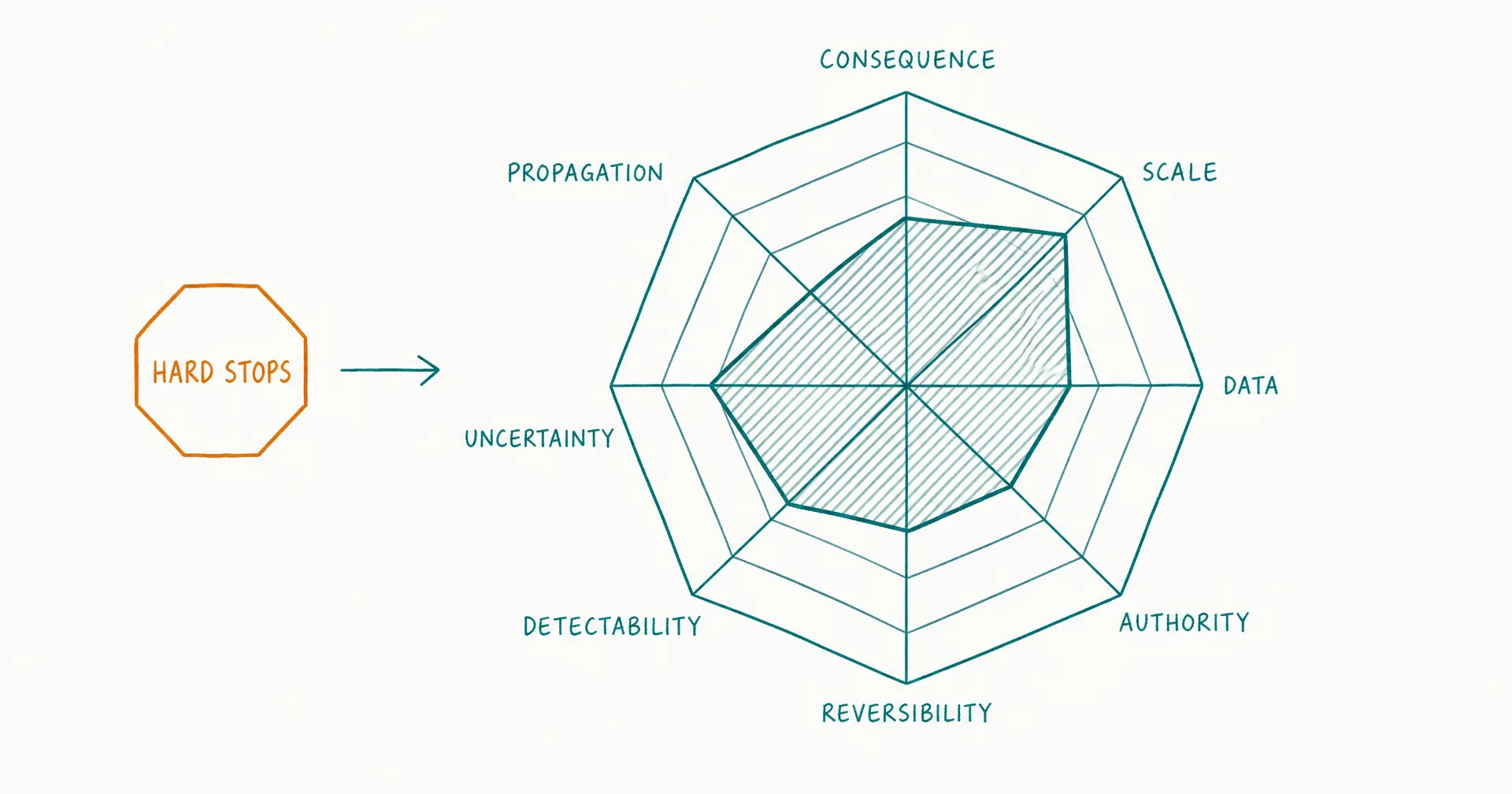
Assess an AI employee as a role operating in a real business process - not as a model in isolation.
Start with hard stop conditions. Then score the proposed role across: consequence; affected scale; data sensitivity; action authority; reversibility; detectability; uncertainty and novelty; and propagation through tools, automations, or other agents.
Do not let a low total cancel one unacceptable dimension. A role that can make an irreversible high-impact decision about a person should not receive broad autonomy merely because its data and volume scores are low.
Use the result to choose one of five launch decisions: reject the role; redesign the workflow; assist only; prepare work for human approval; or execute a narrow, tested, reversible task inside limits.
The assessment is an operational worksheet, not a legal classification or universal compliance score. Adapt thresholds to your organization, use case, jurisdiction, affected people, and risk tolerance.
On this page · 12 sectionsOpen
- The Risk Assessment at a Glance
- Apply Hard Stop Conditions Before Scoring
- Define the Role and Deployment Context
- Build a Scenario Register
- Score Eight Inherent-Exposure Dimensions
- Map Controls and Residual Risk
- Convert the Assessment Into an Autonomy Decision
- Validate the Assessment With Tests
- Assign Ownership and Preserve Evidence
- Reassess Throughout the Role Lifecycle
- How to Assess a CellCog AI Employee
- Final Checklist
- Assess the intended role, task, environment, data, tools, people, and consequences together - not a model in isolation.
- Apply hard stop conditions before calculating a score.
- Score consequence, scale, data, authority, reversibility, detectability, uncertainty, and propagation from 1 to 5 - and preserve the maximum, not just the total.
- Document inherent exposure, required controls, evidence, control gaps, and residual risk separately.
- Reduce autonomy when recovery is weak, detection is slow, authority is broad, or the role affects people materially.
- Reassess after changes, incidents, new destinations, new delegation paths, or evidence that actual use differs from intended use.
§ 01The Risk Assessment at a Glance
Use this sequence:
| Step | Decision | Required output |
|---|---|---|
| 1. Define | What role and use context are being assessed? | Versioned role card |
| 2. Gate | Is any use prohibited, unacceptable, unsupported, or reserved for a person? | Stop/redesign record |
| 3. Map | What normal, edge, misuse, failure, and incident scenarios exist? | Scenario register |
| 4. Score | How severe is inherent exposure across eight dimensions? | Dimension scores and evidence |
| 5. Control | Which preventive, detective, human, and recovery controls apply? | Control-evidence matrix |
| 6. Test | Do controls work in deployment-like conditions? | Evaluation results |
| 7. Decide | Reject, redesign, assist, approve, or bounded execute? | Signed decision and limits |
| 8. Monitor | Does actual use remain inside the assessed context? | Metrics, triggers, review date |
The NIST AI Risk Management Framework Core organizes AI risk work across govern, map, measure, and manage. It calls for understanding intended purpose and deployment context, characterizing impacts, testing before and during operation, tracking emergent risks, and using results to manage or remove unacceptable uses.
This worksheet turns that lifecycle into a role-level launch decision:
role + task + people + data + tools + authority + environment + controls + evidence
Do not begin with “Which model are we using?” Model choice matters, but the same model can be low exposure when summarizing public documents and high exposure when connected to customer accounts, payment tools, production systems, or employment decisions.
Use three records:
| Record | Purpose |
|---|---|
| Role assessment | Decides whether the proposed operating model is acceptable |
| Task/action policy | Decides which tasks and actions fit each autonomy level |
| Change review | Decides whether new evidence invalidates the prior assessment |
The AI employee role scorecard asks whether a role is operationally suitable. This risk assessment asks how much harm the role could create, how well that harm can be prevented or recovered, and what authority should remain.
§ 02Apply Hard Stop Conditions Before Scoring
Some conditions should stop or redesign the role regardless of its numeric score.
| Hard stop | Required response |
|---|---|
| Use is prohibited by applicable law or policy | Do not launch |
| Final decision is legally or organizationally reserved for a qualified person | Keep decision and execution human-owned |
| Purpose cannot be stated or justified | Redesign before assessment |
| Affected people cannot receive required notice, review, or recourse | Stop or redesign |
| Required data use lacks authority | Do not access the data |
| Necessary access cannot be separated from unacceptable authority | Use a different workflow or human execution |
| Material action cannot be reconstructed | Do not automate the action |
| Harm cannot be contained to an acceptable level | Reject the role or remove the action |
| Critical control cannot be tested | Do not grant production authority |
| No accountable owner or incident path exists | Do not launch |
| Role depends on professional judgment the system cannot provide | Assist only under qualified review |
| Vendor or integration evidence is insufficient for the intended consequence | Narrow scope, add controls, or reject |
Hard stops should name the policy or requirement; the affected task/action; the evidence; the owner; whether redesign is possible; conditions for reconsideration; and the decision date.
Separate “AI may assist” from “AI may decide”
A human-only decision can still use AI for: collecting approved records; checking completeness; normalizing formats; organizing timelines; identifying missing information; summarizing competing evidence; drafting questions; and preparing a review packet.
The system must not convert that assistance into an implicit recommendation that the human routinely accepts. Use the human-in-the-loop operating model to give reviewers evidence, authority, time, meaningful options, and a recorded decision.
Do not treat the score as legal advice
For high-risk AI systems within its scope, Article 9 of the EU AI Act describes a continuous, documented risk-management process covering known and reasonably foreseeable risks, foreseeable misuse, targeted measures, testing, and residual risk. Other jurisdictions and sectors impose different obligations.
Use qualified counsel and subject-matter experts to determine applicable duties. This worksheet can support that work; it cannot determine legal status by itself.
§ 03Define the Role and Deployment Context
Risk changes with context. “Draft email” is incomplete. Drafting an internal meeting reminder differs from drafting a denial of service, a medical instruction, or a public legal commitment.
Complete a role card:
| Field | Required content |
|---|---|
| Role | Name, purpose, accountable owner |
| Beneficiaries | Who should receive value |
| Affected parties | Who could experience harm |
| Tasks | In-scope recurring work |
| Non-goals | Explicitly excluded work |
| Environment | Test, staging, production, tenant, region |
| Inputs | Sources, senders, data classes |
| Outputs | Artifacts, decisions, messages, system changes |
| Tools | Connectors, browser, desktop, code, API, other agents |
| Authority | Read, prepare, execute, spend, send, publish, delete, administer |
| Timing | Shift, schedule, wake conditions, deadline |
| Scale | Records, recipients, customers, actions, spend |
| Oversight | Reviewer, approval, sampling, escalation |
| Recovery | Pause, revoke, rollback, notify |
| Dependencies | People, systems, vendors, child agents |
| Retention | Memory, logs, artifacts, deletion |
Identify affected parties
Include: direct users; customers and prospects; employees and candidates; contractors and partners; people represented in data; people receiving decisions or communications; administrators and reviewers; people affected by a system outage or incorrect action; and groups that may experience uneven performance or access.
Do not assume that the purchaser is the only affected party.
Define intended and reasonably foreseeable use
| Use class | Example |
|---|---|
| Intended | Research assigned accounts and prepare internal briefs |
| Adjacent | Research unassigned accounts in the same CRM |
| Foreseeable misuse | Ask agent to export all contacts for convenience |
| Failure | Wrong account matched because identifier is stale |
| Abuse | Malicious email instructs agent to disclose data |
| Drift | Role gradually begins sending messages after successful drafting |
| Emergency | Human requests broad action during an incident |
The NIST AI RMF’s risk framing guidance treats risk as a function of likelihood and magnitude while recognizing that third-party systems, data, and organizational context complicate measurement. The role card supplies that context before numbers are assigned.
Record assumptions
Examples: volume stays below a stated level; sources remain available and current; a human reviewer responds within a defined time; connected accounts keep their present scope; rollback completes within a tested window; no child delegation occurs; only approved destinations are used; and monitoring captures every material action.
An assumption is not a control. Validate it or treat its failure as a scenario.
§ 04Build a Scenario Register
Score scenarios before scoring the whole role. A role score without scenarios often becomes a debate about adjectives.
| Scenario field | Required content |
|---|---|
| ID | Stable scenario identifier |
| Type | Normal, edge, misuse, abuse, failure, incident |
| Trigger | Event or condition |
| Path | Inputs, decisions, tools, and state changes |
| Affected parties | People, groups, customers, organization |
| Harm | Data, financial, operational, legal, safety, rights, relationship |
| Existing controls | Preventive, detective, human, recovery |
| Control gaps | Missing or unproven protections |
| Likelihood basis | Test data, past events, comparable systems, expert judgment |
| Consequence basis | Scale, severity, duration, reversibility |
| Owner | Person accountable for disposition |
Include the happy path
A normal scenario reveals required authority:
A Research AI Employee receives an assigned company ID, reads five allowlisted public and internal sources, creates a cited brief in the account workspace, records unresolved conflicts, and marks the task ready for review.
This scenario establishes the minimum useful system, data, tool, and write permissions.
Include boundary cases
Examples: one required source is stale; sources conflict; the account ID matches two records; the recipient changes after approval; a cumulative volume limit is reached; the reviewer is unavailable; a tool returns success but state does not change; an action may have executed before timeout; the task ends during a handover; or a child agent requests broader access.
Include foreseeable misuse
Misuse may be accidental or intentional: a user asks the agent to work outside the role; a reviewer approves without inspecting evidence; an operator shares a broad credential to save time; the agent is asked to retain personal data “for later”; prompt injection in a document requests a secret; a manager asks for a batch that evades the per-item limit; a failed action is retried without read-back; or a rejected action is delegated to a more privileged agent.
Use public incident reports, internal near misses, red-team findings, and comparable system evidence where available. NIST’s AI RMF Map playbook recommends documenting likelihood and magnitude and using the estimates to inform go/no-go decisions and testing resources.
§ 05Score Eight Inherent-Exposure Dimensions
Score the role before crediting controls. Use 1 to 5 for each dimension.
| Score | General meaning |
|---|---|
| 1 | Limited exposure in a narrow internal, reversible, observable context |
| 2 | Minor exposure with tested recovery and small scale |
| 3 | Material exposure requiring defined controls and oversight |
| 4 | High exposure, broad impact, weak recovery, or sensitive context |
| 5 | Critical exposure, unacceptable uncertainty, or potential severe/irreversible harm |
The scale is an editorial operating model, not an external standard. Calibrate examples to your organization and apply them consistently.
1. Consequence
| Score | Consequence example |
|---|---|
| 1 | Cosmetic internal draft defect |
| 2 | Rework or small reversible operational delay |
| 3 | Material customer, financial, data, or operational effect |
| 4 | Serious contractual, security, rights, or business impact |
| 5 | Severe safety, fundamental-rights, livelihood, or irreversible organizational impact |
Score the worst credible consequence, not the average output.
2. Affected scale
| Score | Scale example |
|---|---|
| 1 | One internal artifact or user |
| 2 | Small known team or record set |
| 3 | Business unit, customer segment, or recurring batch |
| 4 | Large customer/employee population or cross-system operation |
| 5 | Organization-wide, public, cross-tenant, or rapidly propagating effect |
Include cumulative scale over a shift, day, campaign, and role lifecycle.
3. Data sensitivity
| Score | Data example |
|---|---|
| 1 | Public or deliberately published data |
| 2 | Low-sensitivity internal operational data |
| 3 | Confidential business or ordinary personal data |
| 4 | Highly sensitive personal, financial, security, legal, or privileged data |
| 5 | Secrets, credentials, regulated/high-impact records, or cross-tenant sensitive data |
Include memory, handovers, logs, exports, and child-agent context - not only the first read.
4. Action authority
| Score | Authority example |
|---|---|
| 1 | Read public/approved sources |
| 2 | Create an internal draft |
| 3 | Update reversible internal business state |
| 4 | Send, publish, transact, deploy, or change customer/system state |
| 5 | Delete, administer access, mint credentials, make high-impact decisions, or create broad downstream authority |
The least-privilege guide should narrow identity, tools, resources, data, functions, destinations, time, and delegation before launch.
5. Reversibility
| Score | Recovery characteristic |
|---|---|
| 1 | Automatically versioned; immediate tested restore |
| 2 | Simple manual correction with no external reliance |
| 3 | Recoverable with material work, delay, or notification |
| 4 | Partial recovery; distributed or time-sensitive effect |
| 5 | Irreversible or meaningful harm remains after correction |
Do not score a theoretical rollback. Demonstrate it.
6. Detectability
| Score | Detection characteristic |
|---|---|
| 1 | Automatic validation before effect |
| 2 | Immediate reliable postcondition and alert |
| 3 | Sampled or delayed detection with known coverage |
| 4 | Weak signals, fragmented logs, or long detection delay |
| 5 | Harm may remain invisible, external, or impossible to reconstruct |
Slow detection increases the number of actions that can accumulate before containment.
7. Uncertainty and novelty
| Score | Uncertainty characteristic |
|---|---|
| 1 | Repeated, well-specified, stable task with strong evidence |
| 2 | Limited variability and tested exceptions |
| 3 | Material ambiguity, changing sources, or new combinations |
| 4 | Novel workflow, weak ground truth, or conflicting evidence |
| 5 | Purpose, outcome, evidence, or acceptable behavior cannot be reliably specified |
Confidence from the model is not enough. Consider source quality, test coverage, and environment similarity.
8. Propagation
| Score | Propagation characteristic |
|---|---|
| 1 | Isolated artifact with no automation |
| 2 | One bounded downstream step |
| 3 | Several connected actions or recipients |
| 4 | Automations, broad batches, production systems, or child agents amplify effect |
| 5 | Rapid cross-system, cross-tenant, public, or recursive propagation |
Include every automation that the tool call triggers.
Calculate without hiding the maximum
Record:
Total exposure = sum of eight dimensions (8-40)
Also record: the maximum dimension; dimensions scored 4 or 5; hard stop status; the highest-consequence scenario; the weakest recovery path; and evidence confidence.
| Total | Starting posture |
|---|---|
| 8-15 | Candidate for narrow pilot; controls and evidence still required |
| 16-23 | Assist or prepare; limited approved actions may be tested |
| 24-31 | Human-controlled workflow; redesign before any bounded execution |
| 32-40 | Reject, materially redesign, or keep entirely human-owned |
A maximum score of 5 can override the band. Organization-specific policy should define which dimensions and scenarios require that override.
Calibrate the scale with reference roles
Before using the worksheet for real decisions, score several known roles together.
| Reference role | Expected pattern |
|---|---|
| Public-source research draft | Low data and authority; uncertainty depends on claim and source |
| Internal weekly operations summary | Low-to-moderate consequence; detectability and source quality matter |
| Customer support draft | Moderate data and consequence; no external action |
| Bounded CRM field correction | Moderate authority; strong object scope and rollback required |
| External customer reply | Higher consequence and destination risk |
| Payment or refund action | Higher financial authority; cumulative limits and recovery matter |
| Candidate screening support | Higher human consequence; final decision remains human |
| Production deployment | Higher operational authority and propagation |
| Access administration | Critical authority; privilege escalation and recovery dominate |
Ask each assessor to score independently, then discuss the evidence behind differences. Do not average away disagreement immediately. A security owner may see a transitive credential path that the process owner missed. A domain reviewer may understand that a “draft” effectively becomes a decision because staff rarely change it. An operations owner may know that the supposed rollback has never worked inside the required time.
For every score, require a sentence:
Detectability = 4 because the downstream system records only the shared integration account, customer impact may appear after delivery, and no alert correlates the action with the originating task.
That sentence is more valuable than the number. It exposes the facts that a control must change.
Revisit reference cases after material incidents or policy changes. Calibration should improve as the organization learns; do not preserve old anchors merely to keep historical totals comparable.
Avoid false mathematical precision
Do not multiply uncertain dimension scores, convert them into a percentage, or call the total a probability. A score of 32 is not “twice as risky” as 16. The bands are routing aids.
| Error | Why it misleads | Correction |
|---|---|---|
| Averaging all dimensions | Severe single-axis risk disappears | Preserve maximum and hard stops |
| Scoring after controls | Inherent exposure and control value blur | Score inherent exposure first |
| Treating unknown as 1 | Missing evidence looks safe | Mark unknown and restrict authority |
| Using model confidence as likelihood | Confidence may be uncalibrated and task-specific | Use tests, incidents, comparable use, and expert evidence |
| Counting control claims as proof | Descriptions do not show enforcement | Grade evidence from absent to recovered |
| Ignoring cumulative scale | Small actions aggregate | Score per-action and lifecycle scale |
| Ignoring human behavior | Review may be slow or perfunctory | Test reviewer workload and decisions |
| Scoring vendor only | Deployment context disappears | Score the configured role and process |
| One score for every action | Low- and high-impact work mix | Score material action families separately |
| Permanent acceptance | Change invalidates assumptions | Set dates and event triggers |
When likelihood evidence is weak, use scenario language: plausible under normal operation; plausible under foreseeable misuse; observed in tests; observed in a comparable deployment; observed internally; unknown because coverage is insufficient; or unlikely only if a named tested control remains effective. This language keeps uncertainty visible.
Run a sensitivity review
After the initial decision, change one assumption at a time: volume increases tenfold; public release replaces internal draft; a reviewer is unavailable for one shift; the source becomes stale; a new connector adds write access; a child agent receives the task; logs lose task correlation; rollback exceeds the business deadline; personal data enters the workflow; a customer can submit untrusted files; or the role moves from staging to production.
Record whether the autonomy decision changes.
| Sensitivity result | Meaning | Action |
|---|---|---|
| Stable | Decision remains acceptable across tested variation | Preserve bounds and monitor |
| Threshold-sensitive | Small change moves the role to a higher band | Add early warning and reauthorization |
| Control-sensitive | Decision relies on one control | Add defense in depth and verify continuously |
| Assumption-sensitive | Evidence depends on unproven operating condition | Test or restrict before launch |
| Unstable | Several plausible changes make residual risk unacceptable | Redesign role |
A role that is safe only while every assumption remains perfect is not robust enough for broad autonomy.
Score material action families separately
One employee may perform public-source research, internal drafting, external email, CRM updates, spend, publication, delegation, and access administration.
Do not assign one blended score. Score each material family, then set the role’s operating policy to the highest required control for that action. The research function may receive bounded execution while external send remains approval-gated and access administration stays blocked.
This is also why the best-tasks guide recommends beginning with recurring work whose inputs, outputs, evaluation, and escalation can be made explicit. A role can be valuable even when its riskiest actions remain human-owned.
§ 06Map Controls and Residual Risk
Now identify controls. Do not simply subtract points because a control exists.
| Control | Scenario addressed | Enforcement point | Evidence | Test result | Gap |
|---|---|---|---|---|---|
| Dedicated identity | Wrong actor/shared access | Identity provider | Grant and auth events | Pass/fail | Shared downstream log |
| Resource scope | Cross-account read | Downstream application | Policy and denied test | Pass/fail | Export still broad |
| Typed tool | Invalid operation | Tool wrapper | Schema and test | Pass/fail | Redirect not checked |
| Approval | Material external action | Approval gateway | Request/decision/execution | Pass/fail | Timeout owner missing |
| Postcondition | Wrong business state | Workflow | Before/after record | Pass/fail | External delivery unknown |
| Circuit breaker | Repeated failure | Runtime | Trigger and pause event | Pass/fail | Queued jobs remain |
| Recovery | Harmful state | System/incident process | Restore exercise | Pass/fail | Customer notification untested |
The AI agent guardrails model layers task, context, identity, authorization, tool, validation, approval, execution, postcondition, monitoring, and response controls.
Grade control evidence
| Grade | Evidence |
|---|---|
| 0. Absent | No control |
| 1. Claimed | Description only |
| 2. Configured | Setting or policy exists |
| 3. Tested | Positive and negative tests pass |
| 4. Observed | Production-like evidence over sufficient cases |
| 5. Proven recovery | Failure, containment, and restoration exercised |
Do not treat a claim or screenshot as equivalent to tested enforcement.
Write residual risk in words
For each material scenario, document:
After controls, the AI employee can still draft an incorrect renewal claim from a stale but allowlisted source. The draft cannot be sent externally. A named reviewer receives source dates and conflicts. Remaining impact is reviewer time and possible internal delay. The risk owner accepts this for a 30-day pilot with weekly source-freshness review.
This preserves scenario, remaining failure, control, impact, owner, duration, and review.
ISO/IEC 23894:2023 provides guidance for integrating AI risk management into organizational activities. Use standards and legal frameworks relevant to your context; do not assume this worksheet alone satisfies them.
§ 07Convert the Assessment Into an Autonomy Decision
Choose authority per action, not for the role as one switch.
| Decision | AI employee may do | Human role | Use when |
|---|---|---|---|
| Reject | No work in this use | Redesign or choose alternative | Hard stop or unacceptable residual risk |
| Assist | Organize approved evidence | Person performs judgment/action | High consequence or reserved decision |
| Prepare | Create draft or proposal | Review every item before use | Quality useful; external effect remains gated |
| Approve then execute | Perform exact approved action | Inspect and authorize case | Consequence bounded and execution testable |
| Bounded execute | Act inside narrow tested policy | Sample, monitor, handle exceptions | Reversible, detectable, stable recurring work |
Write an autonomy envelope
Example:
The Content Operations AI Employee may research from approved public and project sources, create drafts in the staging workspace, apply validated internal links, and update the task board. It may not publish, send external messages, edit site templates, access customer data, change permissions, or delegate a connected tool. Every public release remains human-approved. Missing or conflicting primary evidence blocks completion.
The permissions and approvals matrix turns this decision into enforceable action rules.
Make promotion evidence-based
Require: a minimum representative sample; accepted-output quality; a material defect rate below limit; no missed critical escalations; action matching approval; permission-denial tests passing; postconditions succeeding; no unresolved material incidents; a passing recovery exercise; viable reviewer load; and actual use matching the assessed context.
Use the AI employee pilot guide to time-box the decision, preserve baselines, and define expansion criteria.
Define demotion triggers
Reduce authority when: a material incident or near miss occurs; a score dimension increases; controls fail; monitoring coverage drops; rollback no longer works; the model, tool, connector, data, destination, or role changes; actual volume exceeds the assessed scale; delegation is introduced; reviewer decisions reveal policy ambiguity; or evidence becomes insufficient.
Demotion can target one action or connector rather than disabling the full role.
§ 08Validate the Assessment With Tests
Risk scores are hypotheses about real behavior. Test them.
| Test family | Required cases |
|---|---|
| Normal | Representative intended work |
| Boundary | Exact amount, volume, time, scale, and data limits |
| Edge | Missing source, conflict, ambiguous identity, unusual object |
| Misuse | User requests out-of-role action or broader access |
| Adversarial | Injection, exfiltration request, bypass wording |
| Tool | Invalid parameter, redirect, timeout, partial success |
| Permission | Adjacent resource, prohibited field, admin action |
| Human | Unauthorized reviewer, changed proposal, timeout |
| Delegation | Unapproved child, excessive depth, parent revocation |
| Recovery | Pause, revoke, contain, restore, notify, resume |
Test the severe scenario directly
If one plausible failure could be severe, do not wait for it to appear in a random sample. Construct the case and prove: trigger detection; prevention or routing; human decision; no unauthorized side effect; complete evidence; containment; recovery; and closure.
Include control interactions
Controls can interfere: redaction removes evidence the reviewer needs; a timeout expires while approval waits; a rate limit blocks containment; a narrow credential prevents rollback; a circuit breaker leaves queued actions active; an agent handover omits the incident state; or a child agent’s result bypasses the parent’s validation.
Test the complete workflow, not isolated controls.
Record uncertainty
For each test, mark: representative/not representative; deployment-like/not deployment-like; sufficient/limited sample; known coverage gaps; unresolved disagreement; untested dependency; and confidence in result.
Unknown risk should not be converted to a zero.
§ 09Assign Ownership and Preserve Evidence
Risk acceptance belongs to an accountable human or organization, not the AI employee.
| Field | Required content |
|---|---|
| Assessment ID/version | Stable reference |
| Role and owner | Named accountability |
| Assessors | Domain, security, data, legal, operations |
| Hard stops | Result and basis |
| Scenarios | Material scenario IDs |
| Scores | Eight dimensions, total, maximum |
| Controls | Required and implemented |
| Evidence | Tests, logs, demonstrations, documents |
| Gaps | Missing or weak controls |
| Residual risk | Scenario-specific remaining exposure |
| Decision | Reject, redesign, assist, prepare, approve, bounded |
| Conditions | Scope, limits, duration, reviewer |
| Exceptions | Accepted deviation and owner |
| Review | Trigger and date |
| Sign-off | Authorized risk owner |
Include affected expertise
Depending on the role, involve: the process owner; intended users; affected-party representatives; a domain expert; security and privacy owners; the data owner; the system administrator; legal/compliance counsel; the human reviewer; the incident-response owner; and accessibility or fairness expertise.
One product owner should not score every dimension alone.
Preserve reconstruction evidence
The AI employee audit-log guide should let a buyer reconstruct: which role and policy were active; who initiated work; which data and tools were used; which controls fired; which human approved; what action occurred; what state changed; whether limits were reached; and how recovery completed.
If material events cannot be reconstructed, increase the detectability score and restrict authority.
§ 10Reassess Throughout the Role Lifecycle
Set a recurring review and event triggers.
| Trigger | Reassess |
|---|---|
| Role/task change | Purpose, consequence, authority, uncertainty |
| New tool/connector | Functionality, permission, data, propagation |
| New data class | Sensitivity, retention, affected parties |
| New destination | Disclosure, commitment, external effect |
| Model or prompt change | Behavior, uncertainty, test coverage |
| Volume increase | Scale, cumulative exposure, reviewer load |
| Delegation enabled | Propagation, identity, child authority |
| Monitoring change | Detectability and evidence |
| Incident/near miss | Scenarios, likelihood, controls, recovery |
| Law/policy change | Hard stops and obligations |
| Vendor change | Dependencies and evidence |
Compare intended and actual use
Monitor: task types actually performed; resources and fields accessed; tools and actions used; destinations reached; volume and spend; human review rate; overrides and exceptions; denied attempts; child-agent use; defects and incidents; time to detection; and recovery performance.
If actual use expands beyond the role card, pause that scope and reassess.
Keep risk and benefit together
A control that removes all useful work is not an effective deployment. Record: expected benefit; accepted outcomes; capacity released; review and correction cost; control friction; remaining risk; and the safer alternative.
Risk acceptance should compare the controlled role with feasible alternatives, including a manual process that may have its own errors and delays.
§ 11How to Assess a CellCog AI Employee
CellCog publicly describes AI Employees with roles, goals, KPIs, permissions, schedules or wake conditions, task boards, memory, handovers, approval expectations, connected tools, browser or desktop access, and delegation. Assess each configured capability and the downstream system it reaches.
| Assessment input | CellCog capability | Organization-owned question |
|---|---|---|
| Role | Role and goals | Is purpose legitimate and specific? |
| Outcome | KPIs and deliverables | What counts as accepted work? |
| Timing | Shifts, schedules, wake conditions | When may work start, wait, stop? |
| Context | Sources, memory, handovers | Which data is necessary and current? |
| State | Task board | Who owns each task and exception? |
| Authority | Permissions and approvals | Which actions and limits apply? |
| System reach | Connectors, Cowork, browser | What can the downstream identity reach? |
| Delegation | Other AI Employees | Can authority or sensitive data propagate? |
| Monitoring | Dashboards and task records | Can material events be detected and reconstructed? |
| Response | Pause and access changes | Can work be stopped and access revoked? |
Run the assessment in this order
- Write the role card and non-goals.
- Apply hard stops.
- Build normal, boundary, misuse, failure, and incident scenarios.
- Score eight inherent-exposure dimensions.
- Map controls and grade evidence.
- Test severe scenarios and control interactions.
- Write residual risk in scenario terms.
- Choose authority per action.
- Name the risk owner and review triggers.
- Reassess before expansion.
CellCog’s AI Employees page describes connected work and persistent shifts. Verify the current platform, account permissions, and connected application before relying on any specific scope, approval, monitoring, or revocation behavior.
Users set the employee’s goals, schedule, permissions, and connected accounts, and remain responsible for monitoring its work and the actions it takes on their behalf. For legal, medical, financial, hiring, or other high-impact work, AI output requires qualified human review and should not be treated as professional advice or a final high-impact decision.
Use the production security checklist to verify that required evidence exists before the pilot receives real data or action authority.
§ 12Final Checklist
- The role, purpose, beneficiaries, affected parties, tasks, non-goals, and owner are documented.
- Intended use, adjacent use, foreseeable misuse, failure, abuse, drift, and emergency cases are mapped.
- Hard stop conditions were applied before scoring.
- Professional or high-impact decisions remain with qualified people where required.
- Consequence, scale, data, authority, reversibility, detectability, uncertainty, and propagation are scored.
- The total, maximum dimension, 4/5 scores, severe scenario, recovery weakness, and evidence confidence are preserved.
- Controls map to specific scenarios and enforcement points.
- Control claims, configuration, tests, observed evidence, and recovery proof are distinguished.
- Positive, negative, boundary, misuse, adversarial, partial-failure, human, delegation, and recovery cases are tested.
- Residual risk is written in scenario terms.
- Authority is assigned per action, not as one role-wide autonomy switch.
- Promotion and demotion criteria are defined.
- An accountable human risk owner signs the decision.
- Exceptions have scope, owner, evidence, expiry, and review.
- Material actions can be detected and reconstructed.
- Pause, revoke, contain, restore, notify, and resume paths are proven.
- Actual use is compared with the assessed role.
- Scheduled and event-driven reassessment triggers exist.
The score is a way to force explicit comparison. The decision still depends on scenarios, evidence, affected people, control effectiveness, residual risk, and accountable judgment.
Q1What is an AI employee risk assessment?
It is a documented decision process that defines the role and use context, applies hard stops, maps plausible scenarios, scores inherent exposure, tests controls, describes residual risk, and assigns an autonomy level with a named owner and review triggers.
Q2What should an AI employee risk score include?
Score consequence, affected scale, data sensitivity, action authority, reversibility, detectability, uncertainty/novelty, and propagation. Preserve each dimension and the maximum score. Do not let a low total cancel one unacceptable high score.
Q3Is a low-risk score enough to launch?
No. Hard stops, required controls, test evidence, accountable ownership, incident readiness, and applicable legal or policy obligations still apply. A low score with untested access control or recovery is not launch-ready.
Q4How does the score determine AI employee autonomy?
Use it with scenario and control evidence to choose reject, redesign, assist, prepare, execute after approval, or bounded execution. Assign authority per action. Increase autonomy only after representative results prove quality, escalation, postconditions, and recovery.
Q5When should the risk assessment be repeated?
Repeat it after material changes to the role, task, model, prompt, tool, connector, data, destination, volume, reviewer, monitoring, delegation, or policy. Reassess after material incidents, near misses, control failures, or evidence that actual use differs from intended use.
Q6Who should approve residual risk?
An authorized human risk owner with the appropriate business authority should accept or reject it, informed by relevant domain, security, privacy, data, legal/compliance, operations, human-review, and incident-response expertise. The AI employee cannot accept its own risk.